How to Consume the News - by Tomas Pueyo How to Consume the News
Some content could not be imported from the original document. View content ↗
Don’t
2021年6月6日
∙ Paid
One of the main goals of this newsletter is to learn to understand the news at a much deeper level, putting them in the context of the big trends of mankind. Ironically, a crucial way to achieve that is by avoiding the news. So today we’re going to talk about that, and we’ll illustrate it by visiting the news about COVID and the Wuhan lab and China’s 3-child policy. Enjoy!
Thanks to the news, I feel informed. For example, I know at least 200 ways my children can die. Which comes in handy to protect them from living.
News also inspire me. They teach me all the ways the world is going to end, and an easy way to prevent it: hating the other half of the country.
After watching or reading the news, how do you feel? Happy? Relaxed? Stimulated? I’m going to make a guess: You’re scared, annoyed, enraged. So why do you watch them? Are you masochistic? Do you also flagellate yourself while watching them to max out your suffering?
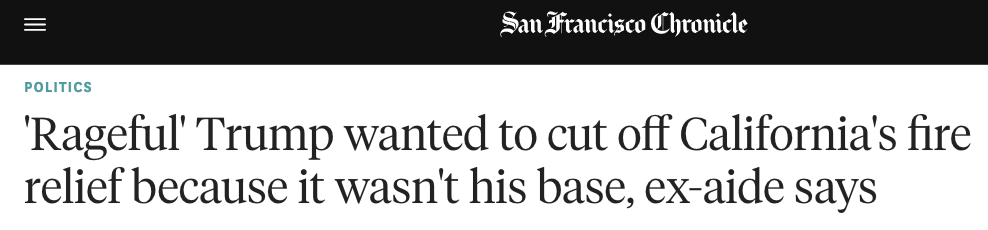
The fact that consuming news fills people with fear and rage is not a coincidence. It’s by design. Let’s metamorphose into a fly on the wall of a reporter with her editor:
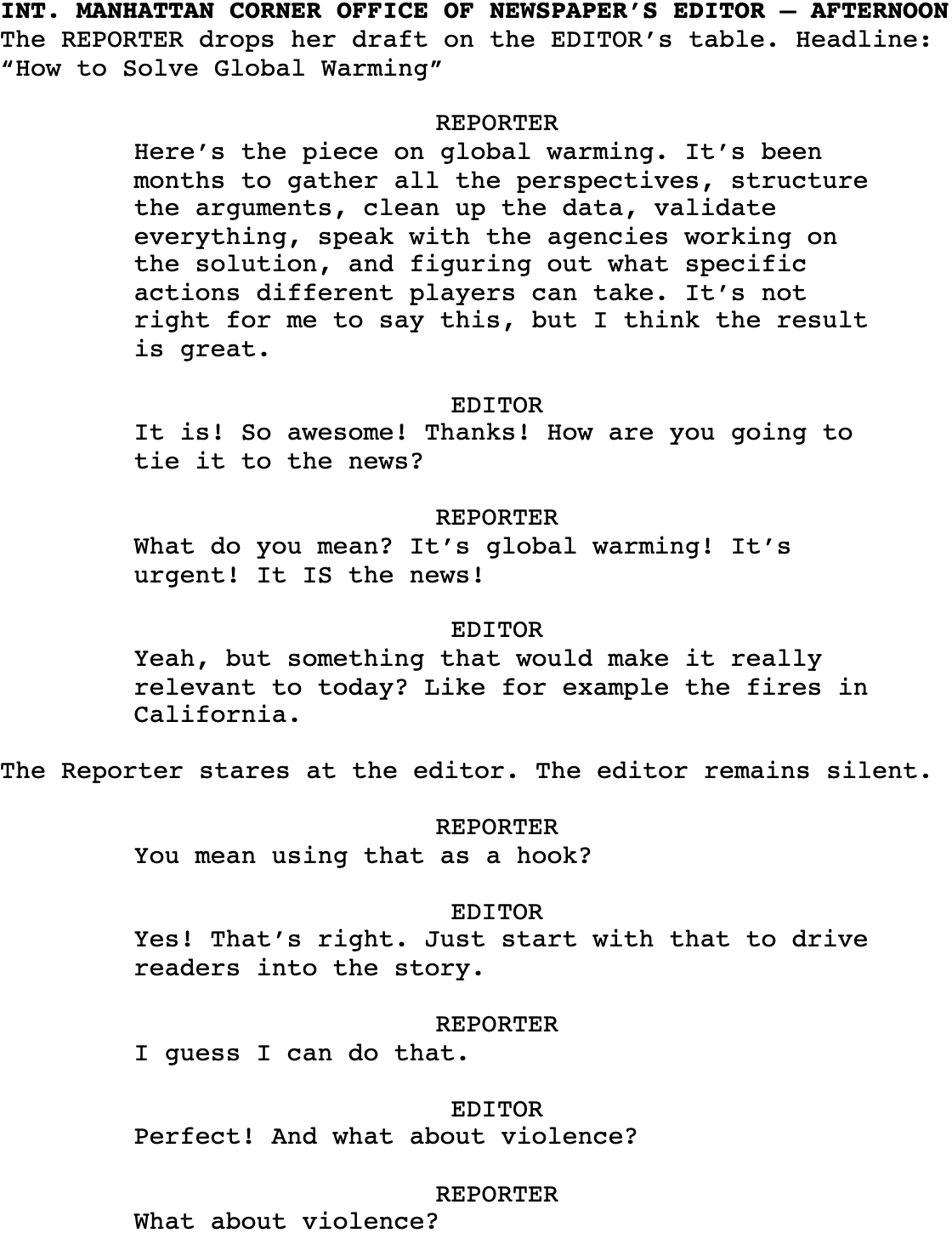
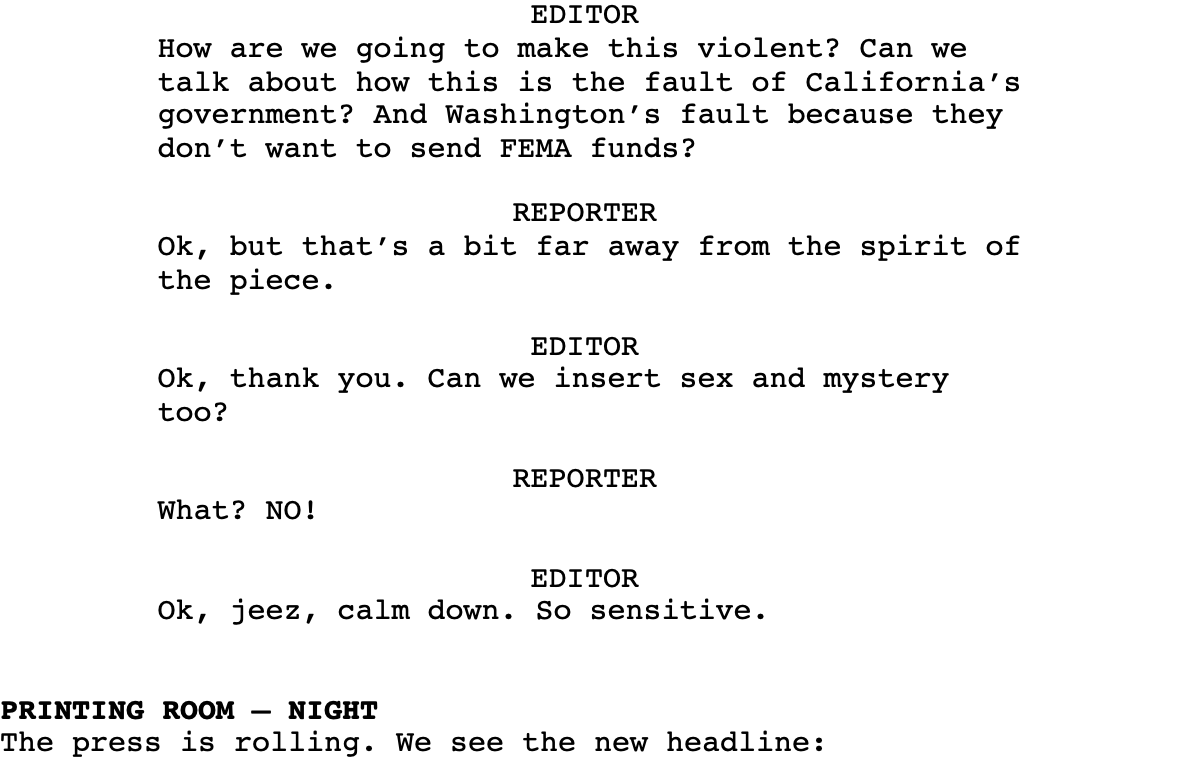
Why News Don’t Inform
News aren’t designed to inform you or to help you make decisions. They’re designed to make money. Best case scenario—which usually means a subscription—they try to inform you in the process. Normally, they pander to keep your subscription alive, which is not always aligned with informing. Worst case scenario—when they live off of ads—they just want you to click on that f****** headline.
They also want you to share their articles with somebody else, and they know you’re much more likely to do so if you’re scared, angered, or hear something that sounds very novel or mysterious.
So news waste your time because they’re designed to grab your attention, not to inform you.
As such, they’re addictive, not informative.
Your brain doesn’t realize it. It can’t stop itself from consuming news because of their dopamine rush. We get addicted to them not unlike drugs. And, like drugs, after consuming them, you’re left empty.
Worse, it leaves you with the illusion that you’re informed, which is a barrier to learning. The only way to win that game is not playing altogether.
So treat news like you’d treat drugs: I keep them at arm’s length—too much temptation.

Think: how much of the news do you remember a couple of months later? What percentage of what you read directly from a news site—as opposed to discovering through friends—has changed your behavior? Outside of COVID, likely very little. And the truly important news you’d learn regardless through social media or conversations with friends.
Look at what news is mostly made of: crime, politics, sports. None of them are really useful for your day-to-day living. So why are they so popular in the news? Because they were crucial for our survival a million years ago.
Imagine you lived then, in your tribe of 150 individuals, constantly battling other tribes. One day, somebody tells you: “Somebody got stabbed.” You better pay attention to that, because if somebody from your tribe got stabbed, you might be next. So that’s why you can’t take your eyes off the screen when you see crime. Same thing for politics: when the chiefs were talking about new rules for the group, they would surely affect you dearly. You need to know what’s going on. As for sports, you better hoped your team was the one beating the other team, or tomorrow you might be taken as a slave.

We’ve evolved to pay attention to these types of news, but now, in countries of tens of millions of people, they’re mostly irrelevant. Outlets take advantage of your old brain circuits to hijack your attention and convert it into cash.
On top of that, most journalists don’t have enough time to create truly insightful content.
Maximize Your Insights per Minute
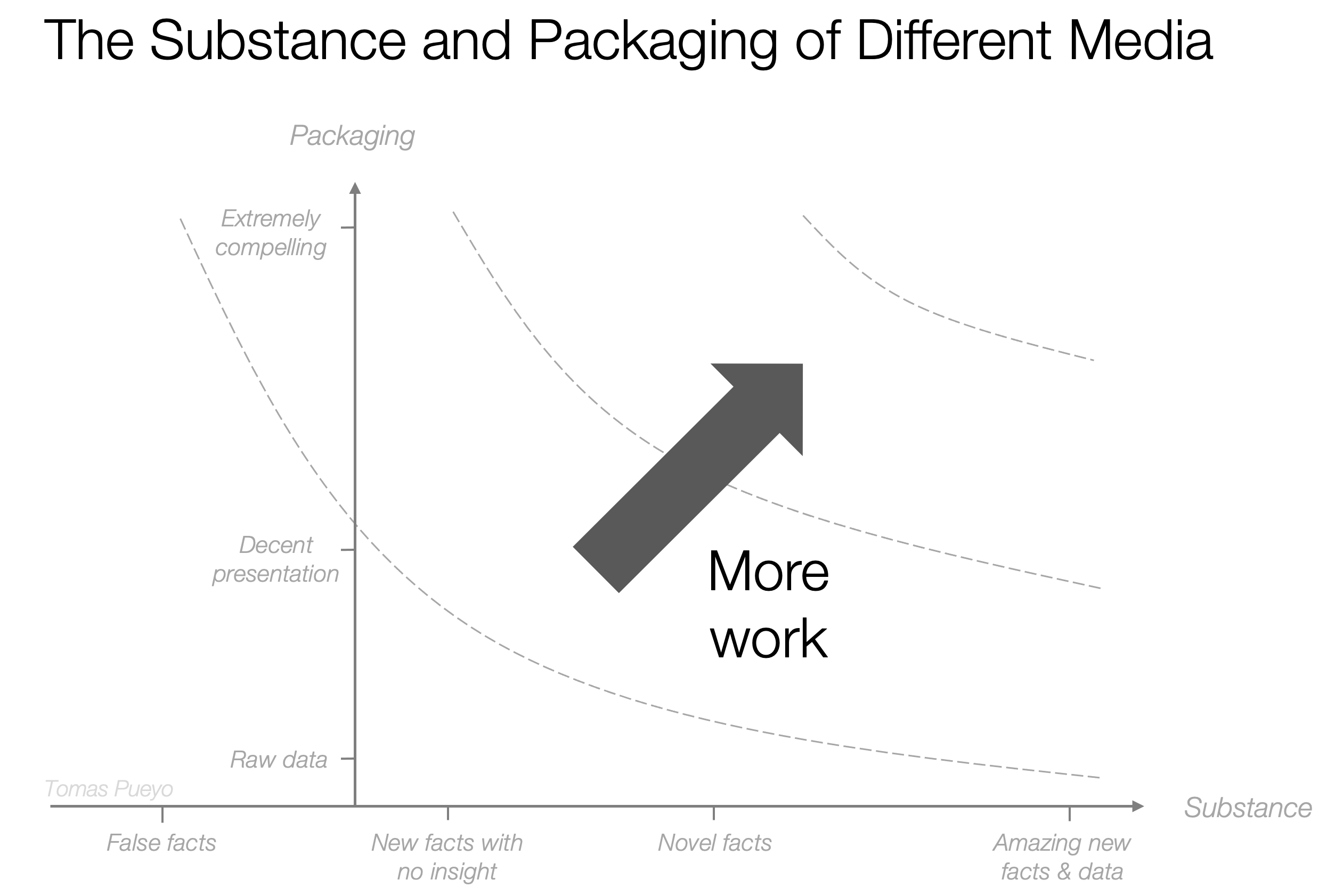
Imagine a graph where on the x-axis you have the substance of a piece of work: how much data, facts, insight, content is packed into a piece of work. On the y-axis, you have the packaging: how much the author spent in making that substance easy to digest, beautiful, memorable, wrapped into elegant storytelling.
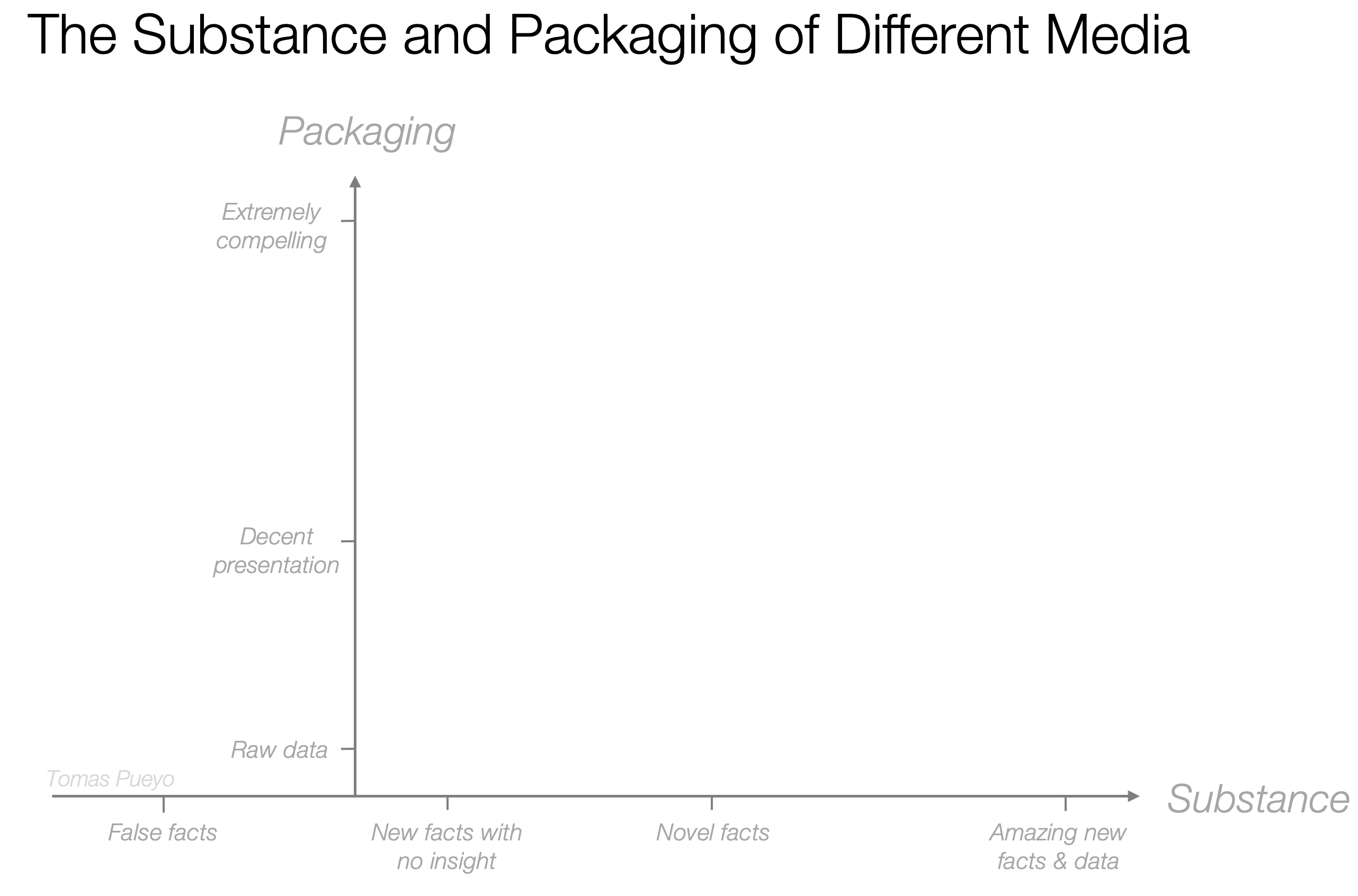
It’s hard to do both. Substance and packaging are a lot of work. The dotted lines in the graph below try to show points of equal amount of work:
Where do news land here?
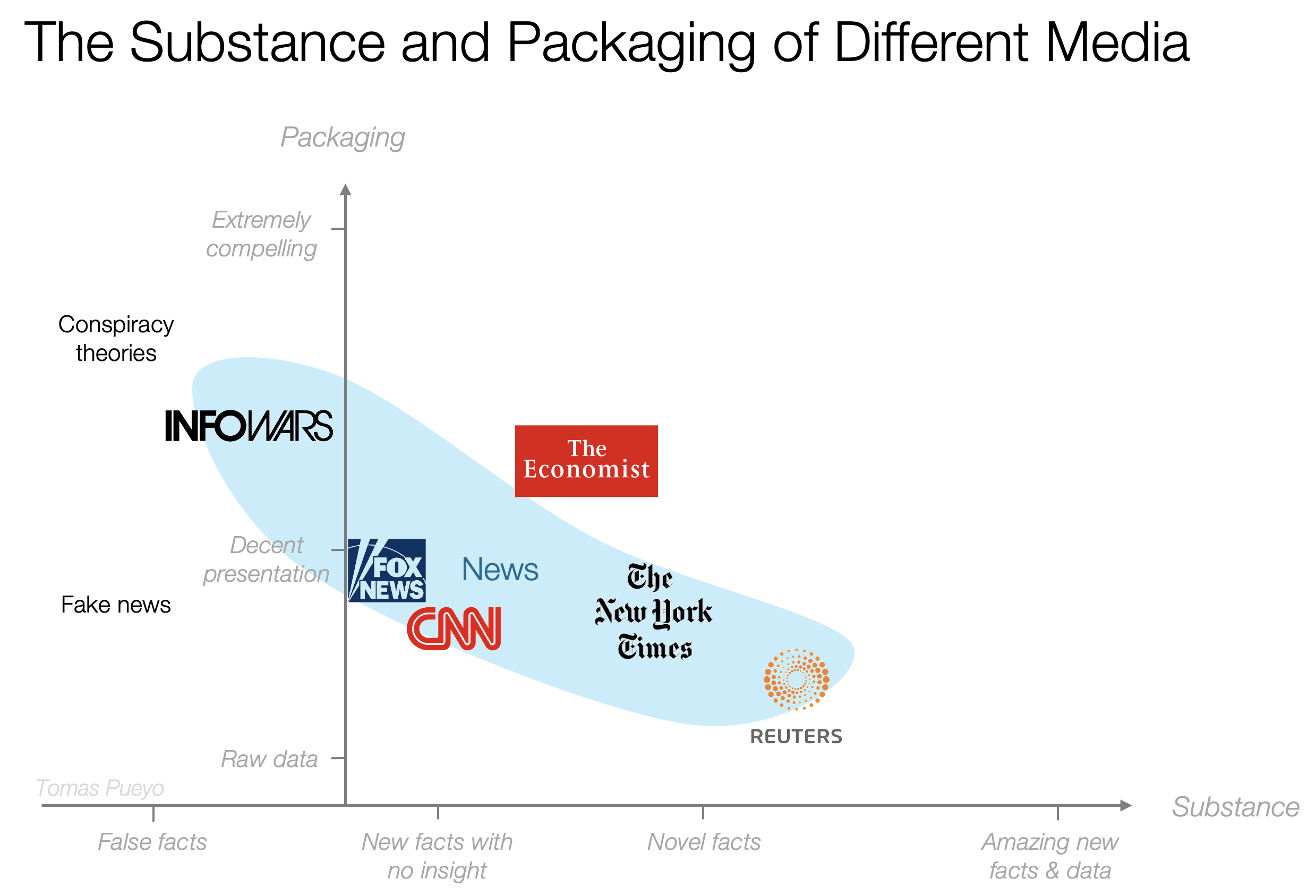
News will seldom have amazing new facts and data, because it’s just too hard to gather these. They also won’t be packaged beautifully, because that takes time. So depending on the outlet and the reporter, you’ll tend to have articles that range from entertaining to novel, but seldom both, and very rarely life-changing.
Scientific papers tend to be the opposite: Those writing them make painstaking efforts to make sure the data is novel and adds to the body of human knowledge. Unfortunately, they target those insights to their peers, and spend most of their efforts on the substance, so there’s very little packaging for the grand public, and the content is hard to learn from.
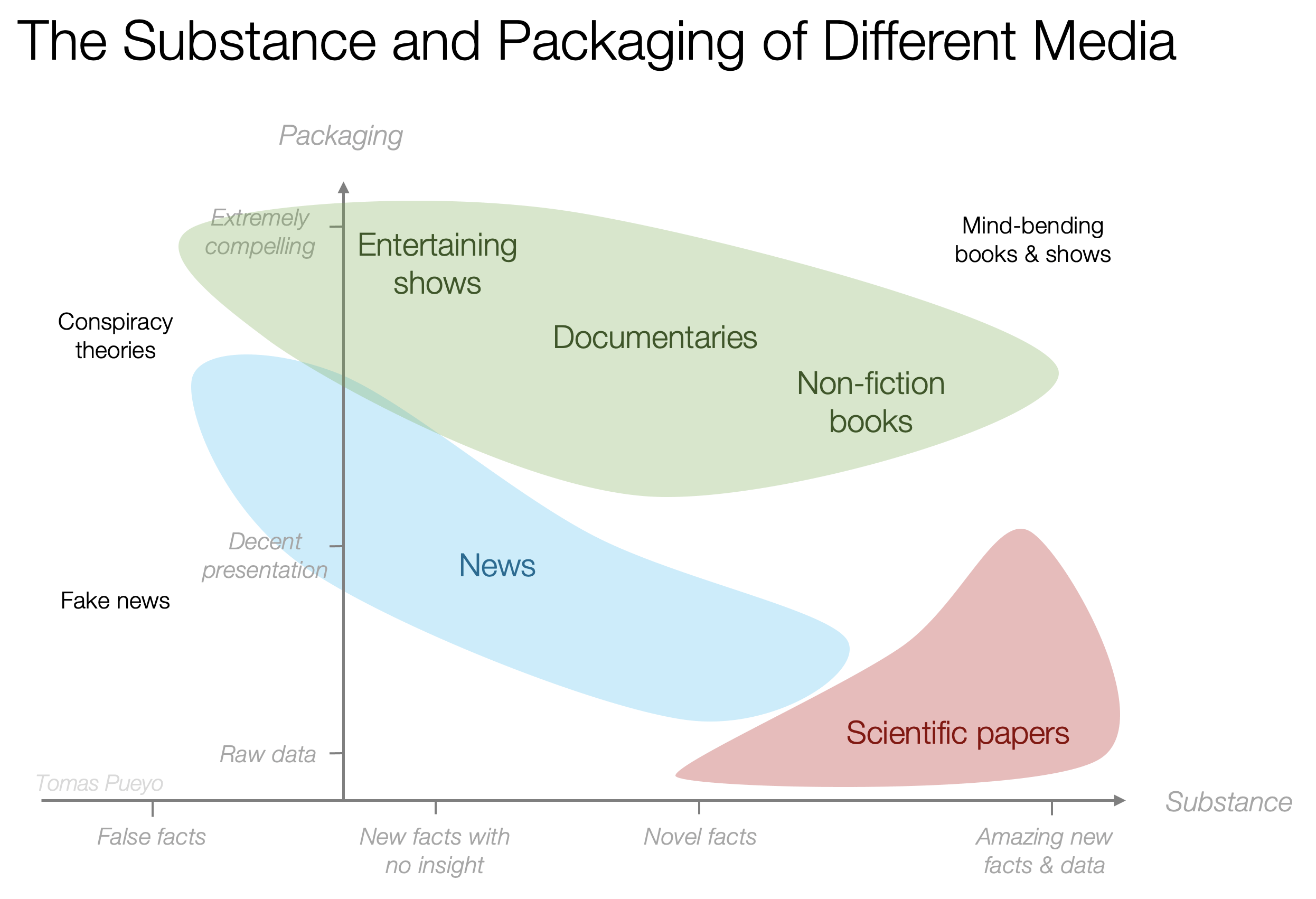
Meanwhile, works like non-fiction books or documentaries gather a lot of substance and packaging. They invest in both to try to leave you with memorable insights.
Let’s take a specific example. How much time does your average journalist have to write an article that takes you 10 minutes to read: 2 hours? So it packs 2 hours of work for every 10 minutes you spend, or 12 hours of work per hour of your consumption.
Compare that with a book, which might have 1,000 hours of work behind it for every hour of your consumption [1] . Even if it had 10 times less work—so 100h of work per hour of your consumption—that would still be 10 times more thoughtful than your average article. In the vast majority of cases, for the same amount of time spent, a book will be more insightful than an article.
This is why most of the news you read are not that insightful. Let’s take a couple of examples from this week.
Unsightful News
COVID and the Wuhan Lab
I used to write every two weeks about COVID. I don’t write about it as much now because what we’re witnessing today is the result of decisions taken months, or even a year ago. Countries are set in their ways, and the outcomes are pretty mathematical, so predictable. They were also mathematical in March 2020, but the policy response was very much in the air.
Here’s the main story of COVID:
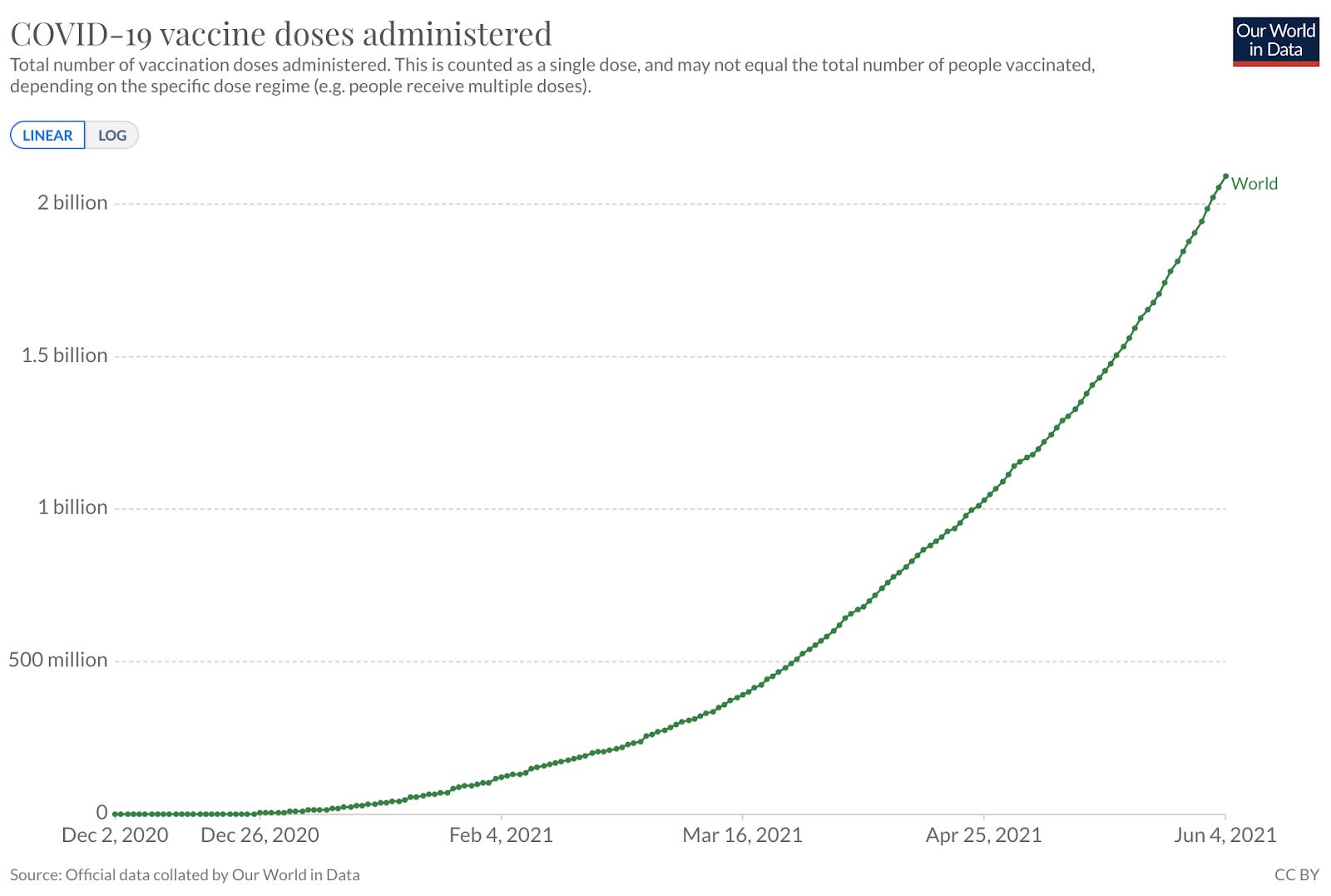
As vaccine production increases and logistics improve, more and more people will get vaccinated, faster. Developed countries get vaccinated first, true. But a few months later, these vaccines will reach the rest of the world. This happens at the same time as summer hits the Northern Hemisphere. So as vaccines reach the world, infections will plummet and the appearance of new variants will slow down. If new variants do appear, new vaccines will likely stop them in their tracks. Slowly, the number of daily infections and deaths will go down and the pandemic will peter out.
There are still thousands of local decisions to be made and millions of tragedies to be suffered. But the broad guidelines of the story are set in stone.
Obviously, that’s not a narrative that is convenient to the media. So they keep churning more and more stories. It’s their job. That’s the context in which to read the Wuhan Lab Escape stories.
If you haven’t heard, the news media are crazy about the possibility that the virus escaped Wuhan’s lab. But I never thought it mattered. If it did, so what? We’d learn the Chinese are playing with bioweapons. Who thinks they aren’t? Nobody! Of course they are! The US is probably too. And probably many other countries. We would learn more or less nothing if it turned out that the virus escaped the lab vs. it jumped from nature [2] . The US would blame China, China would deny it, and we’d be back in square one.
Our attention is not well spent on this.
China’s 3rd Child Policy
If you haven’t heard, China just changed its policy and now couples can have a 3rd child. That news is completely irrelevant.
In fact, when China first implemented the one-child policy in 1980, China’s fertility rate had been dropping precipitously for decades. After it was approved, fertility went up. And after the two-child policy was approved, exactly nothing happened.
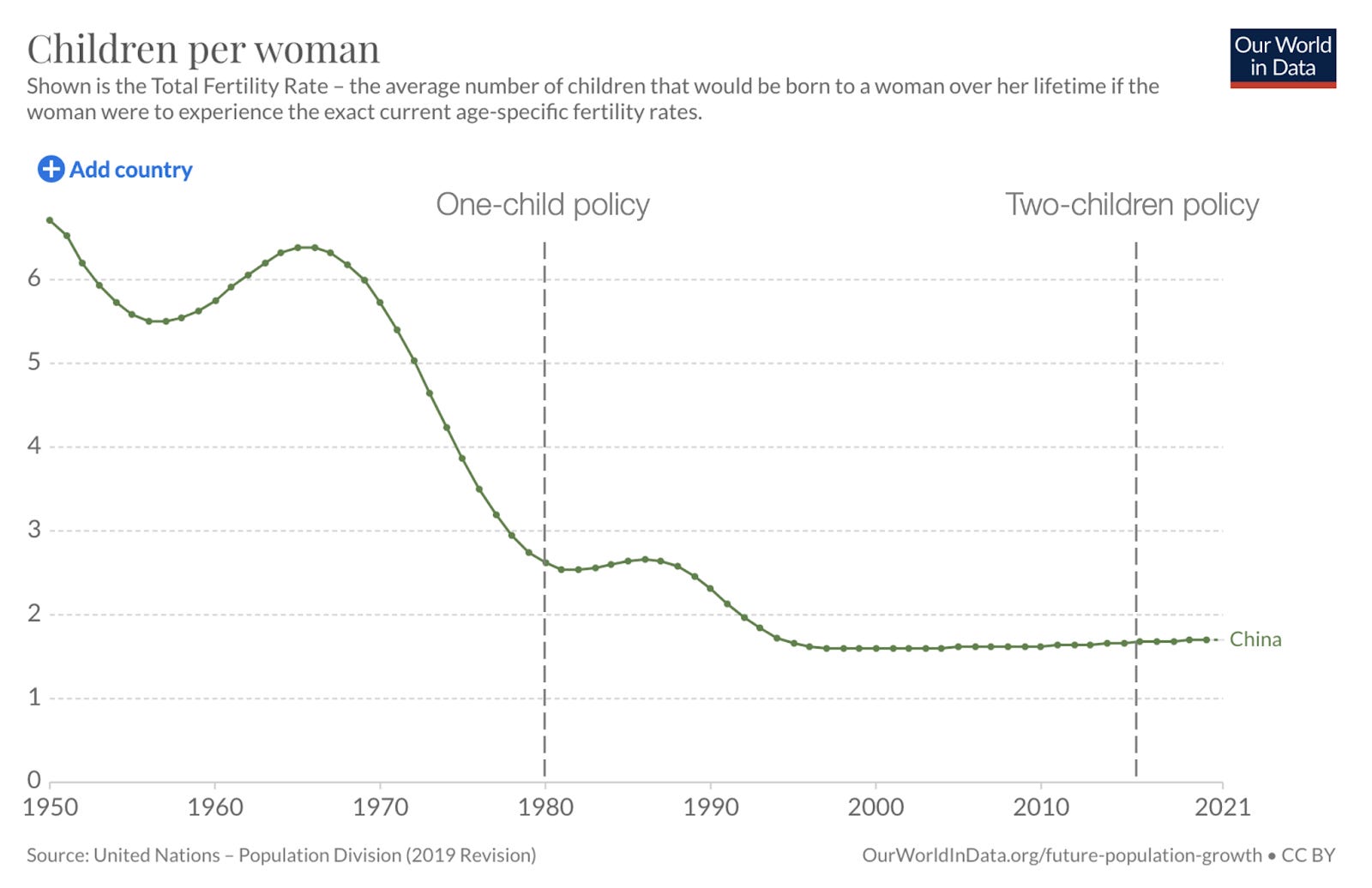
The truth is that China’s fertility rate was just following the path of most other countries like it. What drives women’s fertility rate is not fertility policy.
The true story is this graph:
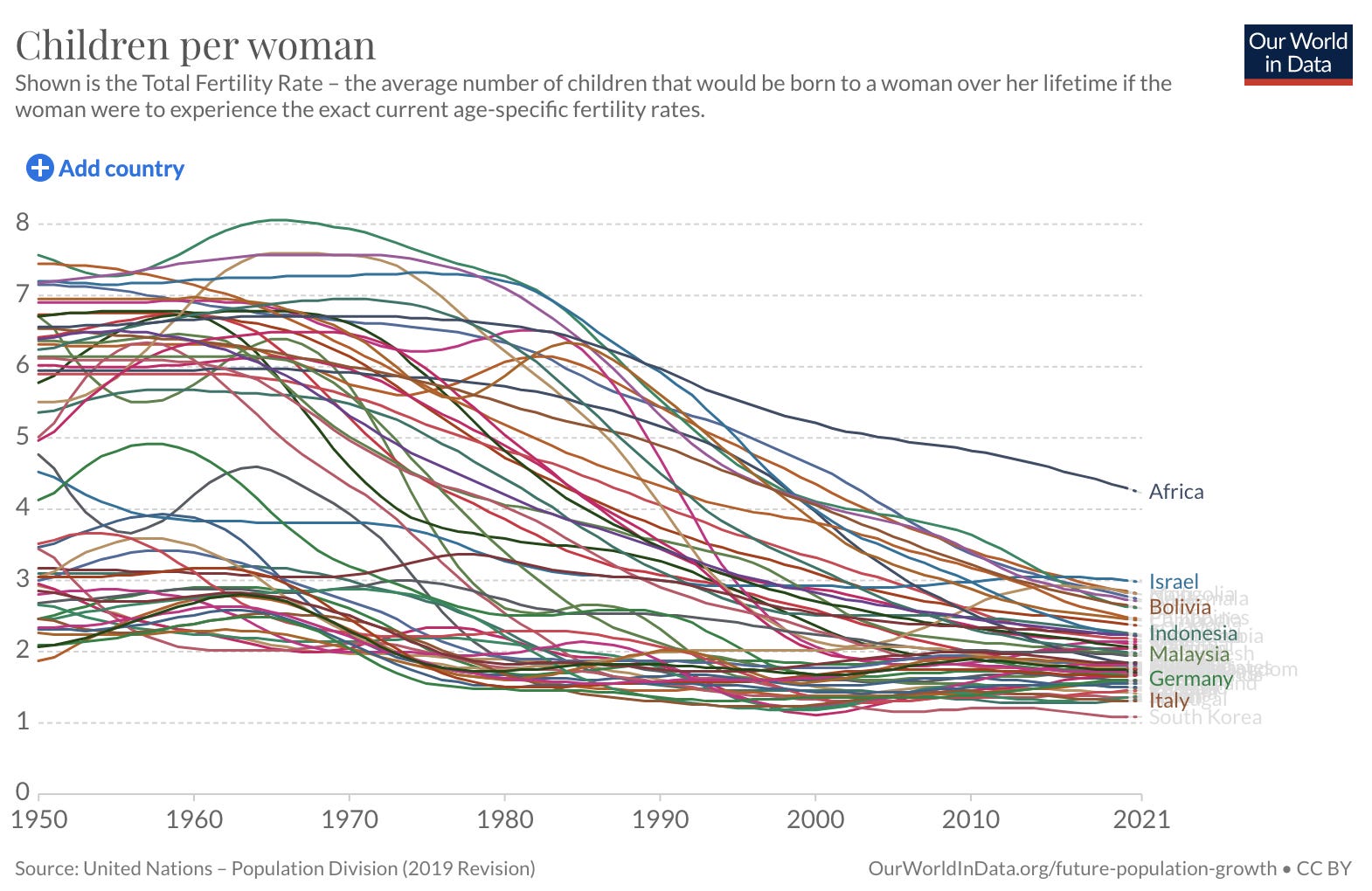
I selected a random sample of about 100 countries from around the world, except for Africa, which I have as a continent. Here are the insights:
Most developed countries have a fertility rate below the replacement rate of 2.1.
The only very notable exception is Israel, at 3, and not going down since the 1990s.
Nearly every other country is already below 3 and going down fast. India, for example, is at 2.18 and is likely going under 2 this decade
The main exception is in Africa: many countries there still have between 3 and 6 children per woman, but that is also going down precipitously.
As a result, unless there’s a cataclysmic change, world population will peak in the 21st century and go down from there.
As far as I know, not a single country has been able to reverse this trend to get back above 2.1.
So a three-child policy is irrelevant. And we can also predict that this policy will be lifted altogether later. And that it will be reversed after that, with the Chinese government incentivizing having children heavily [3] .
Of course, that doesn’t drive daily news readership. Barring a few exceptions, most newspapers don’t take the long view on this, and when they do, they don’t go that deep.
Your Time Is Limited
Life is short.
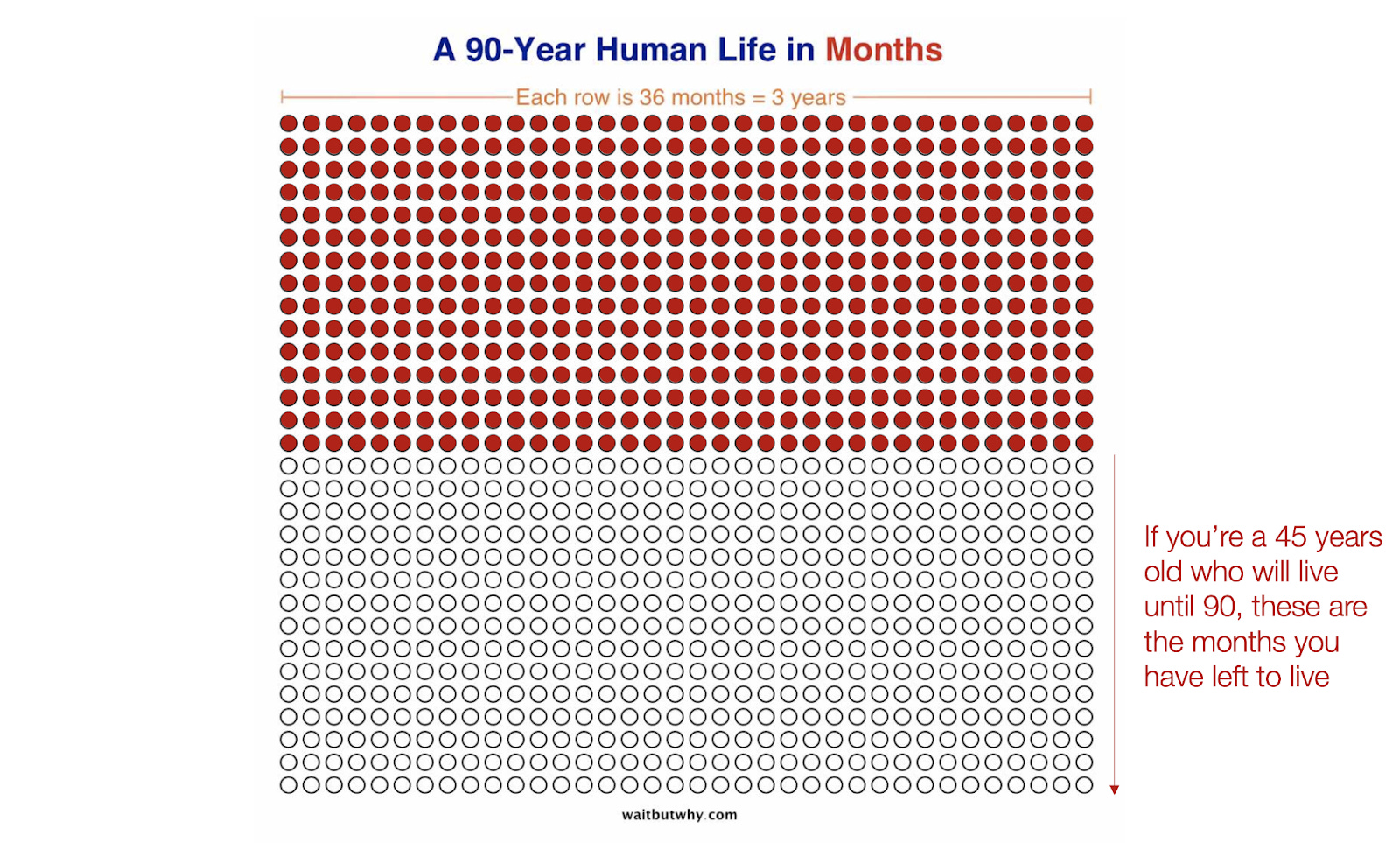
You only have so many months left, so many days left. Every time you read the news, it’s not just that you learn little. It’s that one price is anger and fear. It’s the illusion of knowledge. And more importantly, the worst price is the life you don’t live. Every time you read the news, you don’t go deeper by reading a good book, you don’t enjoy yourself with a great movie, and you miss the little moments that life is made of.
The best way to consume the news is not to.
An author might gather the results of a couple of years of research with a team of 3, and then write a book about them for six months with a ghost writer. That’s about 11,000 hours or work: 3 people * 2 years * 200 days of work per year * 8h per day + 100 days * 2 people * 8h per day. An average 300-page book might take ~8 hours to read, which means that for every hour you spend reading, there are over 1,000 hours of work behind. Two orders of magnitude higher than the 12h spent by your journalist in that article.
It’s not exactly accurate. From a virology standpoint, this is probably relevant. But it’s virology-level interesting, not world politics-level interesting.
They’re already considering incentives. That’s not what I’m talking about. I’m talking about serious investment.