Why Hydrogen Is Not the Answer - by Tomas Pueyo Why Hydrogen Is Not the Answer
Some content could not be imported from the original document. View content ↗
2023年7月15日
∙ Paid
When I wrote about the future of energy revolutions we need, the main question readers asked was “Why didn’t you talk about hydrogen?”
The reason is because I don’t believe hydrogen will matter much.
What problems do people think hydrogen—usually in the form of H2—solves? Why am I skeptical? Let’s see.
What Is Hydrogen Good For?
In What Future Energy Revolutions Do We Need?, I summarize our energy needs:
You don’t just want to generate energy and use it. You want to be able to transform it, store it, and transport it, in a way that is as easy, cheap, and clean as possible.
The best intermediary for energy is electricity. If the history of energy tells us anything, it’s that electricity will eventually take over most of the energy system in the world: It can be transported instantaneously across great distances without pollution, and can be easily and cheaply transformed for use in countless ways.
The Issues with Electricity
Electricity has at least three issues.
One is that very long distance transportation is wasteful. It’s OK to send electricity a few hundreds of kilometers away, but you lose 3-7% every 1000 km. You lose about 20-30% in transmission from coast to coast in the US.
Another issue is that electricity is hard to store: Batteries are expensive, they don’t store that much electricity, and they lose a sizable amount of energy over time: 5% overnight, and then 2-20% per month. Storing June sun for December consumption in lithium ion batteries might lose around 15% of electricity.
What these two issues have in common is that they require infrastructure. If energy is expensive, it’s worth building the infrastructure to transfer and store it. But if it’s cheap, the fixed cost of the infrastructure might be too high in comparison, and therefore not worth building.
So for example, in a world where solar electricity is extremely cheap, it might not make sense to invest heavily in long-distance transportation through interconnected networks; local solar generation might be enough.
The third issue with electricity is that its storage requires batteries, which are heavy. The energy they contain per kg is much lower than in fuels. So electricity won’t work for situations where you need a lot of energy per kg, like for airplanes or rockets.
So we need a complement to electricity that addresses its shortcomings. Three requirements stand out:
Something easy and cheap to transport over long distances
That can be stored for a long time with minimal losses
That has a high energy density per kg
Hydrogen’s Strength
There’s a lot of hydrogen in the universe. From The Secret of the Universe:
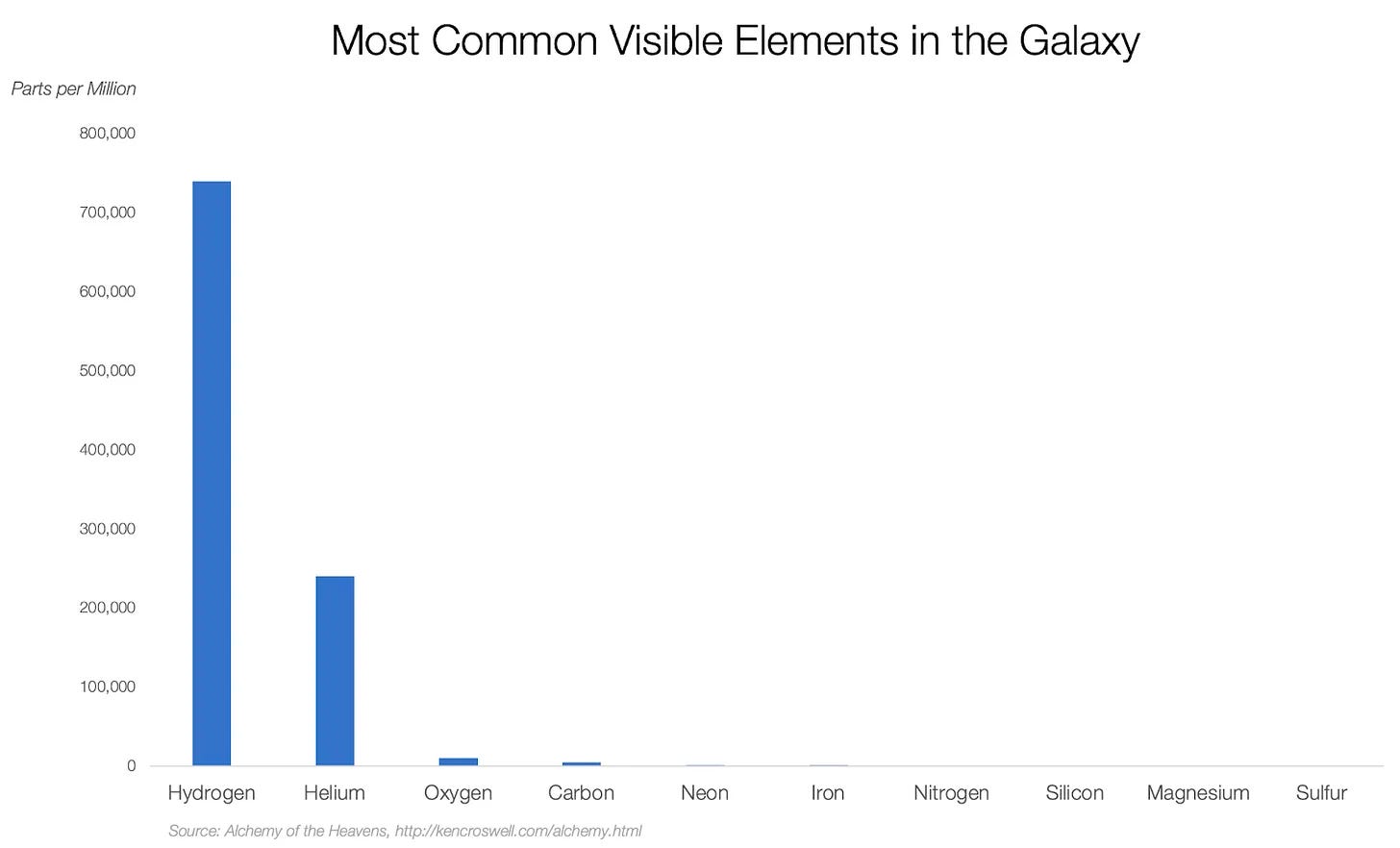
And a lot of it is available on Earth, in the form of water (H2O). No need to mine anything to get it. It’s right there, in the air and the sea [1] .
Since it doesn’t contain any carbon, it doesn’t produce CO2 when you burn it. You’re mixing O2 and H2 to get H2O.
Not only that, but the process is quite efficient. You can use electricity to generate H2 through a process called electrolysis [2] and you only lose 10-20% of energy. Then you can either burn it or simply reverse that process.
Hydrogen’s Problems
Efficiency
But you lose ~40% of the energy when reversing it through fuel cells or by burning it in a power station. However, if you just burn it for heat, you only lose about 10% [3] . Overall, the round trip consumes 40%-60% of the electricity or loses about 20% in heat. So it’s not that efficient. If you compare it to the numbers we mentioned before for electricity transmission or battery storage, you lose less energy in either case. So if energy is expensive (as it is today), you’re better off transmitting electricity long distances or storing it in batteries than storing your energy in H2.
This, however, is the least of the problems with H2.
H2 Is Too Damn Small
H2 is just two protons together.
It is tiny.
It’s also light.
This causes so many problems.
For example, let’s take cars. In a car, you want to pack a lot of energy in a small space. But with hydrogen, you can’t.
Frozen Storage
To use hydrogen in a car, you need to reverse the electrolysis of H2, which you can achieve with what’s called fuel cells.
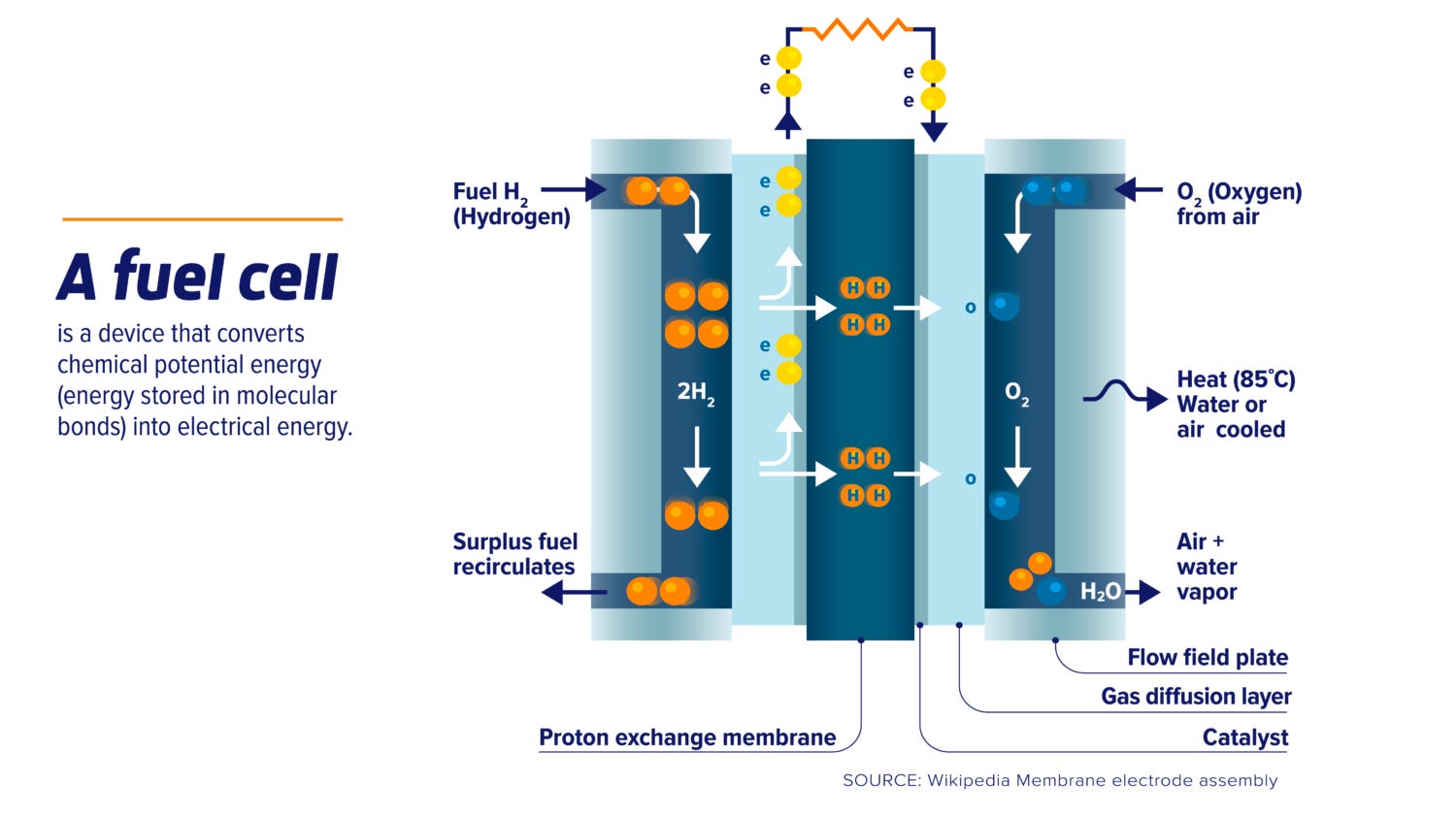
But H2 is so tiny that it packs very little energy per unit of volume. You need to compress the hydrogen a lot to pack a sizable amount of energy. This is done by liquifying it—turning the gas into a liquid. Unfortunately, because H2 molecules are so small, they’re more excited than other molecules at the same temperature [4] . This means you need a much lower temperature to liquefy H2—in fact, you need to get it to −252.8°C. That’s only 20ºC higher than absolute zero [5] . In other words, a hydrogen car must store its energy at cryogenic temperatures. Nice. When you change your fuel car for a hydrogen car, you are changing something that is liquid and safe to touch at room temperature for something that requires industrial-grade management and can kill you if you make a mistake.
Pressure
To keep the H2 liquid, you must also store it at ~700 atmospheres. To give you a sense of how much pressure that is, you’d need to get 7 km deep into the ocean to find that pressure. This is about twice as deep as the Titanic, with its now infamous submarine that imploded due to external pressure.
Every car fuel cell needs that amount of pressure to store its hydrogen.
Tank Size
With that temperature and pressure, your hydrogen will give you about half the energy per kg compared to liquid fuel. Not too bad. It packs a sizable amount of energy per kg, but since it’s such a light particle, that kg will use a lot of space. The result is that H2 packs ⅙ per unit of volume vs standard car fuel. In other words, to travel the same distance, you need a tank that is 6 times bigger. And that doesn’t take into account the heavier, more substantial tank construction required to host all this H with such great pressure and low temperature.
Explosions
OK we’re not done yet. H2 is explosive.

Because it’s so light, hydrogen was used to fill zeppelins—like the Hindenburg—to make them float. Unfortunately, the technology of the time wasn’t great, and the H2 exploded. Why is H2 so explosive?
As we saw before (in a footnote), the H2 molecules are so small that they’re very excited at standard temperatures. They move a lot. That makes them meet other molecules easily. And in the atmosphere, there’s plenty of O2 to meet. And since H and O love each other [6] , they find each other quite easily.
But remember how electrolysis requires a lot of energy to split the H2O into H2 and O2? All that energy is released when the H2 and O2 meet again. Since many O2 and H2 molecules meet so easily, releasing so much energy in the process, any little spark can set the entire thing ablaze.
Of all gases, hydrogen has one of the widest explosive/ignition mix ranges with air [7] . It has extremely low requirements for an explosion to occur. This means that whatever the mix proportion between air and hydrogen, when ignited in an enclosed space, a hydrogen leak will most likely lead to an explosion, not a mere flame.
But wait, there’s more.
Compression
As a gas, hydrogen is easier to move than a solid like coal. You can use gas pipelines. But within the world of gases, hydrogen is not that easy to work with. It’s less dense than natural gas, so it requires more energy to compress and pump through a pipeline [8] .
Escape
Hydrogen molecules are so tiny that they easily find any hole in materials to escape. The result is either huge losses or massive investments to avoid them. This is one of the reasons why there are very few H2 gas pipelines, and those tend to be short-distance.
Freezing Cells
Going back to fuel cells, it turns out that the membranes of fuel cells produce water, which must exit the fuel cell for it to work. So if the water freezes, it can’t leave the cell and blocks it. In other words, hydrogen fuel cells don’t work in freezing ambient temperatures. They need to be constantly warmed up in such conditions.
Expense
High pressure, low temperature, explosions, escapes… All these mean that facilities that store, transport or manipulate hydrogen tend to be quite expensive, increasing the investment required to use it.
Hydrogen Today
All these are the reasons why hydrogen is used like this today:
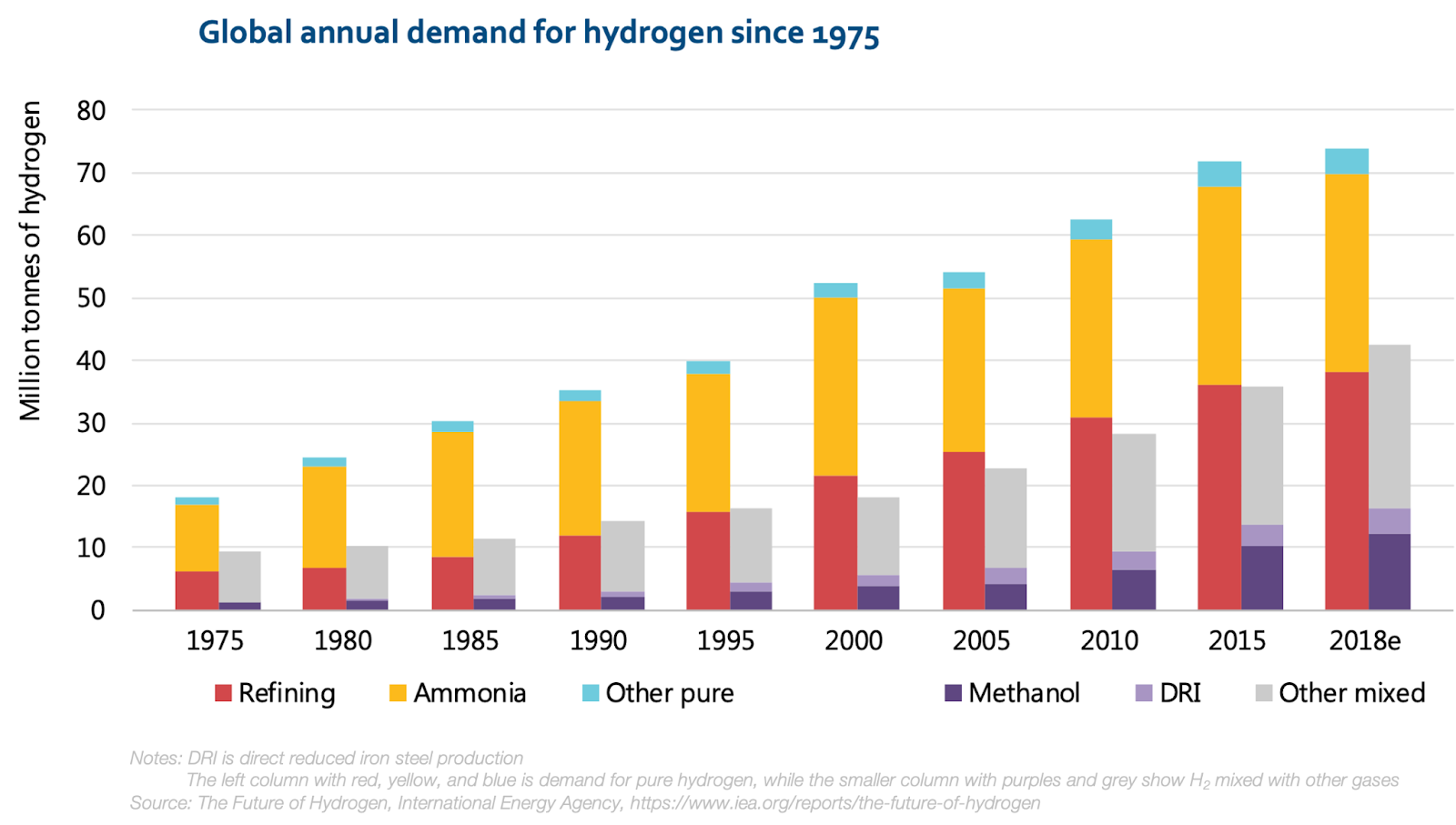
Nearly all hydrogen today is used to generate other industrial products. You can see ammonia, for example, which uses about a fourth of all hydrogen, and is the main nitrogen-based fertilizer (for the Haber-Bosch process, as we explored in this article).
For all the reasons mentioned above, you can see why there are few use cases for which H2 stands out:
Cars: H2 can explode, it takes too much space, requires too much pressure and low temperatures, can escape easily, and is expensive to host.
Long-distance transmission: hydrogen gas pipelines have greater losses, it’s more expensive to move hydrogen gas than natural gas inside pipelines, and hydrogen gas pipelines can explode more easily.
Remember what we said earlier on: We need energy tools that fulfill these requirements:
Something easy and cheap to transport over long distances
That can be stored for a long time with minimal losses
That has a high energy density per kg
But hydrogen is light, volatile, explosive, expensive…
This is why a report from the UK House of Commons said:
We do not believe that it will be the panacea to our problems that might sometimes be inferred from the hopes placed on it.
A report for the French Senate agreed:
In any case, and beyond even being the most flammable and lightest gas, capable of escaping from almost anywhere, hydrogen is not a miracle solution: the low efficiency of the overall process, due to multiple conversions causing a degradation of the energy potential, should be noted.
Does this mean that there’s no place for hydrogen? Not quite.
The Future of Hydrogen
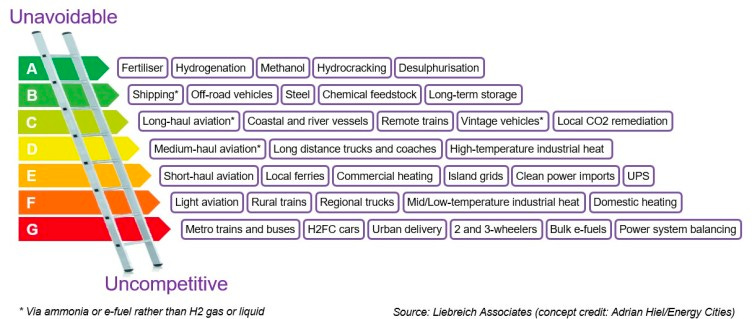
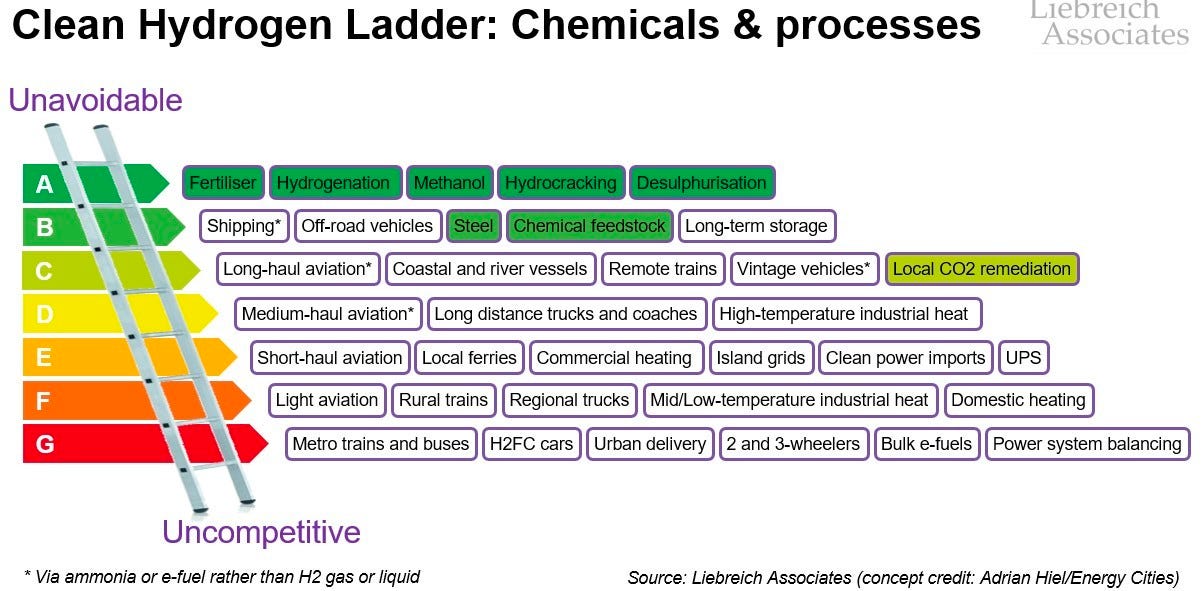
Michael Liebreich has been making and updating this graph about potential uses of hydrogen:
Industrial Uses
What you can see is that H2 is best (A) where it’s already used: industrial situations where H2 is needed for its chemical properties, not as a storage of energy.
Long-Term Storage
As a power system, the only potential use it has is long-term storage.
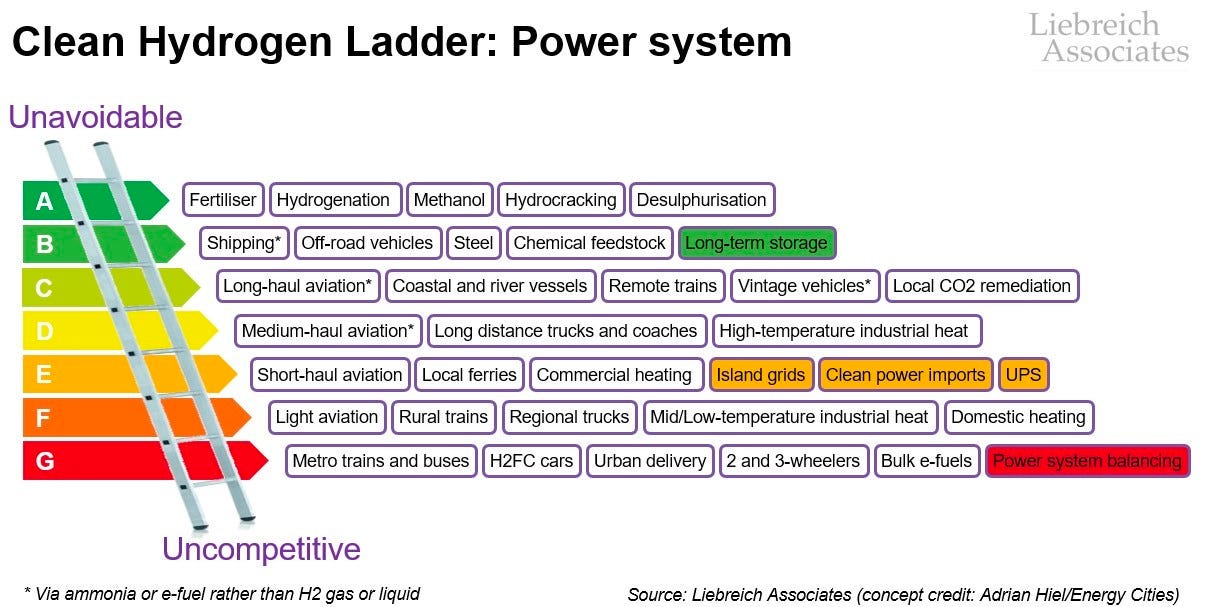
But we saw that it’s not that competitive compared to electricity storage and transmission.
Moreover, it’s much worse than other alternatives, such as methane storage or water storage—that is, pumping water up, and then using it to generate electricity on its way down.
Water is way more efficient and stable than H2. There are already plenty of sites using it.

And some people argue that there are hundreds of thousands of sites we could use as water reservoirs.

According to a roundup by Sabine Hossenfelder, hydrogen long-term storage is one of the least efficient in terms of energy:
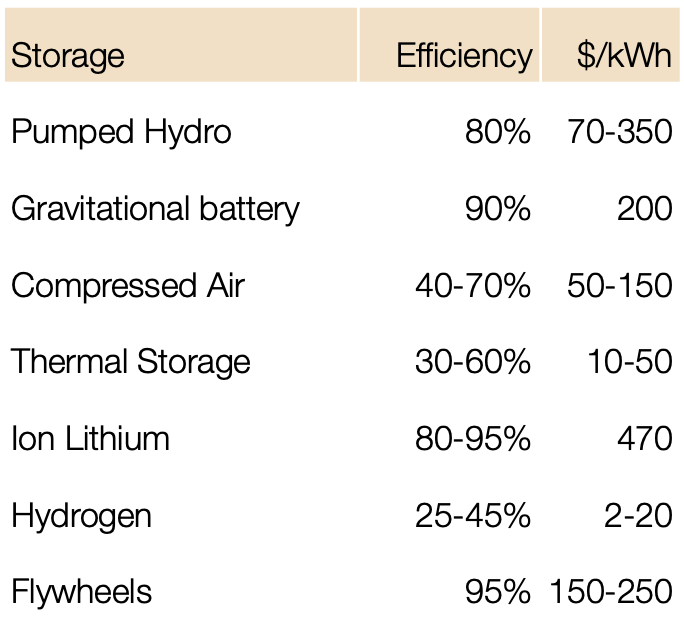
But it’s pretty cheap, so maybe as energy generation gets cheaper, the efficiency matters less and the CAPEX cost of storage matters more? In that situation, would hydrogen win?
For long-term storage, the proposed solution is usually to fill caves with it. But if you’re going to fill a cave, you might as well do it with something we’re already using (that does not require more infrastructure) and that packs more energy per unit of volume. In other words, natural gas/methane. Its storage efficiency is a bit lower, but if we’re in a world where energy costs are much lower, does that matter?
Transportation
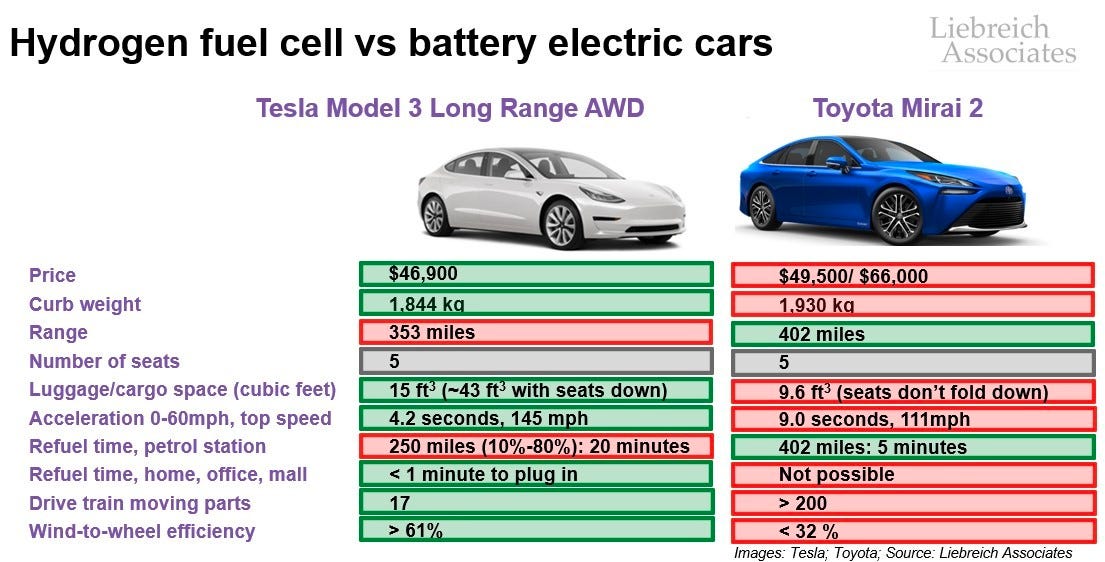
For all the reasons we mentioned, hydrogen fuel cells just can’t compete with ion lithium batteries.
We also ruled out air transportation [9] . There is, however, one huge potential use for hydrogen: cargo ships (ie, zeppelins, but this time well-engineered). Eli Dourado shows in his article that cargo airships are a viable long-haul transportation method that would be extremely efficient.
Aside from that, big seaships could also use hydrogen—since they don’t have big weight/volume problems—but they would have range problems that would be less pronounced with methane. So again, not great for transportation.
Conclusion
Hydrogen’s big positive is that it’s cheap to make and clean to burn. Unfortunately, it’s such a small molecule that it has horrible handling requirements. Nearly all use cases are better served in other ways, either through batteries, methane, or something else. The only uses where it shines are for industrial uses (as today) and for cargo ships.
Hopefully, we will see cargo ships. In the meantime, I’ll keep my bets on methane.
The other ways to produce H2 do emit carbon, because they derive the H2 from carbon fuels like methane. So even though this produces 95% of H2 today, it’s not viable as a process to decarbonize the economy, which is the entire point of exploring H2 in the first place.
Electrolysis comes from electricity and lysis (breaking, loosening). It’s called that because you’re breaking / loosening the chemical bonds between H and O in H2O to form less stable O2 and H2.
As in, you generate the H2 with electricity, and then you just burn the H2 to use the heat. All these numbers are orders of magnitude.
Why does something feel hot? Because its atoms are moving fast, so they hit you a lot. This transfer of energy with every hit is what you feel as heat. The hotter something is, the more excited the atoms, the more they hit you, and the more you feel the heat. You can picture for example a pool/billiards table with the balls hitting the sides. The faster the balls move, the more they hit the borders, and with more energy. That causes the feeling of heat. But the heat you feel also depends on the size of an atom. The bigger it is, the more the impact transfers energy. Think of a massive pool ball vs a tiny marble. The pool ball will transfer much more energy. Hydrogens are tiny, so they don’t transfer more energy. So if a big molecule and an H2 have the same temperature, it means that the H2 must be hitting you many more times to transfer the same amount of energy as the big molecule. The result is that, for any given temperature, H2 tends to be much less stable than other molecules. But when you’re a liquid or a solid, you need to be a pretty stable molecule. That’s why hydrogen needs a much lower temperature to liquefy.
Compare it with liquefied natural gas (LNG, ie, methane), which is stored at -162°C, or 110ºC above absolute zero.
Oxygen and hydrogen both seek electrons to become more stable. Hydrogen needs one, oxygen needs two. The result is that they are eager to react with each other.
With few exceptions such as acetylene, silane, and ethylene oxide
Which makes it more expensive per unit of energy, since it packs less energy per unit of volume, and moving volume is what is expensive in gas pipelines.
Air transportation appears in the chart above because it displays “hydrogen and its derivatives”, which includes methane. Methane can be used for rockets and could be used for airplanes. If not, it can be used for other synthetic fuels, but not hydrogen.