Deep Dive on How Internet and Blockchain Will Kill Nation-States
Some content could not be imported from the original document. View content ↗
Aug 31, 2021 • 25M
Deep Dive on How Internet and Blockchain Will Kill Nation-States
Premium Article
Aug 31, 2021
- Your private RSS feedCopy your RSS link and paste it in your podcast app. Learn about RSS.
Appears in this episode
Tomas Pueyo
Welcome to the premium content of the week! And I say content because you’re getting an article, a video, and podcast in one.
First, the first podcast! Some of you had asked me to do one, so here we are. Let me know what you think! It’s about my take on the conversations I had with Mrs President Sakellaropoulou from Greece, the first lady of Mr the President Van der Bellen of Austria—Mrs Doris Schmidauer—, and Nobel Laureate Joseph Stiglitz.
I touch on the biggest obstacle to becoming a creator, gatekeepers, how they might disappear from education, climate change, Greece’s immigration, designing social dynamics, and their role in spirituality. Enjoy!
Next, the video of the speech I gave at Alpbach. It’s 28m long, but I pack it with interesting content. If you’ve read the free article from Sunday, you’ll recognize the first part of the speech. The second is new, and this is what I’ll be covering in the next article this week.
Finally, here’s the written article for today!
The Printing Press Explosion and the Industrial Revolution
Books went from ver very few in the 15th century to 200 million a century later!
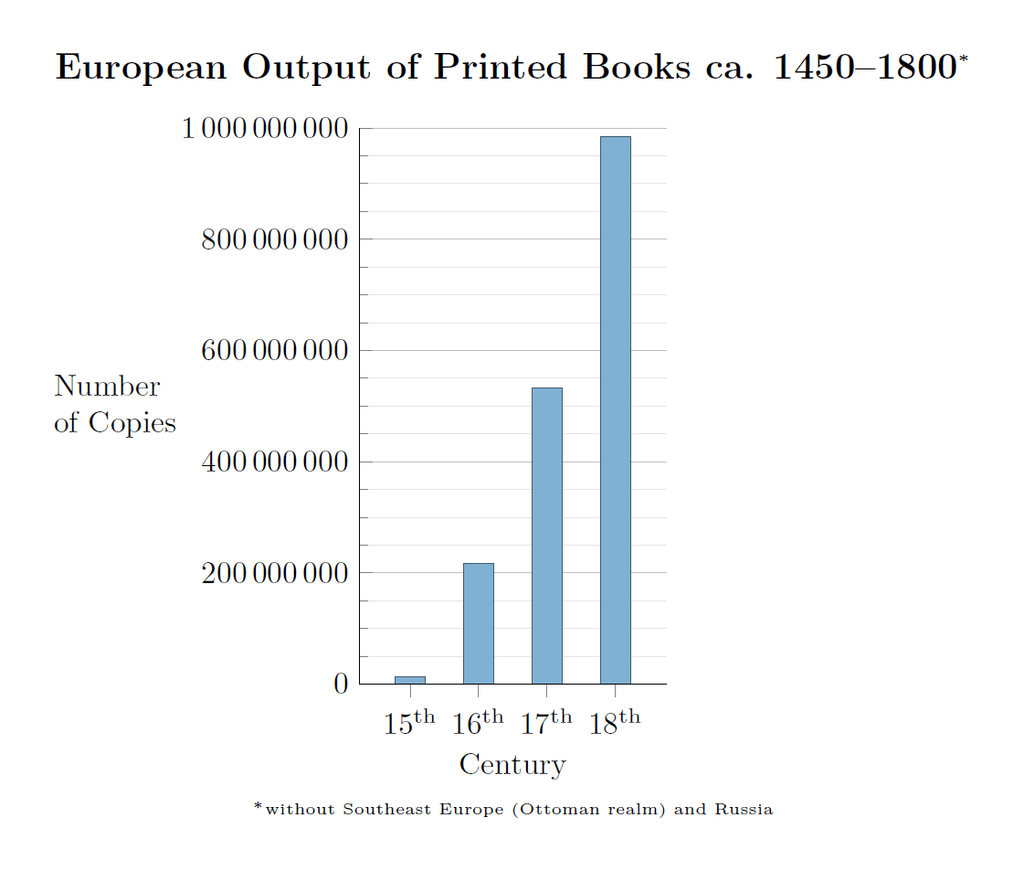
I’ve seen a bunch of these graphs now, and they’re all similarly astounding.
This reminds me of a big question I’ve seen over and over while studying the industrial revolution: nobody knows when it starts, where it starts [1] , or why the effects only start to be felt in the 19th century.
When I see that an exponential trend “only starts to be felt by X date”, I immediately think: “It was probably happening for a very long time before X, but we just didn’t notice.” It’s a bit like worldwide governments going crazy in the middle of March 2020 because of COVID, when in fact you could look at the numbers in February and realize exactly where you were going to be a month later.
An increase of several orders of magnitude in information generation and sharing sure sounds like the type of event that would cause the industrial revolution down the line. So maybe the right way to see the industrial revolution is just as the explosion of a trend that had been brewing for centuries, with the printing press as one of the key milestones.
How Information Technologies Produced Political Systems Before the Printing Press
We talked about how the printing press and broadcasting changed political structures in the past. But I glanced over writing and speech. Let’s talk about them today, to really see the pattern.
Writing
“If you add literacy to Attila the Hun, you don’t get Plato. You get Genghis Khan.”—Robert Wright, Nonzero.
We talked about how powerful the Catholic Church was for half a millennium, between 1000 and 1500, thanks to their monopoly of information. A key component of that was writing.
It’s not just the Church. Kingdoms and empires emerged thanks to script.
We know this because we have evidence of many scripts that have emerged independently, but the emergence of one script is extremely well documented: Sumerian Cuneiform.

Sumerian Cuneiform was written on wet clay tablets. Once dried up, it keeps in perfect conditions for millennia. There’s so many of these clay tablets, that researchers have been able to see the evolution of the script not over millennia, but over decades.
What we learned is that Sumerian Cuneiform emerged for accounting: livestock, food, and goods.
“Most agree that [writing] helped orchestrate division of labor and public works. A farmer brings barley to the temple, the payment is duly recorded, and the barley goes to pay men who build a canal—a canal from which the farmer may in one sense or another benefit.”—Robert Wright, Nonzero.
Without writing, you can’t do a census of your population. You need a census to know who you can recruit to your army.
Without writing, you can’t do accounting. You need accounting to tax your population, to know who paid and who didn’t.
Without writing, you can’t do big public works, because you don’t know who contributed what, and who deserves what.
Without writing, you can’t have the rule of law, because laws are not fixed and immutable, so their application only responds to the will of the local judge. Without rule of law, you don’t have trade.
Without writing, you can’t invest for the long term, because somebody will steal your stuff and you’re not sure justice will be made because the law isn’t clear.
Without writing, you can’t finance anything, because you’re not sure anybody will repay.
Without writing, you can’t have diplomacy, because you need the kings to speak in person—human couriers are unreliable—but moving kings to meet was too expensive and hard.
And so it’s not a surprise that all empires, from the Incas to the Chinese, had some sort of writing. No writing, no empire.
And you can keep finding these examples of technologies that shaped political structures. Here’s the last one: before writing, we had speech.
Speech
We don’t have records of speech—history starts with writing. But there are some insights that come from the observation of pre-script chiefdoms.
With the emergence of speech tens of thousands of years ago, humans started being able to exchange information easily. That created a lot of wealth: it costs me nothing to share with you my information, but it’s extremely valuable to you. You create value out of thin air by sharing information.
All types of coordination were extremely hard before speech. With it, suddenly you can coordinate to hunt, to know where the best food to gather is, you can trade, you can coordinate to build irrigation systems together, granaries, temples… Modern humans couldn’t have created chiefdoms without speech.
Languages and dialects in Europe, and the tension between them
In Europe, there’s a tension between national languages, such as French, Spanish, or German, and dialects, such as Occitan or Napoletano. Europe not the only place. This happens nearly everywhere in the world, especially in the Old World.
To give you a sense of how intense the debate is, some people might get offended at me calling Spanish “Spanish”, because they prefer the use of “Castilian”, to show it comes from the central area of Spain, not from others such as Galicia, the Basque Country, or Catalonia—which each have their own languages/dialects. Even calling them dialects is the source of more debate [2] .
As a kid raised in European nation-state propaganda, I fully believed the importance of the national languages, and felt threatened by the push for more prominence of dialects.
All of that changed as I’ve started understanding history and geography better.
In case you missed it, here’s how I’ve described modern European languages in my previous article: They are the vernaculars that prevailed because they came from the biggest, central cities, so they got printed more, and then broadcasted more. Over time, they became more and more important, until at some point nation-states started systematically eliminating other vernaculars and bolstering their chosen national language to strengthen the nation-state.
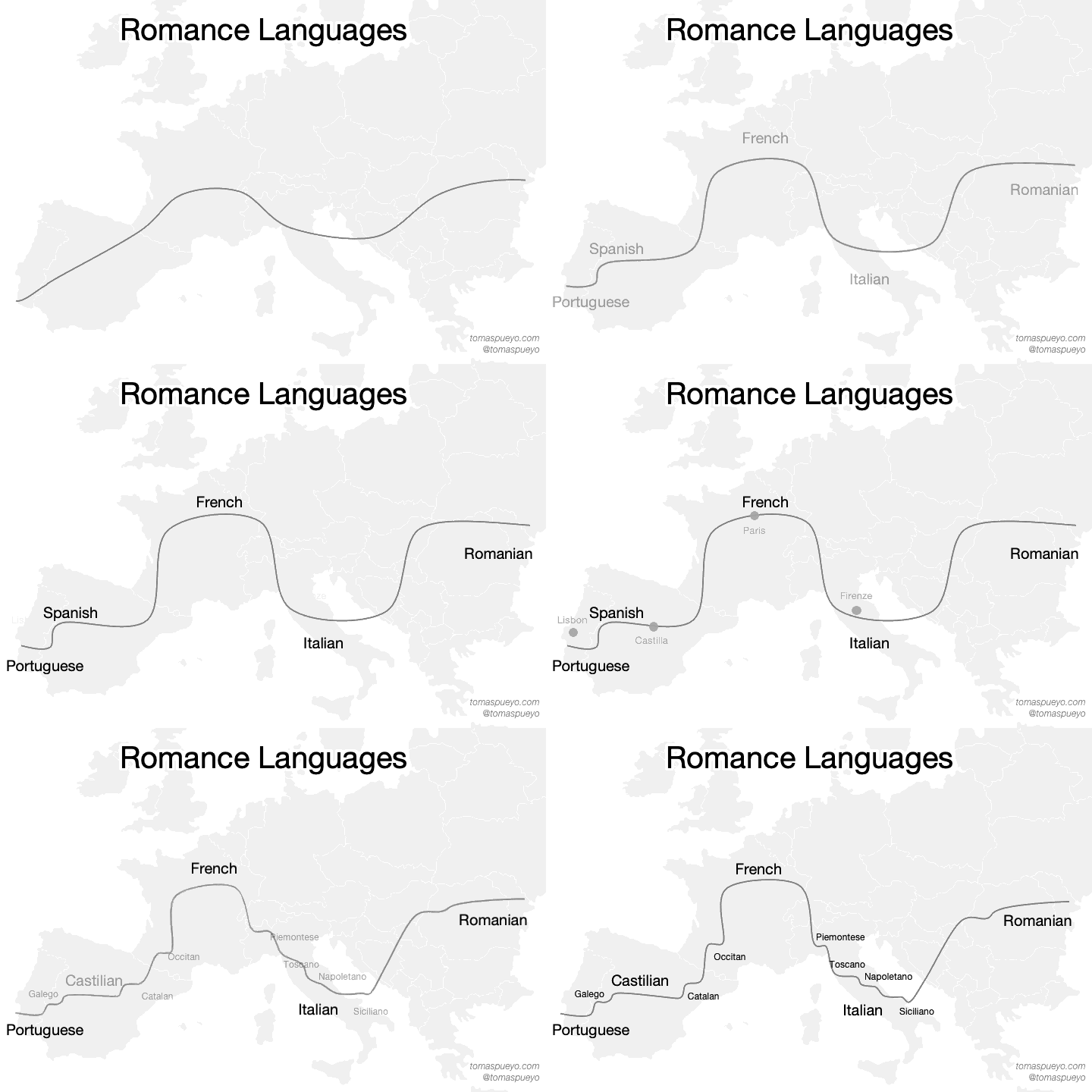
Seen this way, when you speak the national language you know and love, you are doing the bidding of gatekeepers who want to better use you.
When they wanted you to spend hours every week at school reading literature you didn’t care about, it’s because it wasn’t really for you. It was for them. It is for them.
You can actually see this process still happening today: dialects that don’t exist are being taught in European schools: the people who teach them all come from different areas within a regions. These areas never got a standardized version of their vernacular, so they maintained it for centuries, continuously drifting. As a result, no two villages speak the same dialect. So no two teachers speak the same dialect either.
Regional governments work to standardize these languages so they can be taught. They want to teach them so they can bolster the nationalist movement of the region. They want to bolster the sentiment so they can get more power. Your tax dollars at work.
Personally, I think speaking local vernaculars is awesome. So much diversity! So much feeling of belonging! If people want to learn and teach them, good for them. If some regions chiefly feel like nations and want to bolster their local language to strengthen their newly-forming nation, I understand and respect that.
I’m less sympathetic about teaching languages when it’s more about the state’s goals than it is about the individual’s.
The best ROI (return on investment) is learning English. Everybody should do that.
If a person belongs to a country that has a very widely-spoken official language (French, Spanish, Chinese, Arabic, Russian…) it makes sense to learn that language too. Beyond that, since study hours have a high cost of opportunity, I would leave it to parents to decide how they want to use their children’s time. Should they learn a 3rd language? A 4th? Or study, say, personal finance and design instead? Ask the parents, not the state.
A Moral Argument for Global English
One of the main answers I get to my article Why Everybody Should Learn English is: “You focus so much on productivity, Tomas! There’s more than that in the world. National languages are so important. They represent the identity of a people, their culture, their civilization, the expression of their ideas…”
Now that we’ve covered the historical emergence of languages in Europe, we’re better equipped to answer this.
National sentiments and brotherhood emerge first and foremost through language. When people understand each other, they can more easily exchange ideas, see they are similar, and fraternize. This is exactly what happened with national languages over the last 5 centuries.
And what about the Arabic world: doesn’t it share a kinship across countries that it doesn’t share with non-Arabic countries? What about the kinship of the Spanish-speaking world? Of the English-speaking world? Russian? Language is probably the biggest force of fraternization.
This is what I want for the world now.
If it’s true that languages break down barriers, if everybody spoke English, we would fraternize much more than today. Wars, confrontations, misunderstandings… A huge part of them is caused by the simple fact that we don’t understand each other.
Not only that, but a common language would allow all of us to share our ideas. Sure, it would homogenize world culture the same way as national languages shrunk the importance of other vernaculars. That was the price to pay for an explosion in the exchange of ideas.
Imagine 7 billion world citizens seamlessly exchanging ideas. How much richer would our intellectual life be?
This newsletter is a good example. You guys come from everywhere in the world. The type of insights you share back with me from all over the world dramatically enhances my perspectives, which I then share back with you.
All of this would accelerate the creation of a global identity, which I’d argue is more urgent than ever, as problems become global in scope, like Climate Change is showing us.
This is what a common English can provide us: more fraternity, fewer wars, a richer intellectual life, a global identity. I think it’s worth it.
Why the printing press might have been a key reason why Europe beat China and India in arriving at the Industrial Revolution
I’ve touched on it in the past, but with the new information about the development of the printing press, it’s worth revisiting this topic.
If the printing press was so important to the Renaissance in Europe, because it allowed knowledge to be shared much more widely, and to be enhanced rather than lost, then it follows that those who’d use it first would be the most likely to win the race to the Industrial Revolution, and hence take over other countries.
We’ve talked in the past about how the three biggest candidates to have a strong emergent civilization were Europe/Middle-East, India, and China.
India never developed the printing press. If it was falling behind technologically, I’d love to understand why. The current hypothesis, as I described in the past—and as Jared Diamond hypothesized before me—is that its north-south axis, plus its two non-navigable rivers, and the massive barriers from outside but light inside barriers, all contributed to a massive population but worse.
But China did invent the printing press. Before Europeans. Why didn’t it succeed there? As I said in The Global Chessboard:
Something very similar happened in China. After inventing the paper and the printing press, and becoming the biggest naval superpower, the country’s influence started dwindling during the Ming period. After the Ming beat the Mongols, they became isolationist. They rebuilt the Great Wall, abandoned the Silk Road, and stopped the voyages of the biggest naval fleet the world had ever seen. They also reduced the power of their civil service, which accounted for a large part of writing, thus minimizing the potential impact of the printing press.
The Ming had a monopoly on information and a political monopoly. They could suppress the printing press in a way the Church couldn’t.
Also, with 70k characters—some of which could be needed more than once per page—it was orders of magnitude more expensive to print than just having the ~25 letters of the Roman alphabet.
The Parallel Between the 95 Theses and Russian Interference in Western Politics
As I was studying the 95 Theses, I started modeling it as a meme (protest the Church’s indulgences) that took over a new distribution channel (books) to undermine the existing superpower (the Church).
This is exactly what the Russian interference in Western politics is doing: Trump, Brexit, Spain, Italy, France, Hungary… They use memes over new distribution channels (social networks) to undermine the existing superpowers (nation-states).
If this parallel works, we should not see these attacks as anomalies, but rather as a signal of where things might go in the future. In information networks ruled by engagement and without nation-state gatekeepers, the winners will be the those who create the most engaging content, regardless of where they come.
I don’t think the winners are companies like Facebook or Twitter. They are gatekeepers with network effects, but a huge part of their success is bringing to us the most engaging content, not our love towards those networks. Take the content out, and they lose the power.
If instead fraternization emerges from consuming the same type of engaging content, it sounds reasonable to assume that the communities that share that content are the ones that will want to be ruled together and will become sovereigns.
History moves to the cloud.
England? Or Netherlands? Or France? Did the UK beat the others for other extraneous reasons such as being an island with a merchant-based legislature, but didn’t really start it?
For the sake of simplicity in this article I’ll call a “language” any language that is official across an entire nation-state, and “dialect” any unofficial language or official languages only in regions of a nation-state. I choose that because I’m specifically talking about the tension between these two, so I need vocabulary to differentiate them.