Brazil, Part II: Everything Else You Didn’t Know You Wanted to Know About Brazil Brazil, Part II: Everything Else You Didn’t Know You Wanted to Know About Brazil
Some content could not be imported from the original document. View content ↗
2023年2月10日
∙ Paid
Why is it such a big country?
Why did it remain united while most other colonies split?
Why are its borders where they are?
Can it become rich? How?
Could it become a superpower?
What are its main foreign affairs challenges?
Why does Brazil have the biggest Japanese population outside of Japan?
This premium article is the third and last piece about Brazil. Let’s answer these questions today!
Why Is Brazil So Huge?
Brazil is huge.
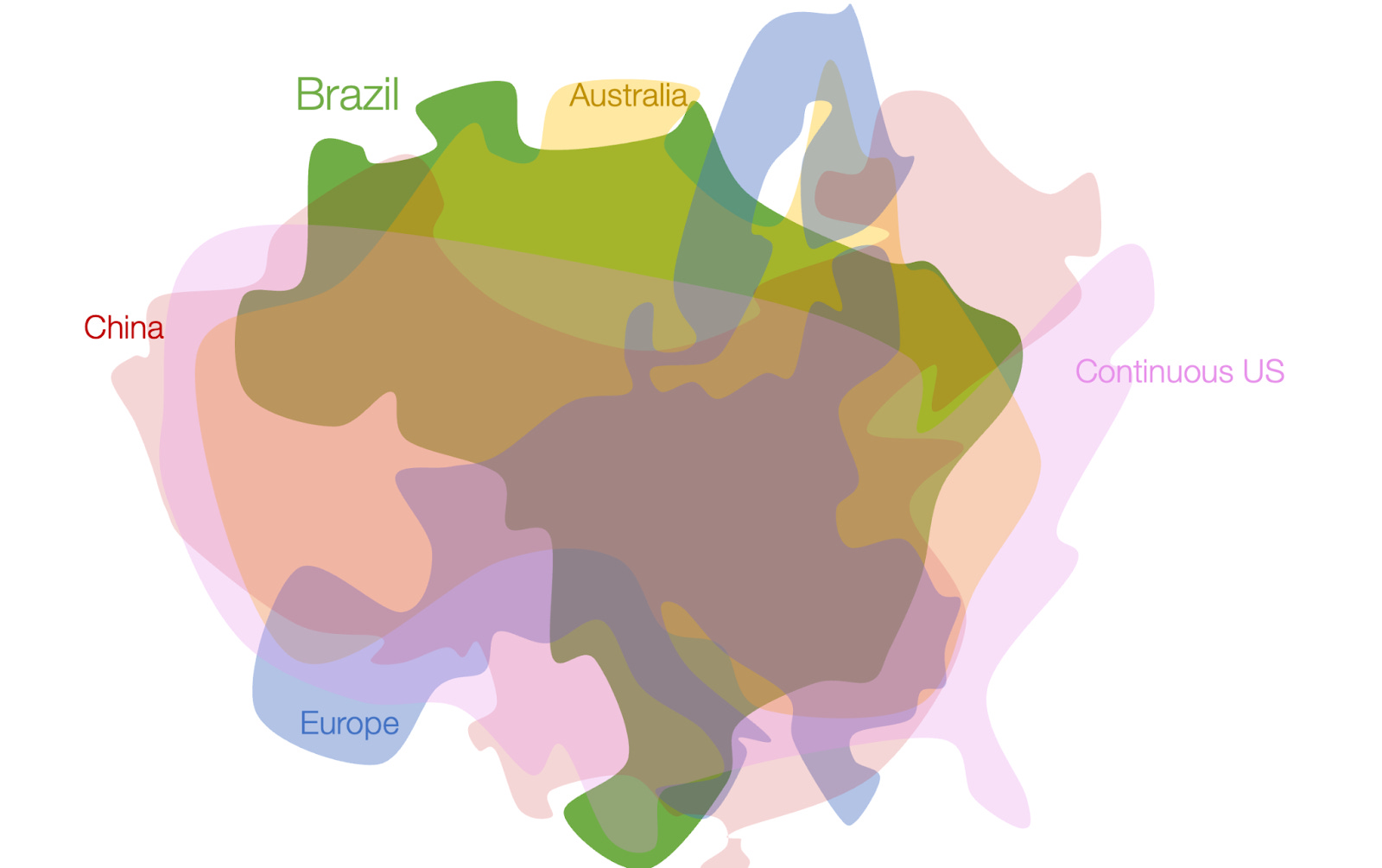
It’s the 5th largest country in the world by area. It’s bigger than Australia. Bigger than the contiguous United States. It’s twice as big as the European Union. Nearly three times as big as India, and three times bigger than its neighbor and rival Argentina. It covers about half of South America’s surface area. No other tropical country gets even close to this size. What happened?
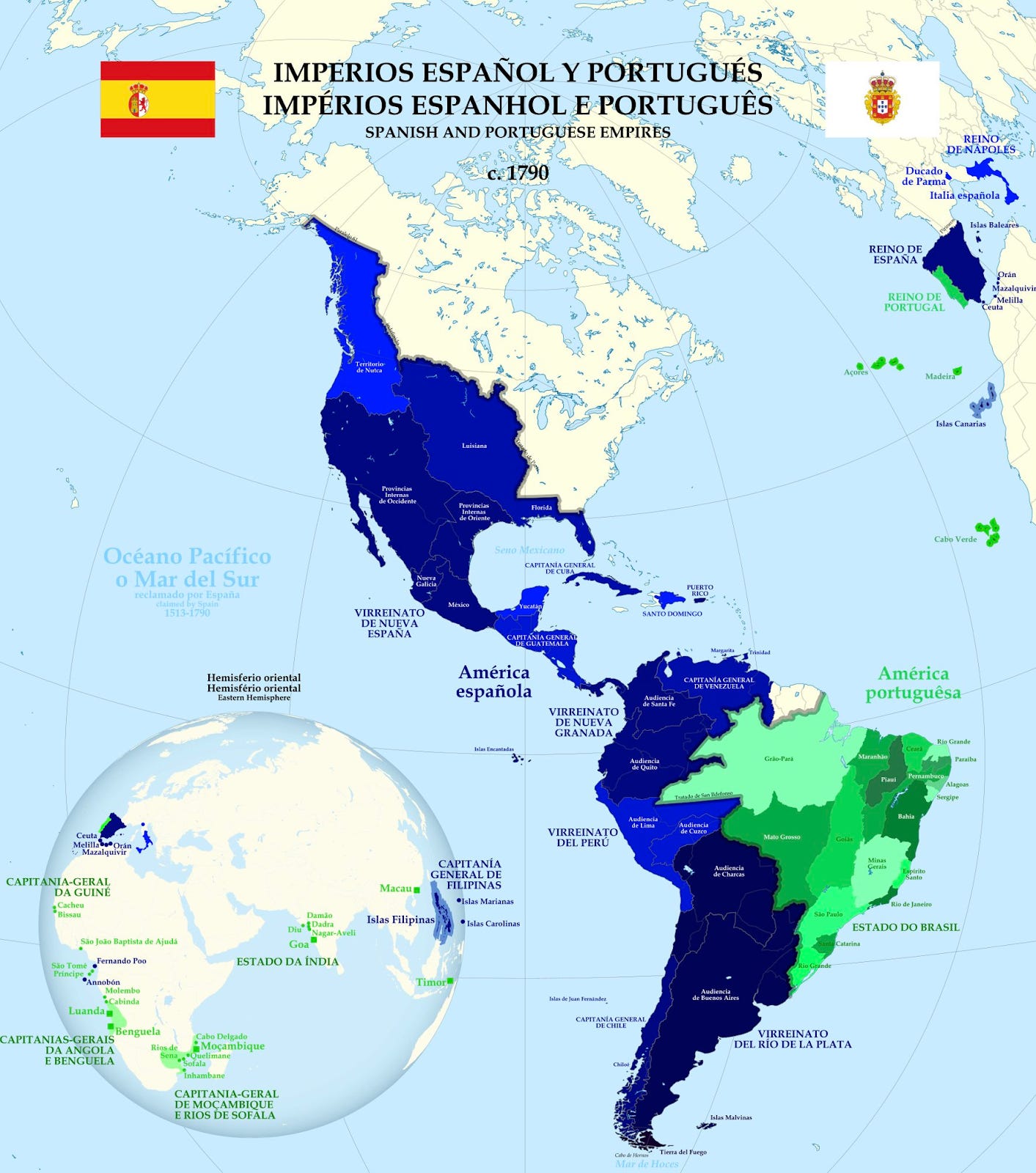
This is even weirder considering that Spain’s American colonies were much bigger than Portugal’s:
And the fact that Brazil was never supposed to be so big: When Spain and Portugal split the world amongst them, Portugal was supposed to get only one small piece.
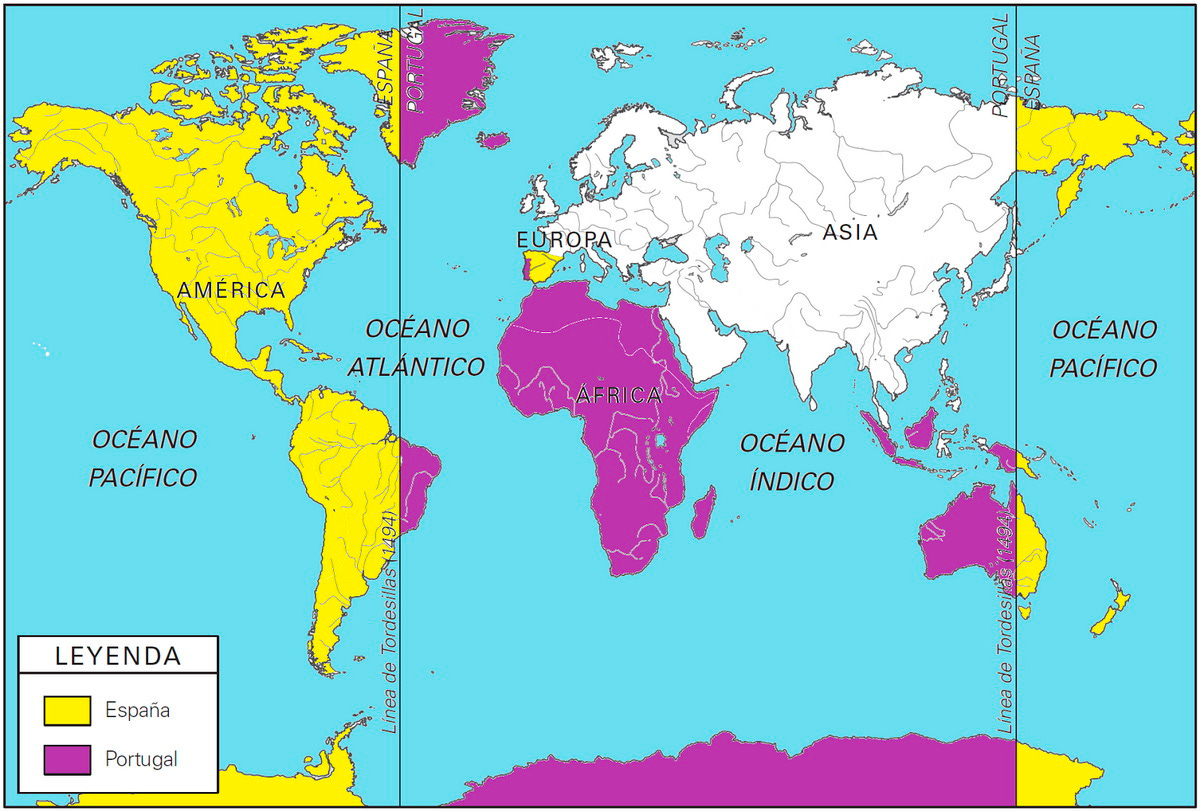
So first, let’s see why Portugal expanded so much, and then we can see why it remained cohesive.
Why Did Brazil Expand So Much?
Early on, Portugal respected the treaty.
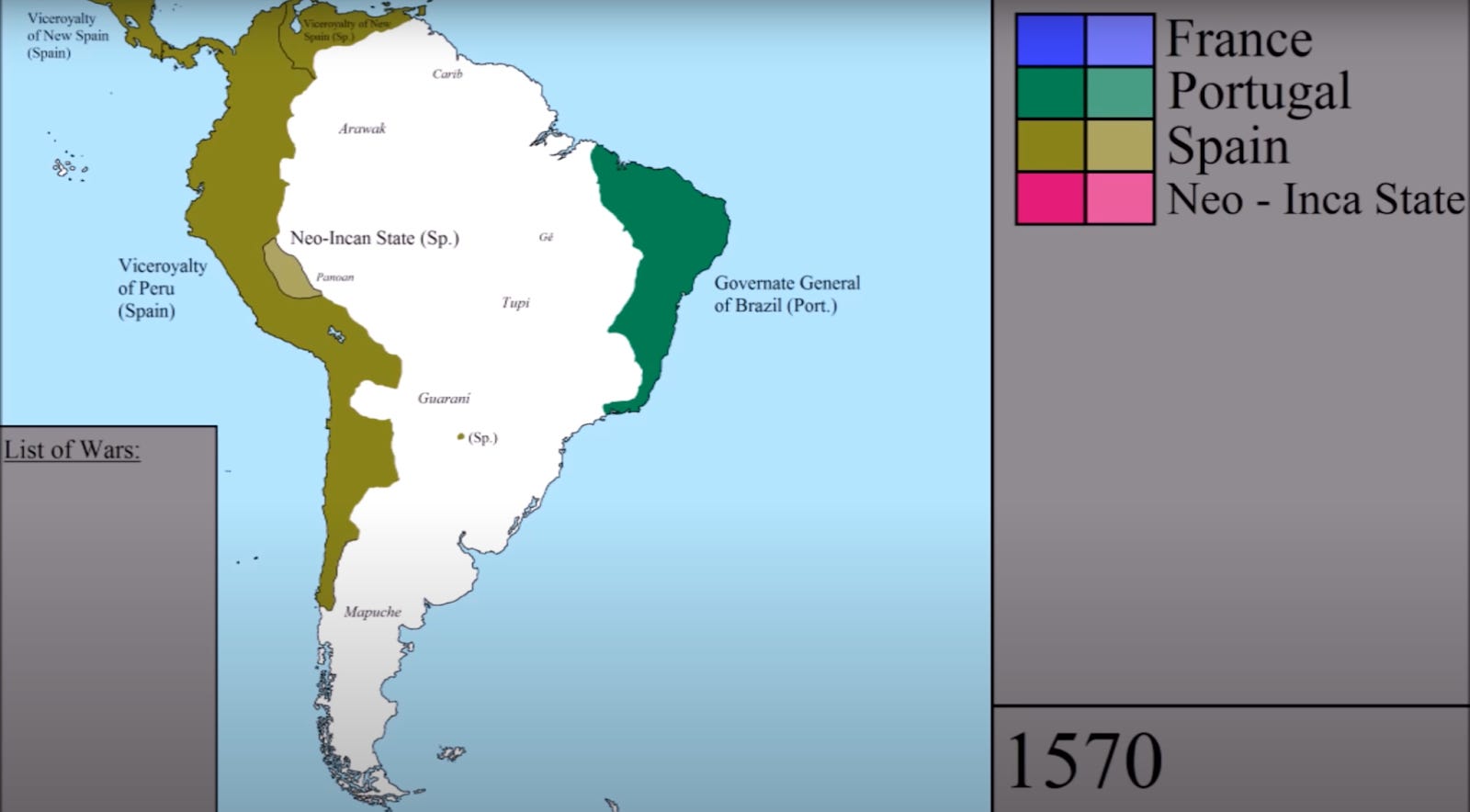
And then… Portugal and Spain united! We saw that in A Brief History of Spain.
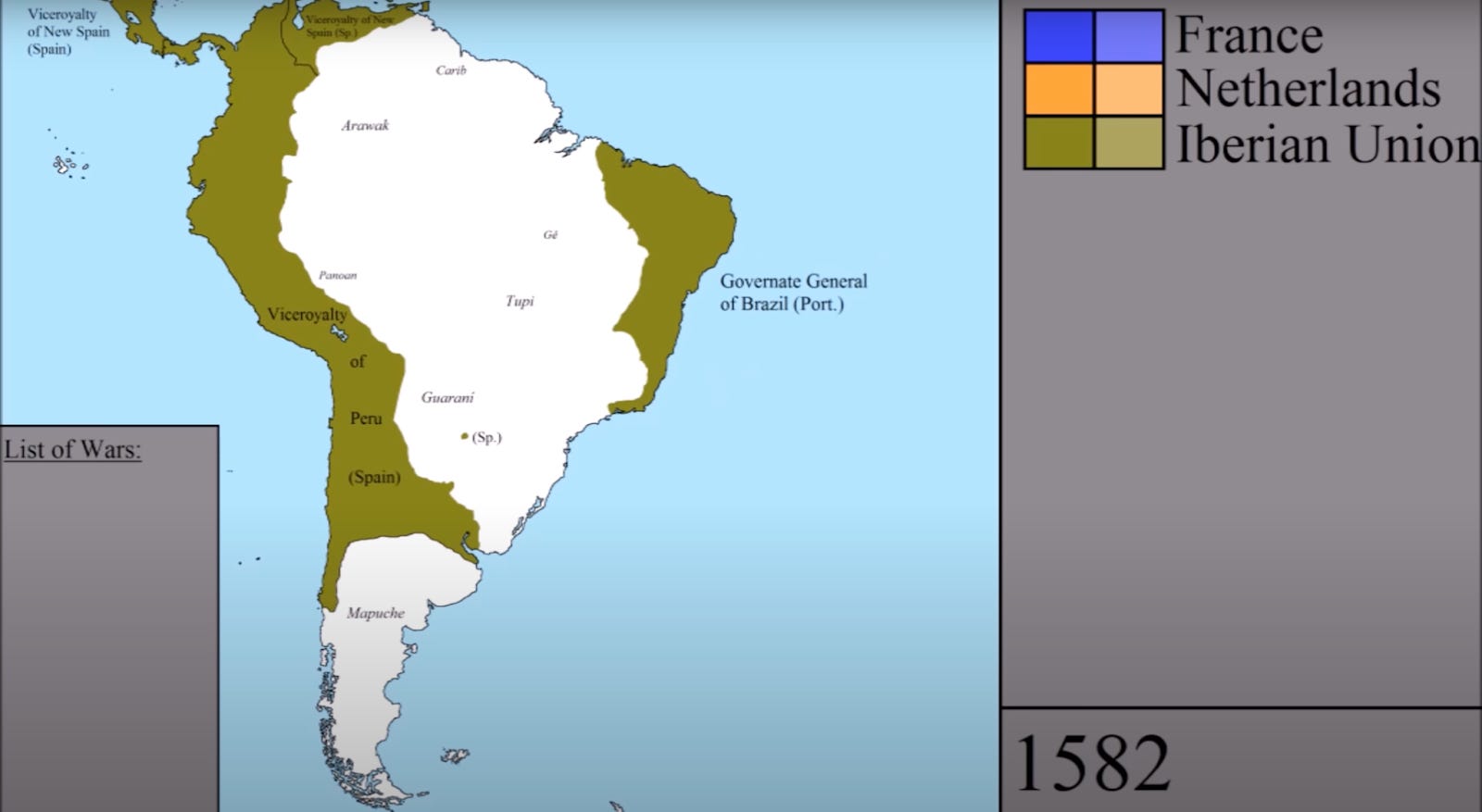
That’s when Brazil started expanding westwards.
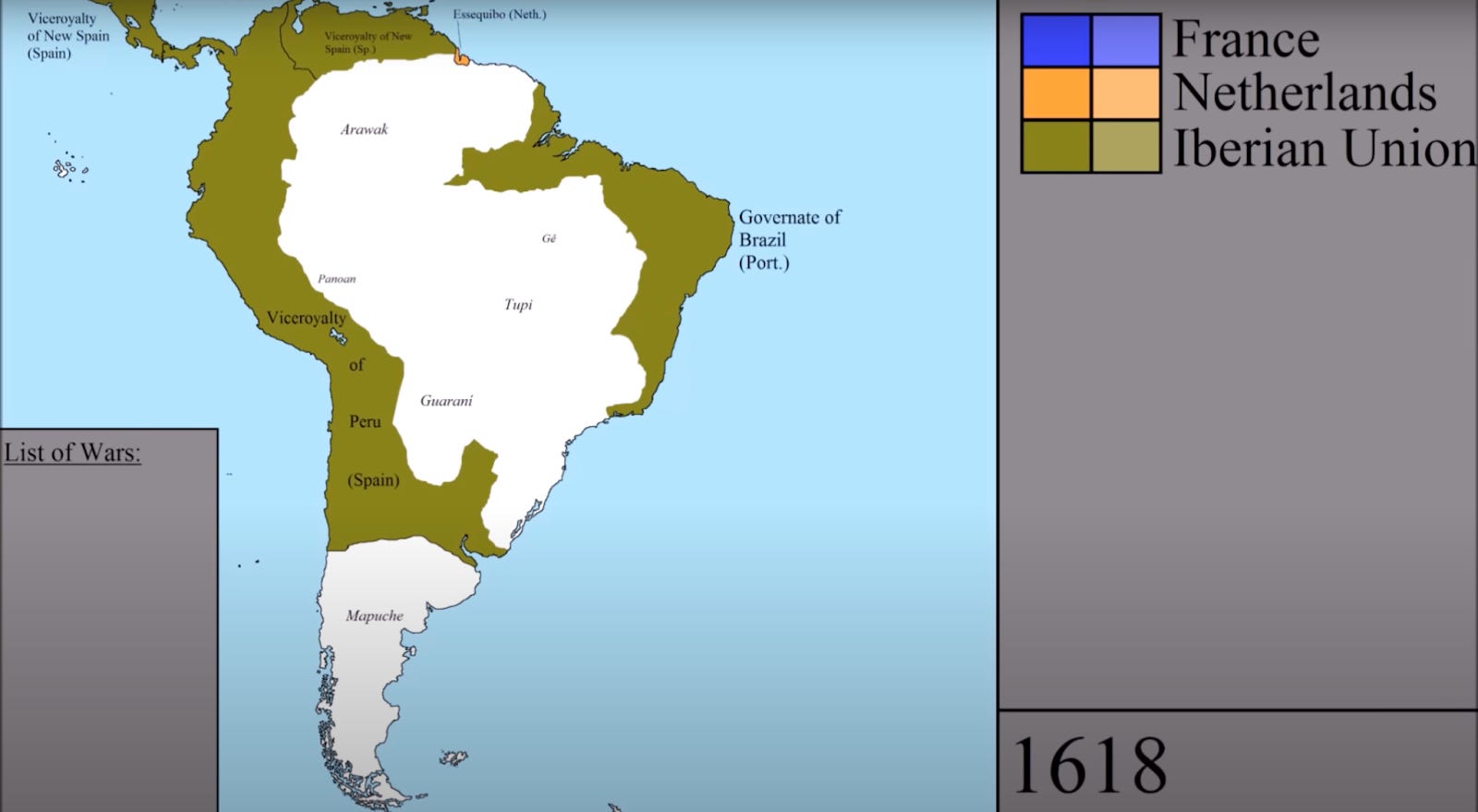
The union was not good for Portugal’s interests: The rule from Madrid didn’t protect the Brazilian coast from the Dutch and French.
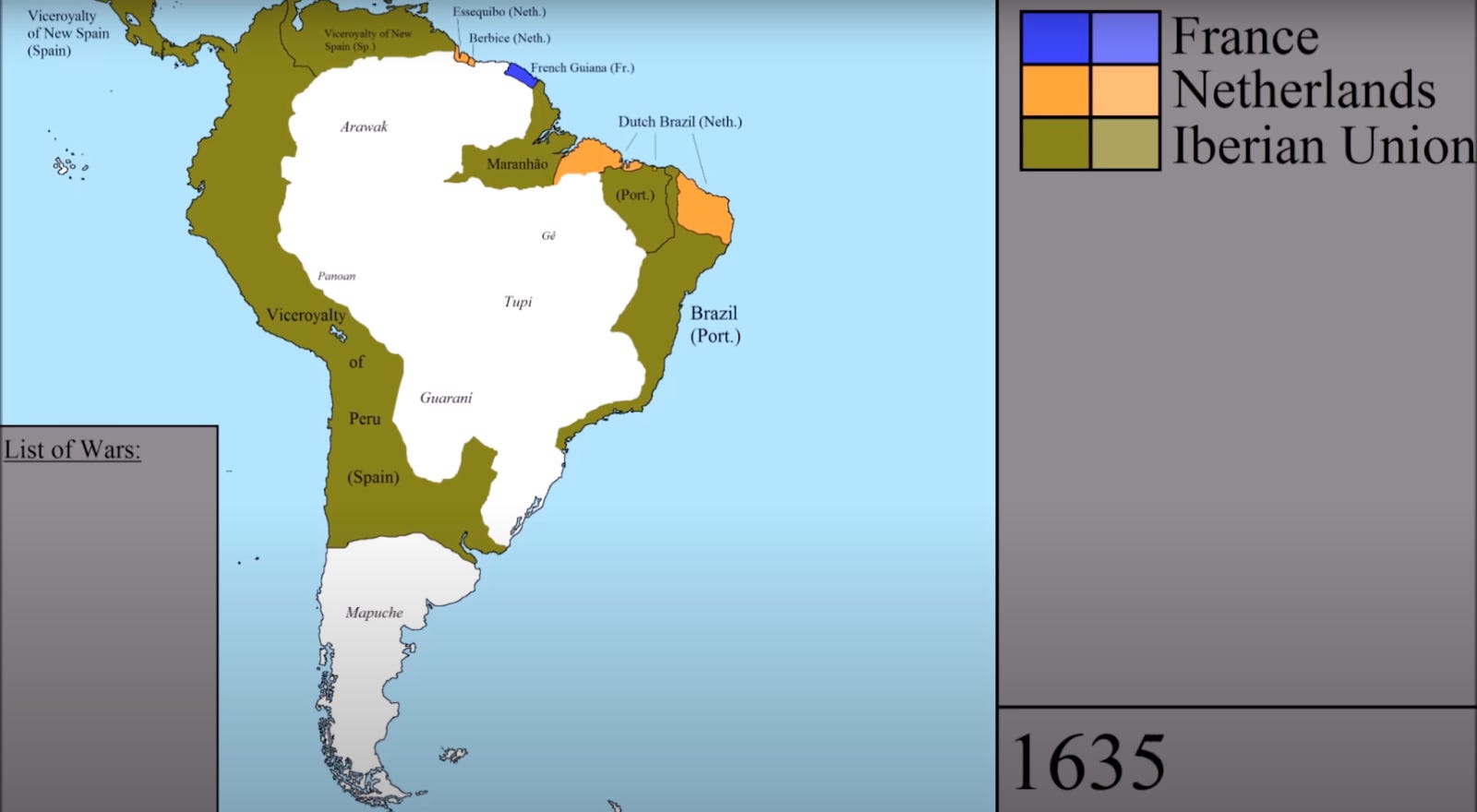
This was one of the key reasons why the Portuguese split from Spain and regained their terrain.
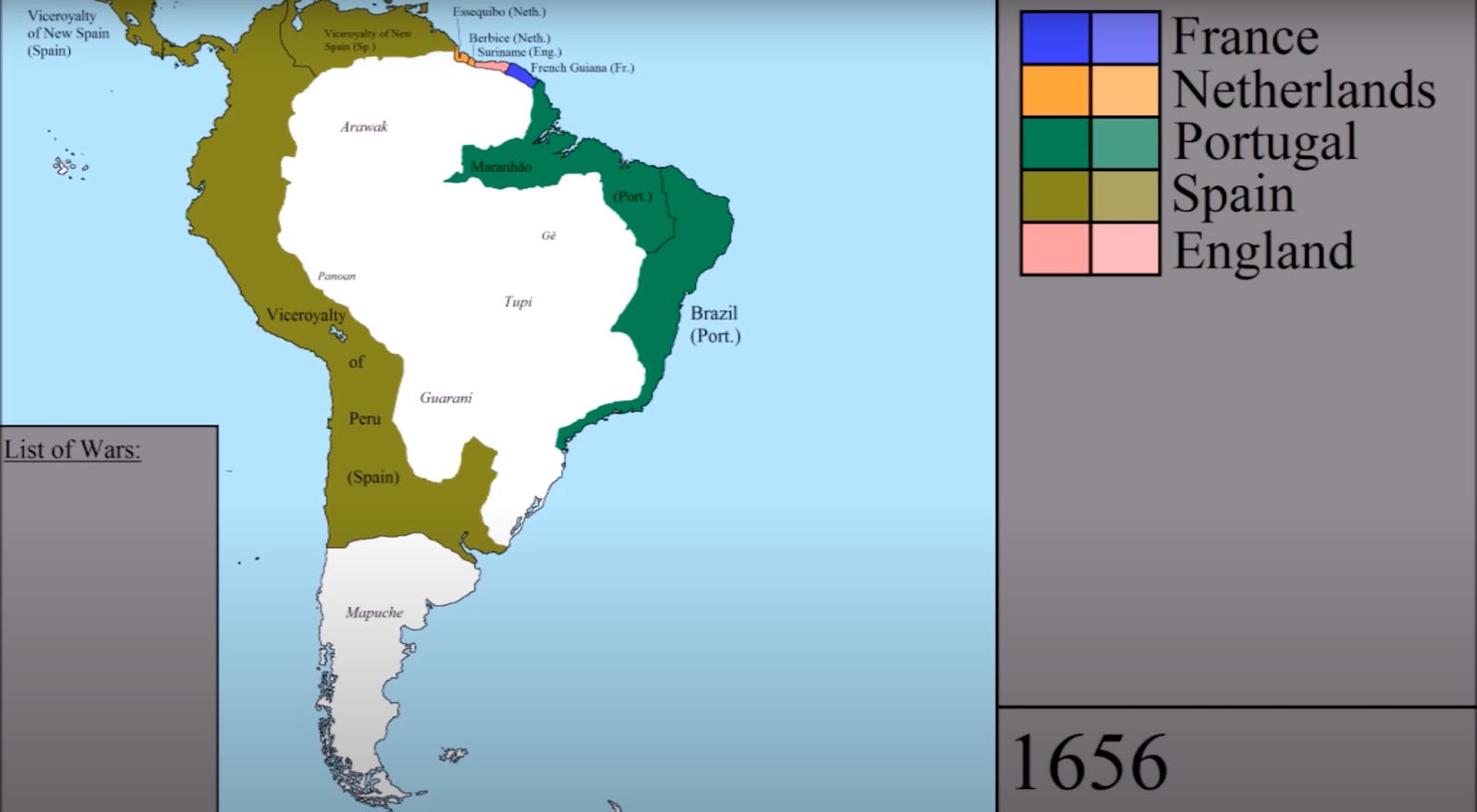
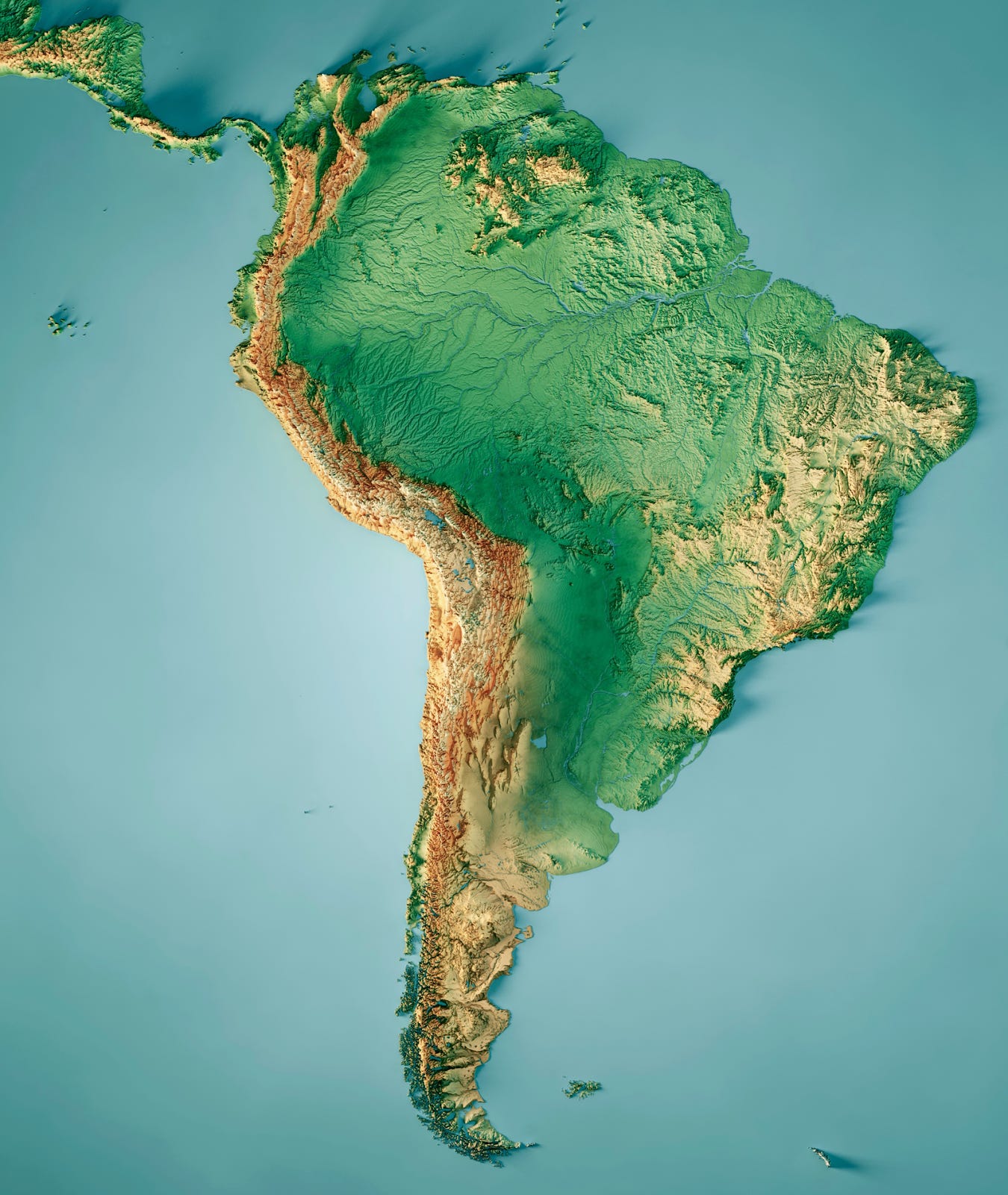
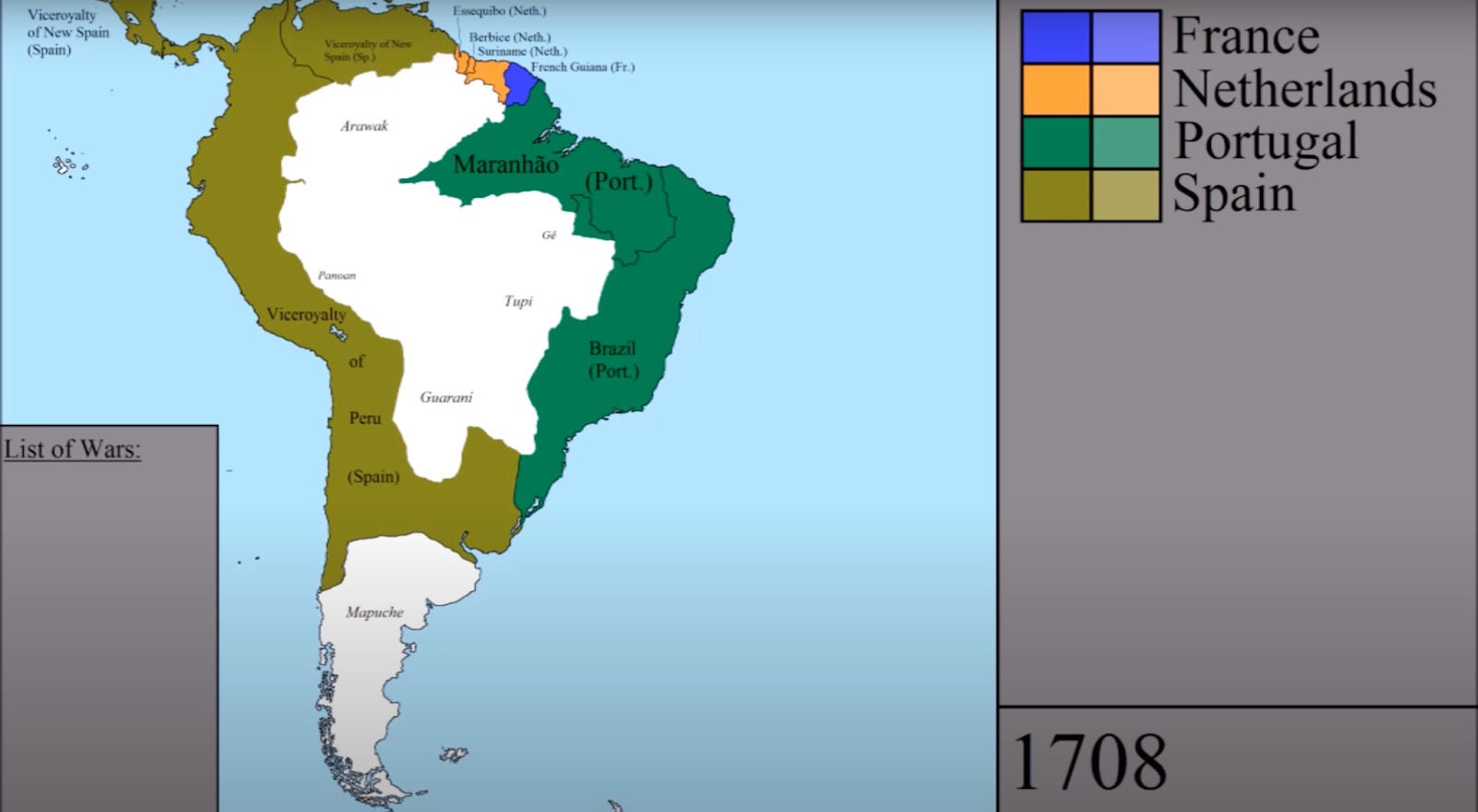
Now at this point, most of the coast was controlled by somebody. The big areas left were the Amazon rainforest, Patagonia, and most of the Brazilian Shield, so mountainous.
The Brazilians realized the middle of the continent would be awfully hard for Spain to reach, so they started pushing.
And they kept pushing.
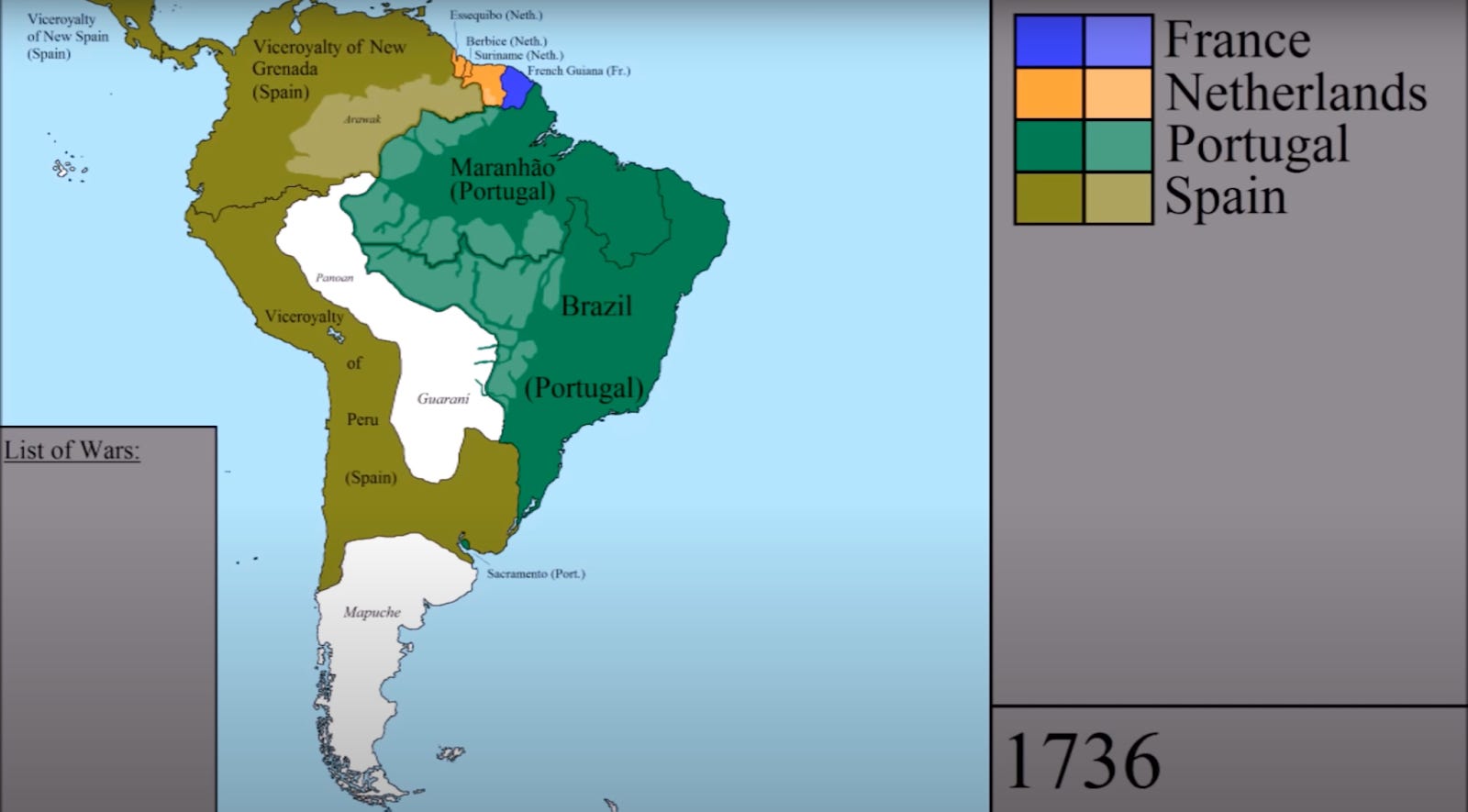
Interestingly, most of this push was not officially carried out by Portugal; it didn’t have a policy of westward expansion. It was instead done by Bandeirantes.
Portugal focused its efforts on the coastal cities we discussed in the previous article, where they could grow cash crops, worked by African slaves.
But some Portuguese climbed the Great Escarpment in the São Paulo plateau, where they started mixing with the local population, and enslaving natives: They were cheaper than Africans, as they didn’t need to be either bought or transported.
Back then, the interior of Brazil was supposed to be Spanish. The Spanish forces didn’t reach it, but the Jesuits did, working on converting the local population to Catholicism.
The Jesuits were then the enemies of the Bandeirantes, preventing them from enslaving the locals. But the Jesuits were not the military. So the Bandeirantes consistently encroached on Jesuit missions to take over the land and, more importantly, the natives.
Eventually, these politics of facts on the ground worked, and by the mid 1700s Brazil had pushed west as far as it could, while the Spaniards started pushing east—until they met.
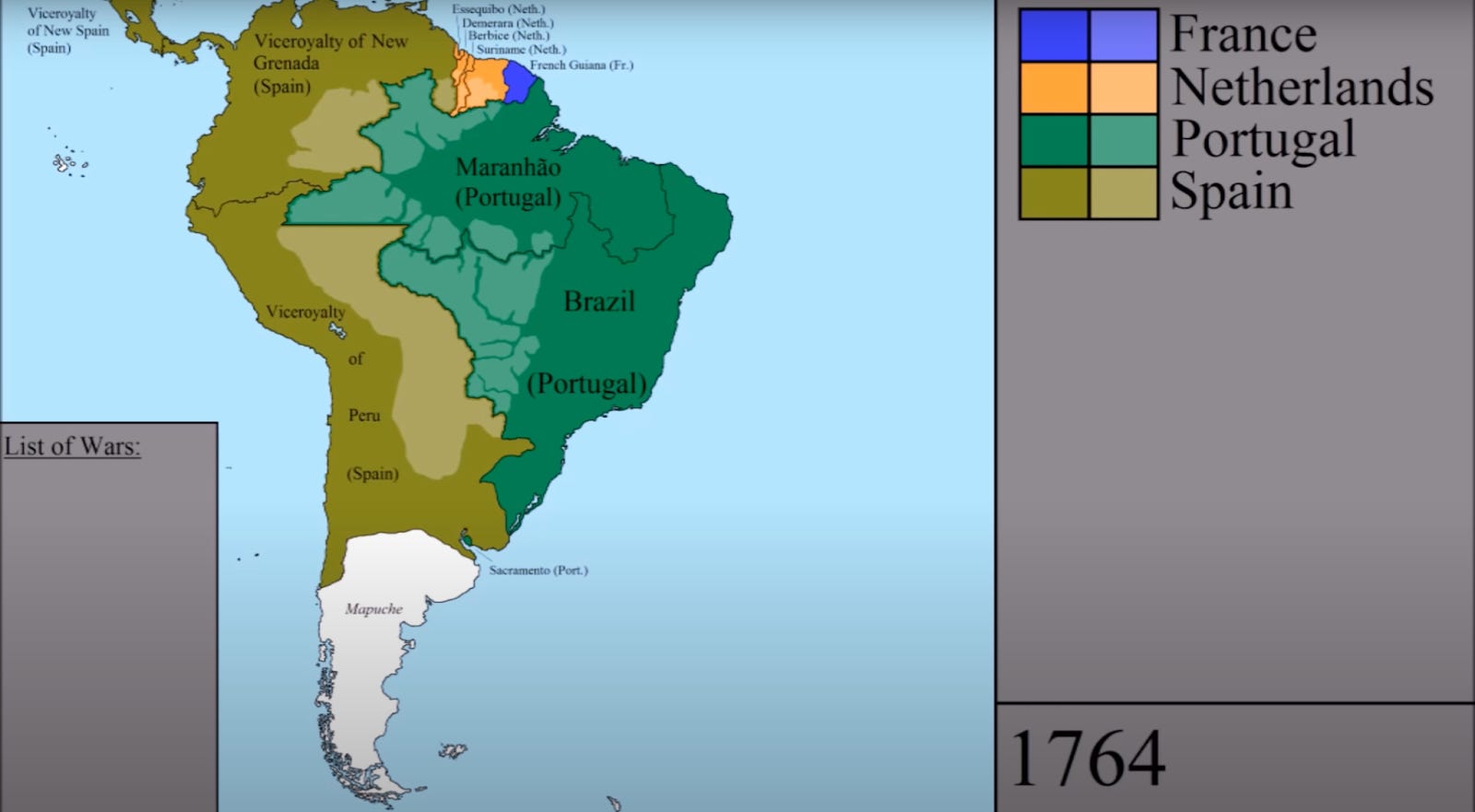
At that point, Portugal and Spain signed a treaty where Spain accepted Portugal’s encroachment in South America, while Portugal gave back Uruguay and accepted Spain’s ownership of the Philippines.
Why Did Brazil Remain United?
This brings us to the end of the 1700s. The Western world was boiling over the fire of a new idea, nationalism. This new idea, born out of the growth of the printing press, took hold in the US to spur its independence. It took France by storm, upending the monarchy and charming the souls of the French populace enough to embark on a Napoleonic march across Europe.
While Napoleonic forces were trampling on their neighbors, other European countries were quickly adopting nationalistic ideas to conscript their populace and fight back.
While Europeans were focused on the war theater (their continent), everything else was a defocus. That’s why Napoleon sold half the Louisiana Territories to the newly-minted US—doubling that country’s size—and why Haiti saw the first successful slave rebellion, which ended in its independence.
Napoleon invaded Portugal in 1807, helped by Spain. Overwhelmed, the Portuguese monarchy escaped to Brazil with other rich families and all the assets they could carry. Then, France turned on Spain and occupied it in 1808. The Spanish government remained in Spain, though, because the French didn’t have a strong foothold in the country. A six-year war of independence ensued.
At that point, the entire Portuguese government was in Brazil, in Rio. When Portugal was liberated, the king returned, but he left his son as king of Brazil. The son declared the independence of Brazil from Portugal in 1822, but at that point Brazil was stable, with a legitimate government. The monarchy continued until 1889.
So Brazil had a legitimate government and strong continuity of its institutions during the independence movement of the 1800s. Add to that the fact that Brazil’s economy was very concentrated in one region, its Atlantic coast and the São Paulo region, and you realize there was no separate region that could easily break away: Even if Brazil is big, the remote areas were didn’t have wealth or population, so it was hard for them to break away.
Meanwhile, during the French occupation of Spain, the Spanish colonies rebelled against Napoleon. Once the war ended, they wondered: Why would we keep financing Spain? Bleeding for it? Spain is weak now. We can easily declare our independence.
This is the time of leaders like Simón Bolívar, who dreamed of a united Spanish America, like Brazil or the US.
But there were two crucial differences, politics and geography.
When the US started its independence war, it had a strong intellectual movement. The 13 colonies were close to each other geographically, people were literate, they exchanged ideas, and settled on the enlightenment ideas to drive them through independence. Brazil didn’t have that, but it did have government continuity. Nobody wondered what the Brazilian government should be.
This was not true for Spanish colonies: They spent the last few years rebelling against Napoleon, and then against Spain. They achieved independence before they had agreed on a strong philosophy around it.
And geography didn’t help: While Brazil and the US were mostly concentrated in small coastal areas, Spanish Latin America was across an entire continent with several independent regions that barely communicated with each other.
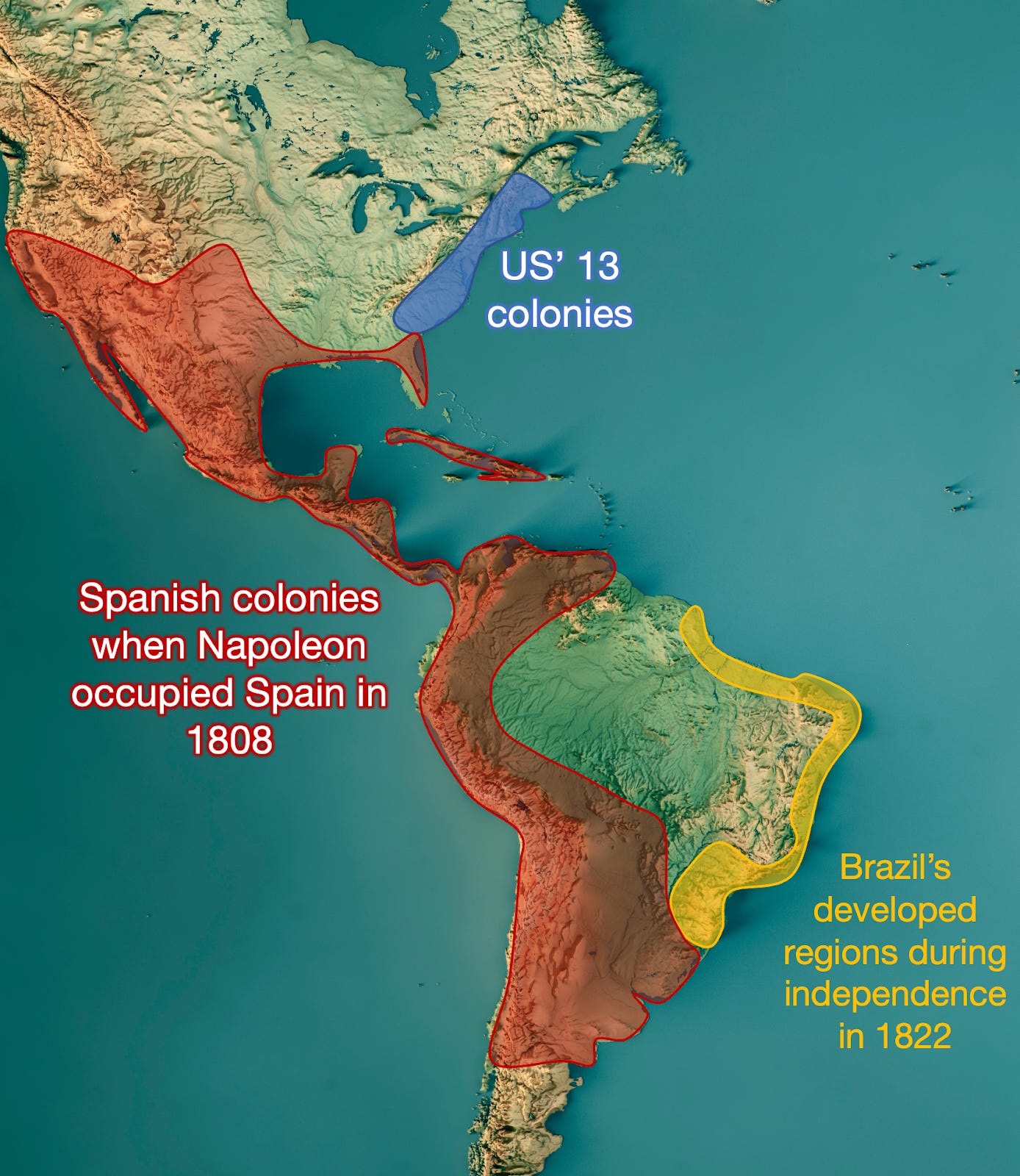
The US was united and compact. Brazil was mostly compact too. Spanish colonies, meanwhile, were spread across the entirety of America, with vastly different regions such as California, Mexico, Cuba, Colombia, the Andes, the Rio de la Plata basin… Each one of these areas had its own government, the Spanish viceroyalties. Naturally, when the time came to split from Spain, each tried to keep their power—and they initially succeeded. Then, they started fighting each other until the countries we know today were born.
So this is why Brazil remained united whereas Spanish countries split.
Why Is the Japanese Population So Big in Brazil?
Brazil’s Japanese population is the biggest in the world outside of Japan [1] . How did that happen? It’s linked to slavery.
Plantations, as we saw, need a lot of work, so plantation owners used slaves to lower costs. In some cases, natives were used too, to lower costs. But there were only so many accessible natives, and slavery was abolished in 1888.
The Brazilian government then pushed for Europeans to immigrate—especially Italians—because the elites wanted to “whiten” the country, but there were only so many Europeans, who also had other options, and European governments started disincentivizing immigration to Brazil because of the poor working conditions there.
At that point in the early 1900s, Brazil had a hard time attracting immigrants. But Japan had a hard time finding destinations for its emigrants.
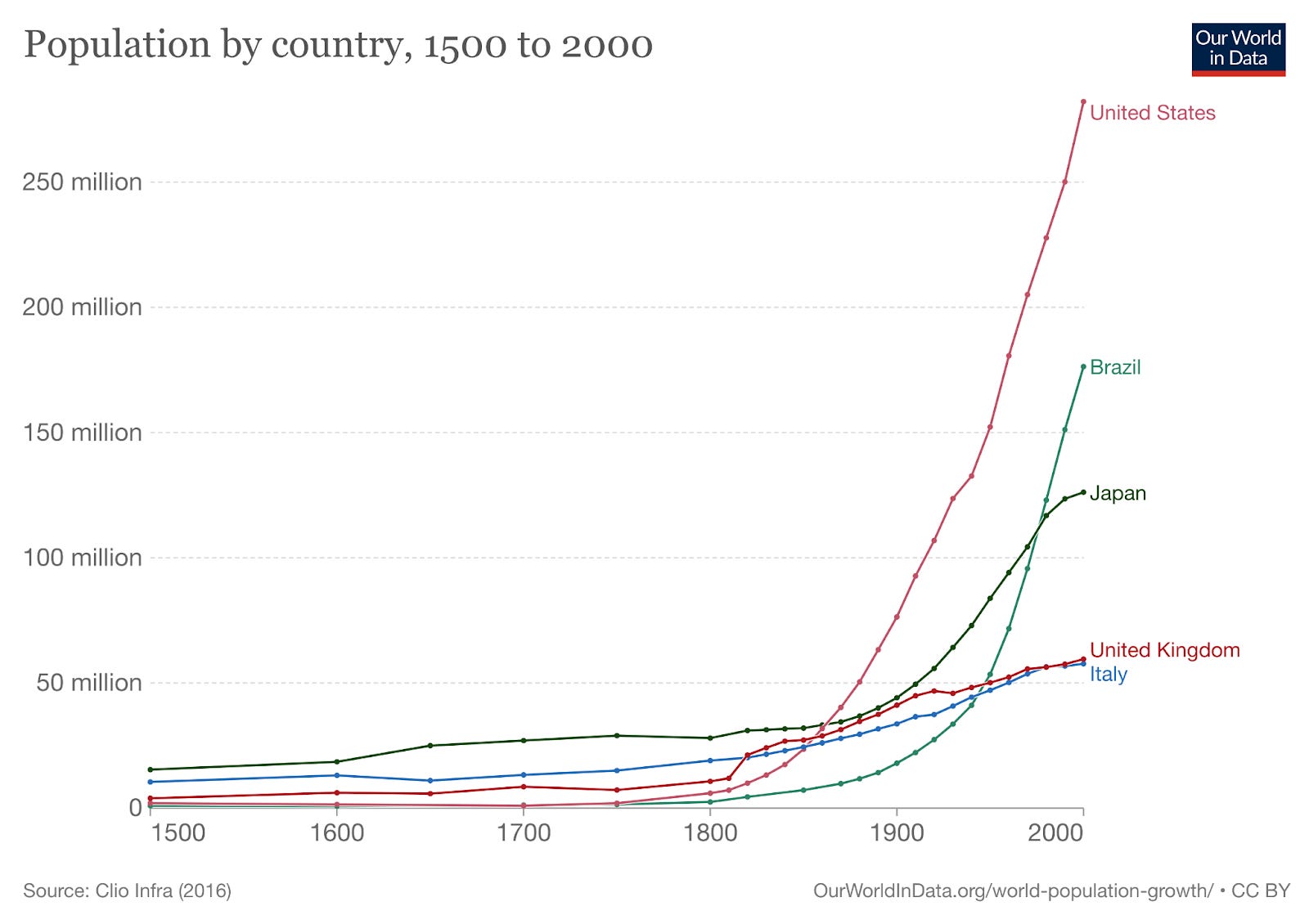
In the mid-1800s, Japan started industrializing heavily. This brought a huge increase in population, but conditions were not great. This was the time when many Japanese emigrated to the US.
But the US started thwarting Japanese immigration, first with the Gentlemen’s Agreement in 1907, and later with the Immigration Act of 1924. Japanese emigrants needed a new land of opportunity open to them. That land was Brazil.
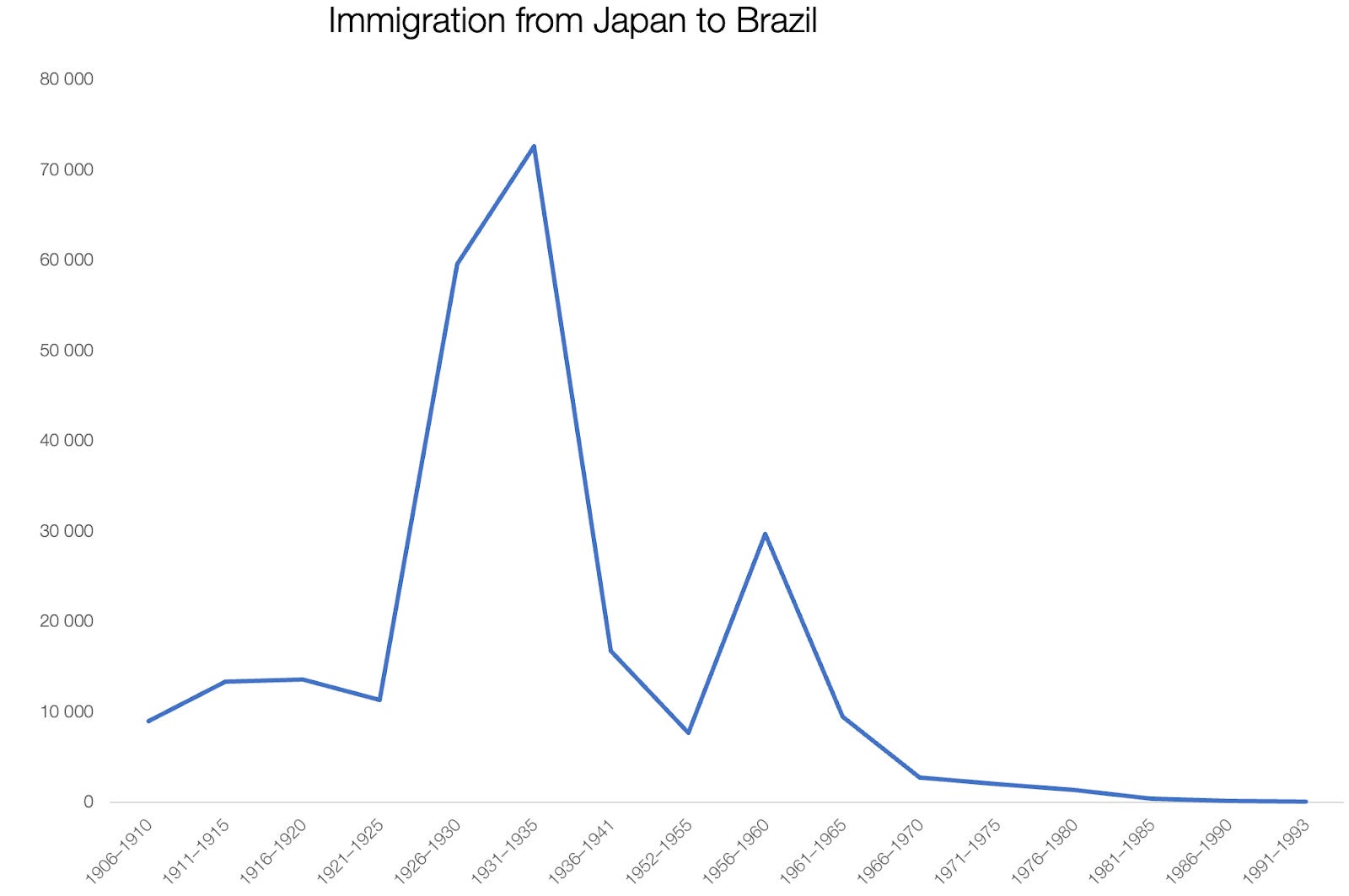
A total of nearly 250,000 Japanese emigrated to Brazil. Today, they have 1.5M descendants.
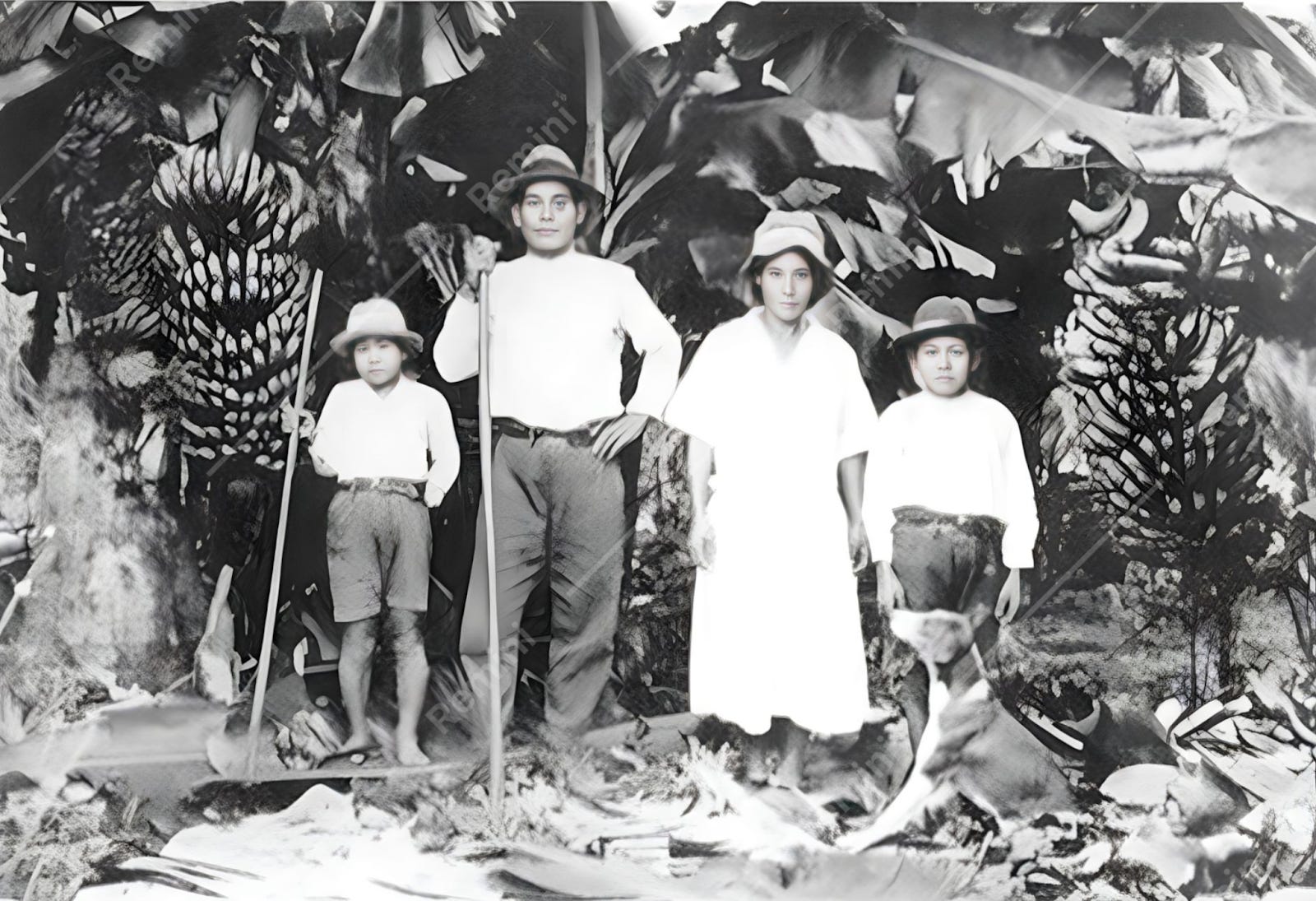
These immigrants went mainly to the São Paulo region. Many were indentured servants and wanted to leave after suffering the terrible working conditions and poor treatment, but plantation owners did everything they could to avoid it, and they didn’t have the money for the trip back to Japan.
As a result, many of them had to make a living in Brazil. Many saved enough to establish their own businesses or buy small farms.
Between the terrible conditions, the racism of Brazilians at the time, and the cultural clash, many Japanese communities remained closed. They built their own schools, published their own newspapers, had their own radio stations. Most of those in the first generation never learned Portuguese.
Over the generations, Japanese descendants integrated more and more. They learned Portuguese and started mixing more with Brazilians from other races.
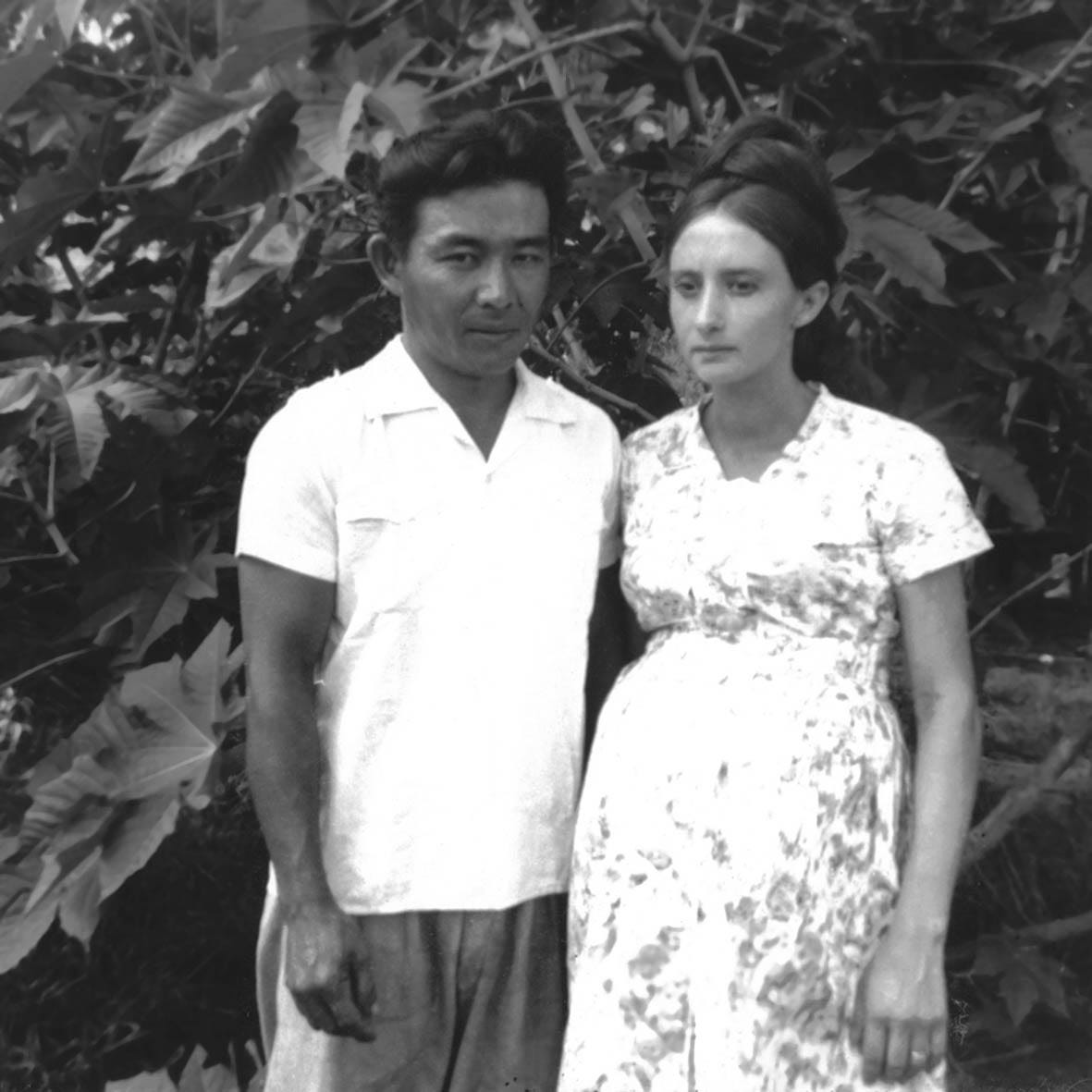

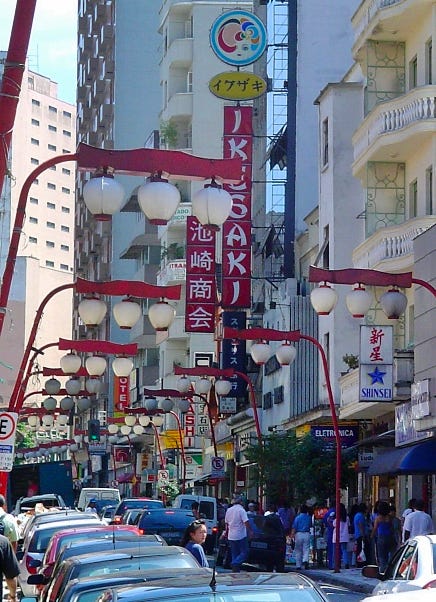
Today, the community is part of Brazil’s culture. Nearly half live in São Paulo.
In other words, the history of the Japanese community in Brazil is similar to that of the US: Both countries were huge and needed a massive amount of immigration just as many Japanese needed somewhere to emigrate to, slavery was abolished, and competition for European immigrants was high. Brazil’s population is smaller than that of the US overall, but it has a similar number of Japanese descendants simply because the US was more racist earlier than Brazil, and banned immigration in a way that Brazil didn’t.
What Can Brazil Do to Escape the Middle Income Trap?
Brazil should keep on its current path of “terraforming” the Brazilian Shield. It’s the only sure way for it to keep improving the lives of Brazilians.
But if it wants to go above and beyond, there’s only one viable approach for Brazil to overcome its geography: It must accept that its geography will always be an obstacle, and work around that.
For example, as the world becomes richer, people want to travel more. Brazil is famous for its beaches, which could attract tourists and their money. But Brazil is also known for its violence. Reducing violence might help increase tourism.
That said, violence is very correlated with inequality.
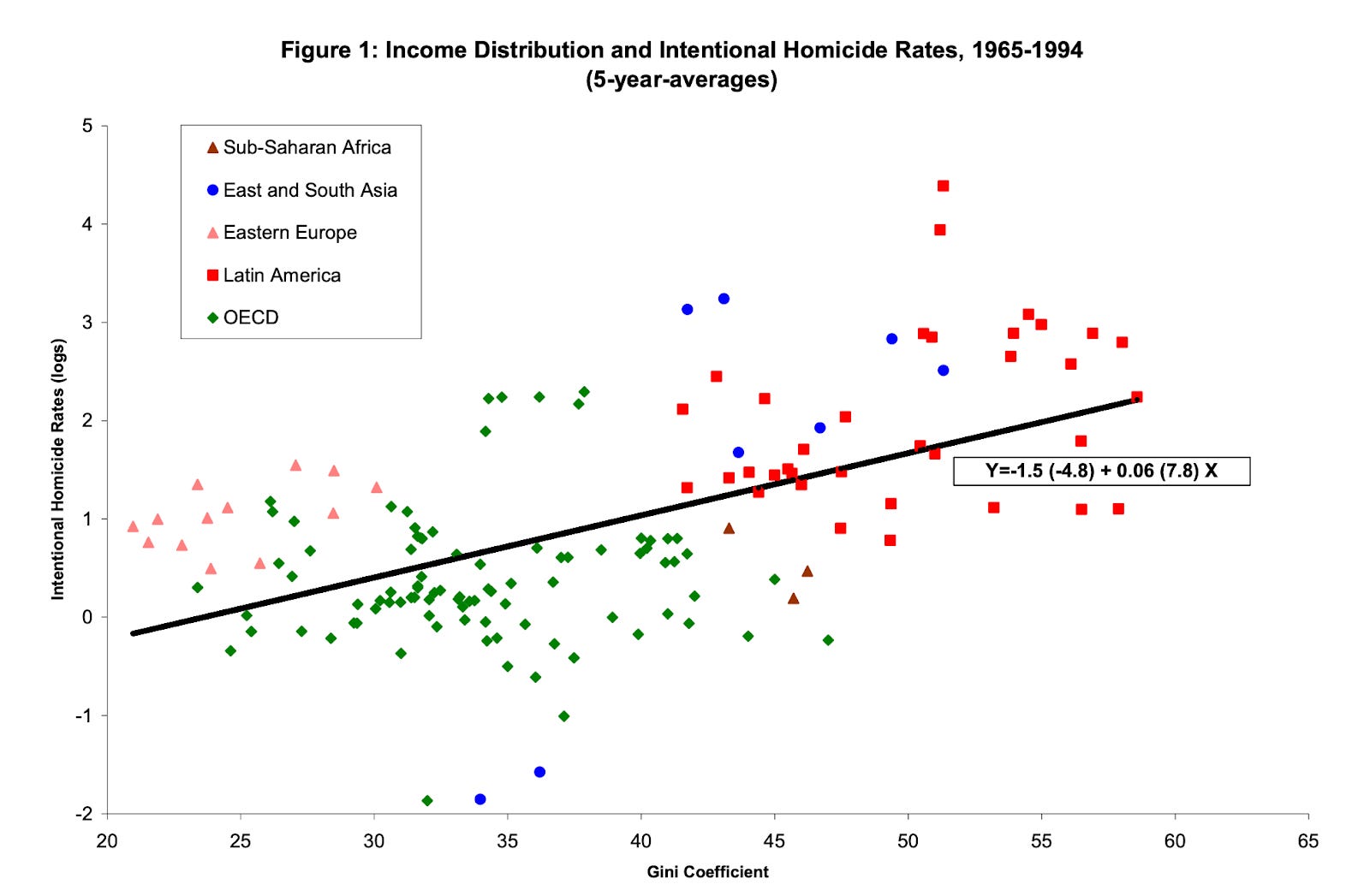
So it might be hard for Brazil to increase tourism without decreasing inequality—which brings us back to the previous point.
There might be alternatives. For example, tourism in the Amazon Rainforest could bring an alternative source of income to the region. But its sheer size would require lots of tourists to make up for the loss in agriculture: The value of agriculture is proportional to the surface area, but the tourism is not.
So alternatives like industry or tourism will be hard. We always go back to geography issues. Maybe Brazil should bet on the only part of the economy that doesn’t care where you live—the Internet.
As remote work becomes commonplace, more people can produce online from anywhere. Brazil’s education is improving, and it is broadly located in the same timezone as the richer US and Canada, so it could benefit from the relocation of tech jobs to Brazil: Both locals working in the industry, and foreigners moving to Brazil. This would add to Brazil’s already very active tech scene.

In other words: Brazil should make a big push in education, while changing the laws to make remote technology work extremely easy. It should approve laws for digital nomads, and for digital companies to be excited about moving to Brazil, or to recruit Brazilians.
This has a good and a bad side: The good side is that Brazil would lose its disadvantage against other countries in this battle. The bad side is that it doesn’t gain any big advantage—except maybe being in a similar time zone as the rest of America, the beaches, the friendly people, and learning to better enjoy life.
Summary: Can Brazil Become a Superpower?
To answer this question, we should summarize everything we’ve learned about the country:
It’s huge, with some radically different regions.
The Amazon is mostly worthless for economic might.
The Brazilian Shield is very hard to manage. It will still take decades to fully develop it.
Most of its cities are coastal, independent from each other, without a strong hinterland to develop, and so they behave much like city-states.
Its southern region is more economically connected to the Rio de la Plata region than to the rest of Brazil.
Argentina has by far the best real estate in the region, so it will always remain a regional power that checks Brazil.
Brazil is condemned to high costs of capital and low margins.
Its economy depends dramatically on crops and mining, which means it’s denominated in dollars and depends on the vagaries of international markets.
In this situation, without capital, with high costs, and without a skilled population, it will be hard for it to develop a local, internationally competitive industry.
For Brazil to become a superpower, it would first need to become economically strong and independent. This, as we saw, is going to be very hard.
Another way to achieve this is by becoming a military power. But here, again, it will be hard for Brazil. It shares the Atlantic with the US and Europe, which makes oceanic might difficult. It has to its south a neighbor that is well positioned to become a naval power. And Brazil can hardly become a naval power itself: It lacks the capital, the deep ports, and a strong, united sea economy. Instead of building up its navy, it’s abandoning its biggest ship, the São Paulo aircraft carrier.

Another way to become a superpower is to become a strong regional political power. This might be possible: Its influence on Uruguay and Paraguay only increases, and if Argentina doesn’t wake up, Brazil might keep tipping the balance of power in the Rio de la Plata region towards itself.
This begs a new question: Is Brazil’s regional power linked to Argentina’s weakness? What would happen if Argentina woke up? Could it? I’m planning on writing an article on Argentina to look into this.
In the meantime, we can safely say that it will be really hard for Brazil to become a world power any time soon, except through perseverance against a hostile environment for decades.
That’s it for Brazil. I hope you enjoyed these two articles! Let me know what you think in the comments. I read them all, and respond to most. And feel free to share them with people you think will enjoy them!
Just bigger than the US one.