21 Suprising Facts About Climate Change - by Tomas Pueyo 24 Surprising Facts About Climate Change
Some content could not be imported from the original document. View content ↗
2023年7月7日
∙ Paid
I remember vividly the first time I worried about our environment. I was 7 years old, and my teacher showed a video of the Amazon forest burning. I was shaken, scared about the future. Later, I started forcing my family to separate paper from the rest of the trash. I came of age with Kevin Costner’s apocalyptic Waterworld and Al Gore’s An Inconvenient Truth. I used to look for cities that would benefit from global warming, in case I needed to resettle.
As I got older, I read summaries of the IPCC dossiers [1] . I became frustrated at climate change deniers, who were not just trying to fool us all, but also themselves. I could not comprehend the stupidity and selfishness of denying fundamental facts: Yes, climate change is real. Yes, it’s warming up the world. Yes, it’s man-made. Yes, it’s going to create catastrophic consequences to some humans and their livelihoods.
This was broadly my mindset when I started looking into the environment for my articles, about three years ago. With more information, my perspective has shifted. It is more nuanced and not as one-sided, as you saw in the article earlier this week.
Here are 24 of the most surprising facts I have come across while studying global warming. Together, they have done more to change my stance on the topic than anything else I’ve read.
If you have more, share them with me! And if you think I’m missing some crucial perspective, please also share it with me! I’m not here to hand you the truth, but to discover it together.
1. Temperatures really have been increasing quickly over the last few decades
Some content could not be imported from the original document. View content ↗
Here’s another visualization:

Global monthly temperature between 1851 and 2020 compared to average for 1850-1900. This uses the latest version of HadCRUT5 showing many recent months more than 1.5°C above pre-industrial values.
#dataviz #globalwarming #climatechange

And another:

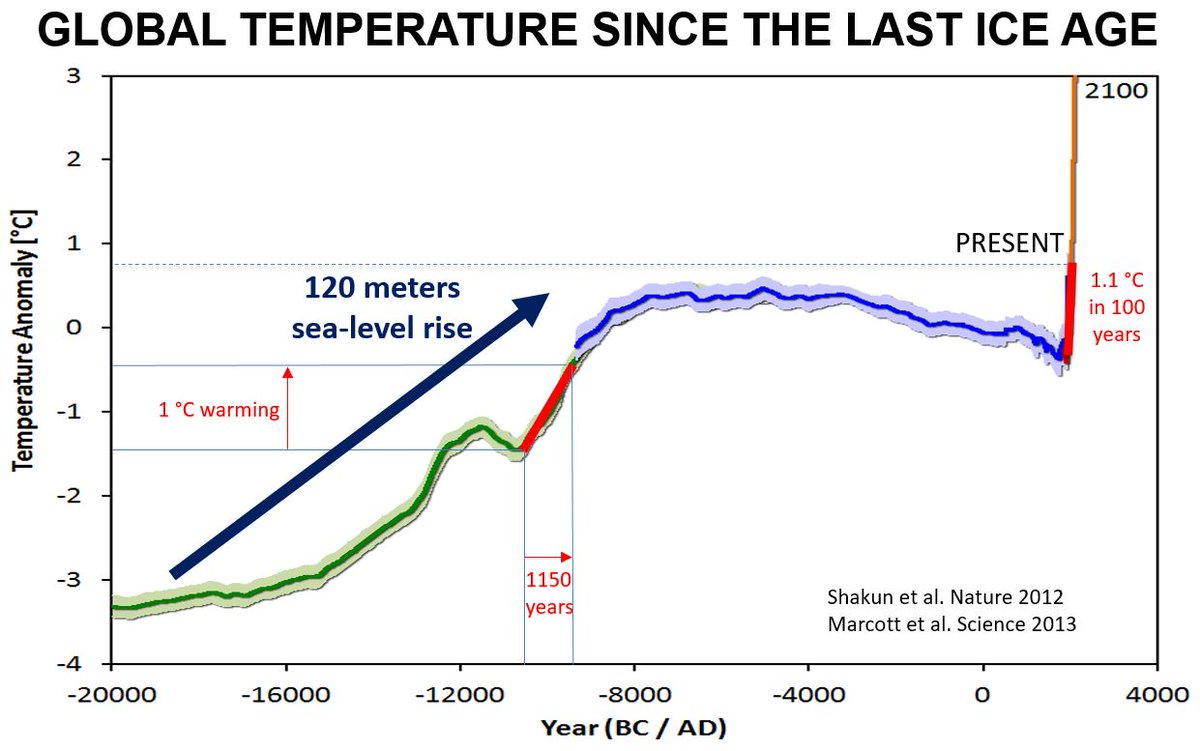
Modern global warming has been ~10x faster than any warming and temperature is now higher than any time in at least the past 20,000 years. Without us, very slow orbital cooling (23,000-year precession cycle) would have continued. More on these data: realclimate.org/index.php/arch…
And another:
We use 30 year averages to show climatology (average weather conditions). During the 20th century the UK climatology followed a path round a confined box. With #globalwarming and #climatechange they have escaped out the box. This #dataviz shows UK rainfall and temperature.
And another:

Animated chart shows 2000 years of global temperatures in twenty seconds. Source: buff.ly/2EhDTmv
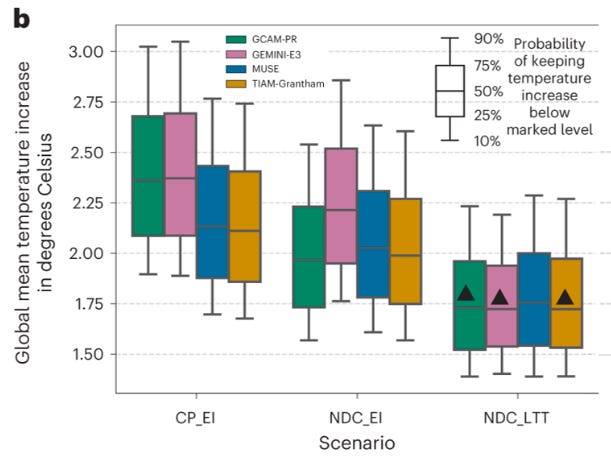
2. Our best guess at temperatures in 2100 is around 2.3ºC above pre-industrial levels
With a range of 1.9-2.7ºC:
To spell it out, this is not much in the scale of the Earth.
It also seems unlikely to cause a huge sea level increase.
3. Land temperatures increase faster than sea temperatures

So why do we see such crazy heat extremes after “only” 1.3 degrees C #GlobalWarming? A short 🧵.
1. Land areas have warmed much more than ocean, and the global average temperature consists of 70% ocean surface. Check out your country here: berkeleyearth.org

Because water can contain more energy than air, adding the same amount of energy to both will increase the temperature of water less. Also the sea mixes more than soil, so heat can be redistributed below the surface.
4. Sea levels were much lower just 10,000 years ago
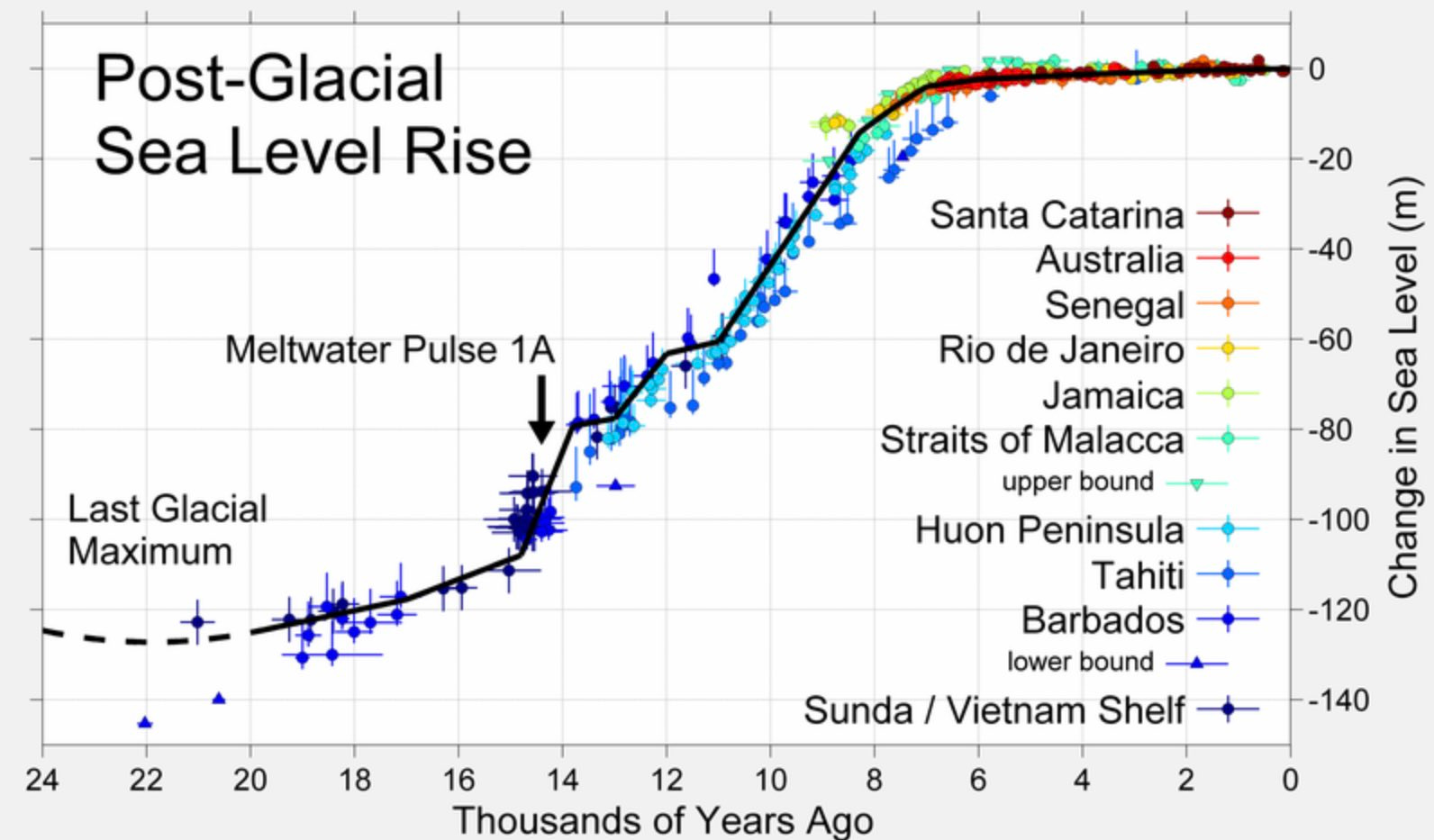
I already shared this one, but it’s important to really grasp it: Hundreds of thousands of years after we appeared on Earth, and just before the time when human culture exploded on Earth, sea levels were vastly lower.
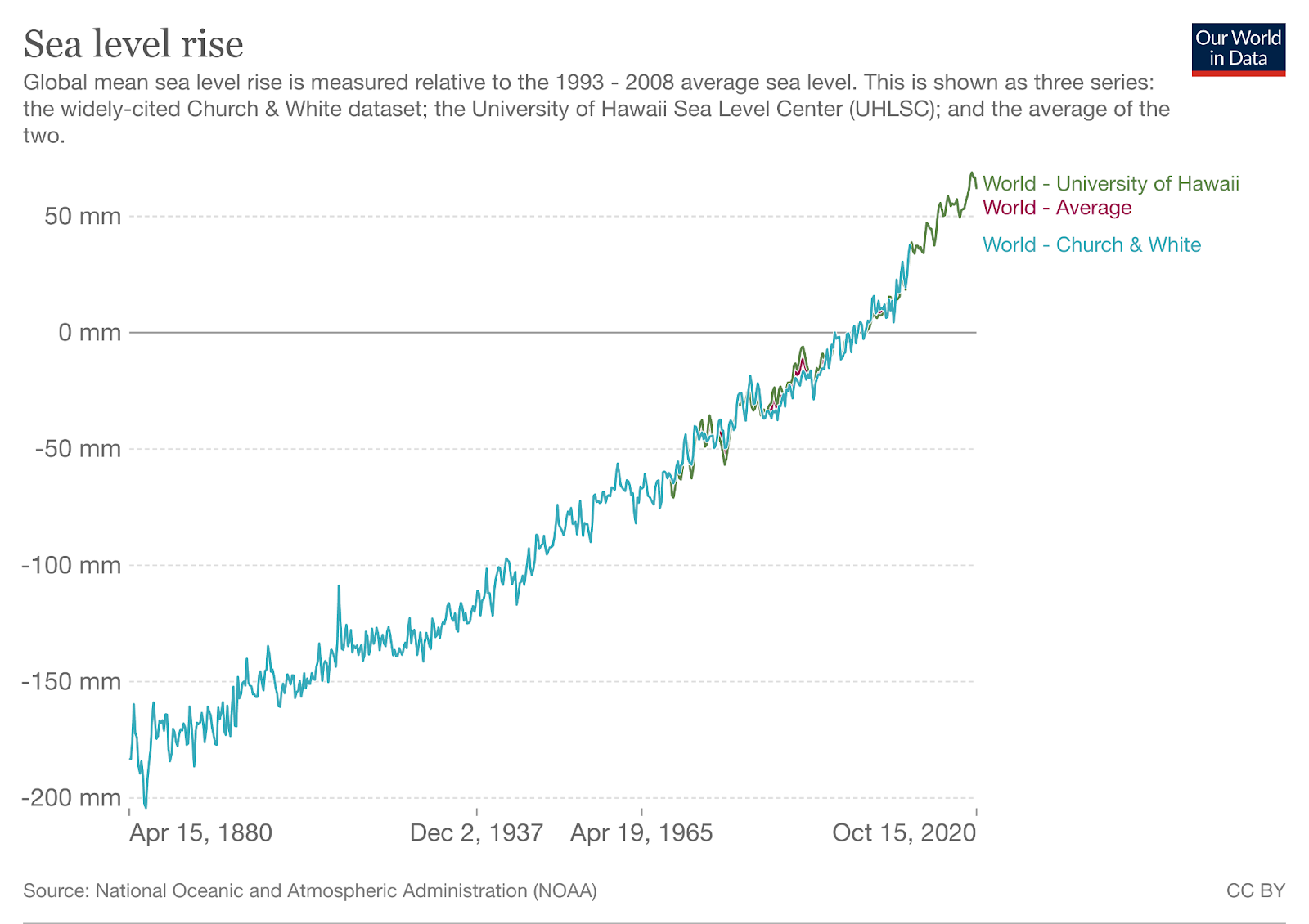
5. But sea levels are now rising quite quickly
About 1-2 meters or so in the last 150 years.
6. Sea levels might go up about 0.5-1m higher
This is what the IPCC has to say on the topic:
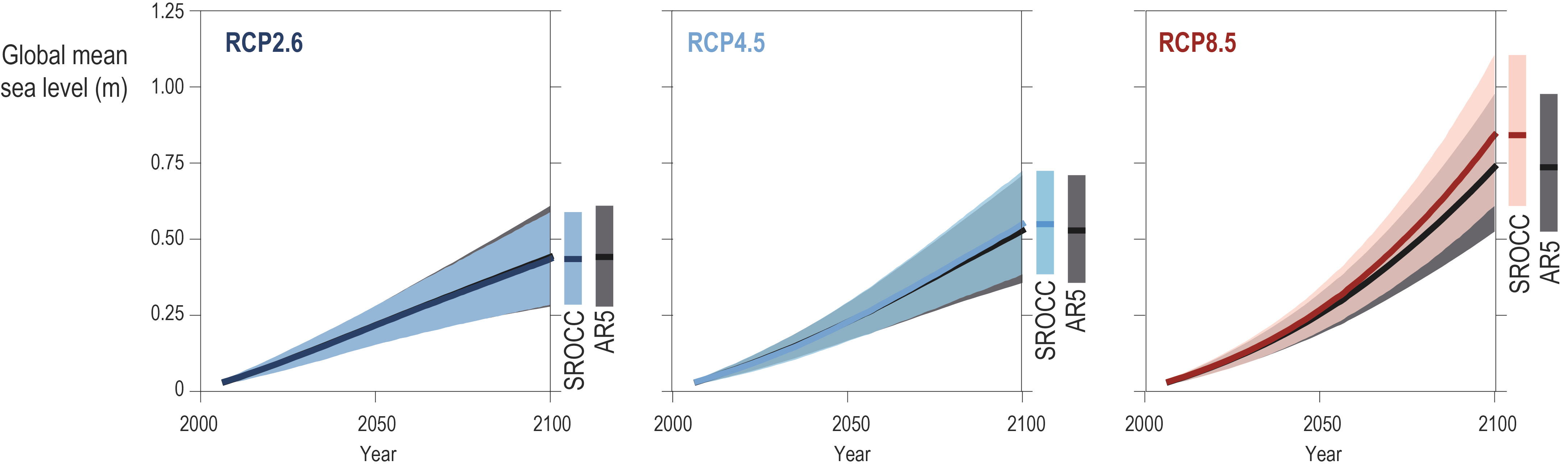
Since sea levels have risen by ~1.5 m already, and the next 80 years will only see a smaller increase of 0.5-1 m, I think we’re pretty safe from catastrophic events involving seas engulfing huge swaths of human habitats.
The Dutch have been gaining land from the sea with their engineering. It doesn’t look like an additional 1 m is something we can’t engineer our way around.
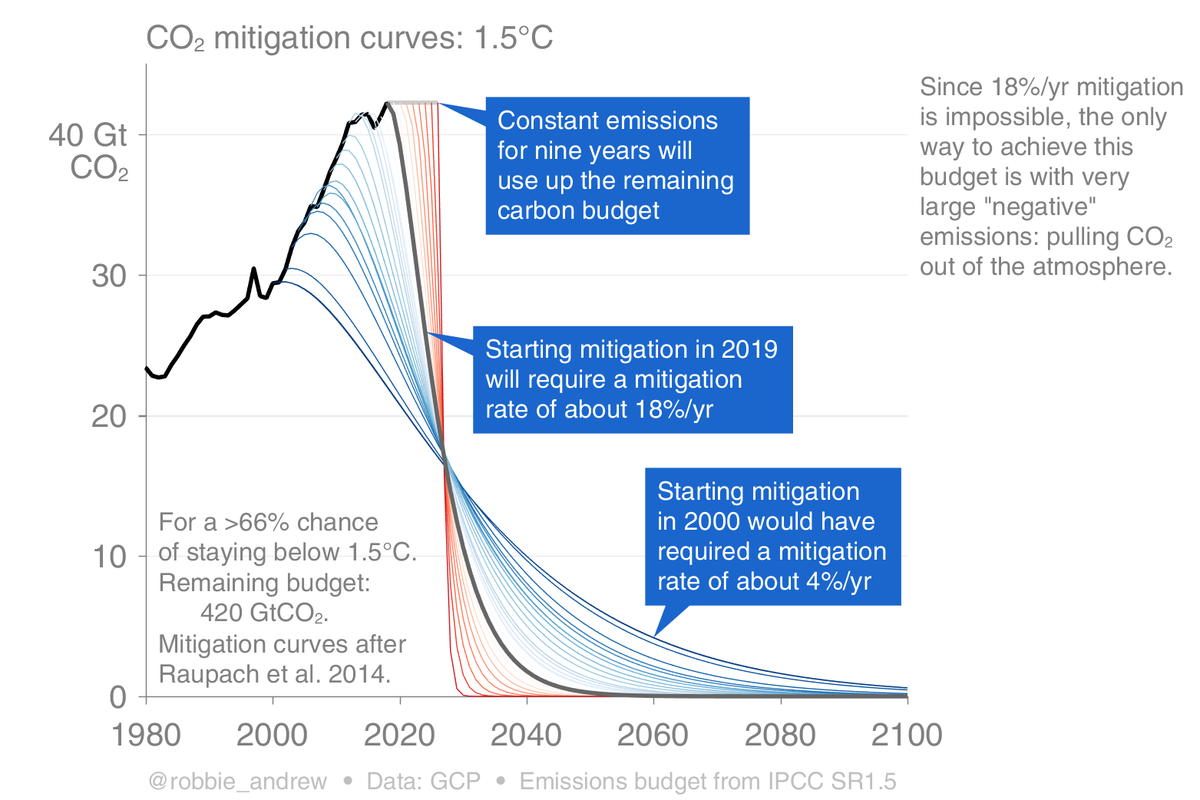
7. Every year we wait, it gets harder to limit temperature increases to 2ºC
See how easily we could have solved the climate crisis if we had started in 2000! Only 4% reduction per year. Now we need 18% per year. You can thank climate deniers, lobby groups and cowardly politicians for this delay. From Global Carbon Project, folk.uio.no/roberan/GCB201…
8. The idea of the individual carbon footprint comes from a Big Oil company

Reminder for whenever you hear the term “personal carbon footprint”

Of course, this puts the weight of fighting global warming on each of us, causing guilt, and reducing pressure on those who can actually act on it at scale—companies and governments.
9. Polar bear numbers are likely increasing
This is not data that’s easy to find, because it’s super inconvenient for many environmental organizations that have based their campaigns on showing poor endangered polar bears at the brink of extinction, but this is what I learned.
Polar bear numbers were very low a few decades ago because of hunting. Now that this has stopped, their numbers have increased accordingly. The best estimate I can find suggests numbers have gone from 22k-27k in 1997 to 22k-31k now. There are few estimates for the 1950s-70s, but the best estimates range from 5k to 20k.
The concern is that polar bear habitat is shrinking because ice caps are shrinking. With a smaller habitat, eventually their numbers might start decreasing again.
It looks like ice caps are shrinking and this is indeed bad for polar bears. But some research suggests that when ice caps shrink, polar bears adapt and even interbreed with brown bears.
This is fraught with debate, so I’ll wait for a meta-analysis to come out. However, since global changes take decades, polar bears seem resilient, and their numbers right now are likely increasing, I will strike this from my list of urgent concerns for now.
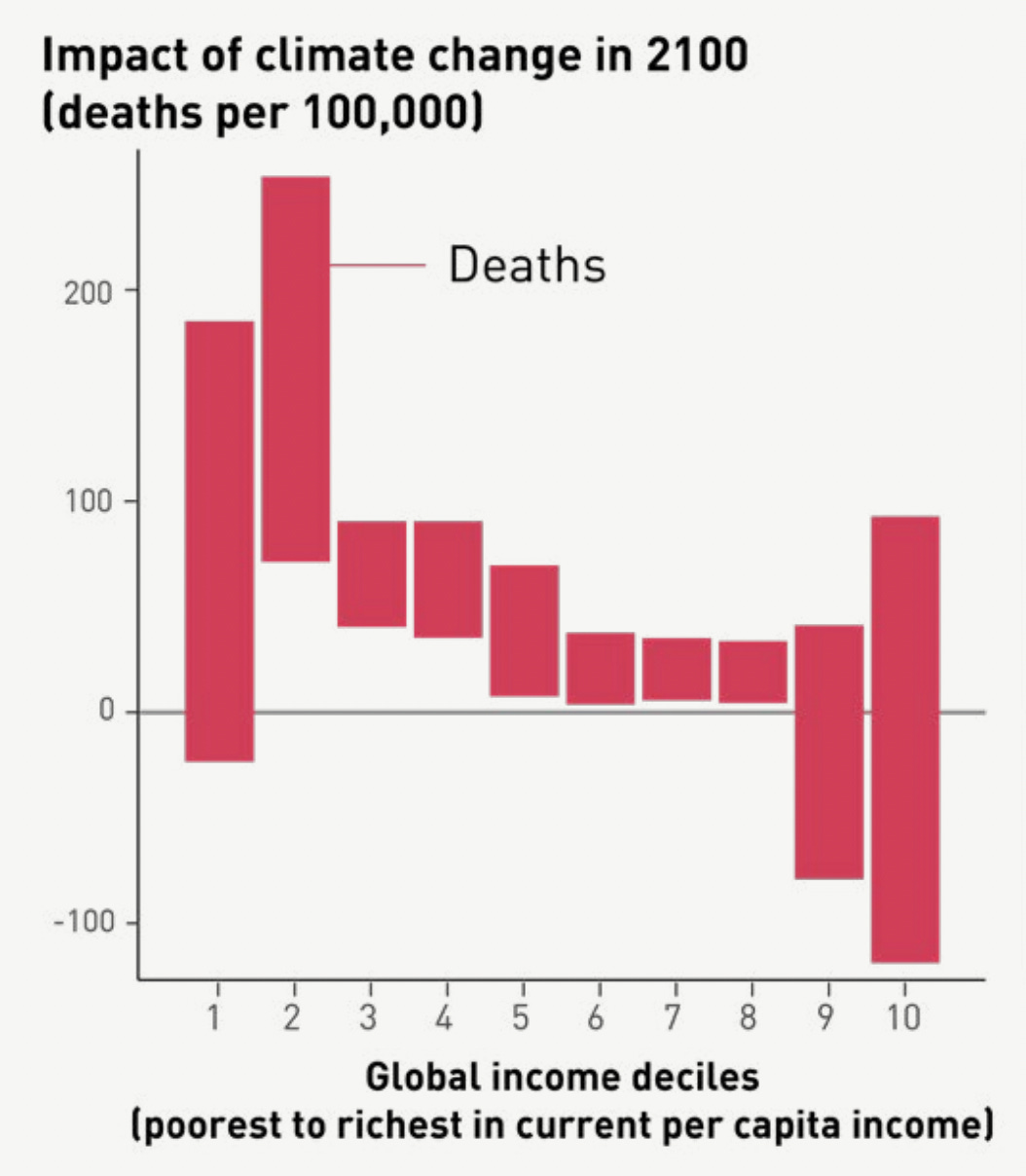
10. Global warming will impact poor countries the most
Most of the deaths will be in the poorest countries. Rich countries will in fact have fewer deaths.
The map below shows changes in mortality. Red means more deaths, blue means fewer deaths.
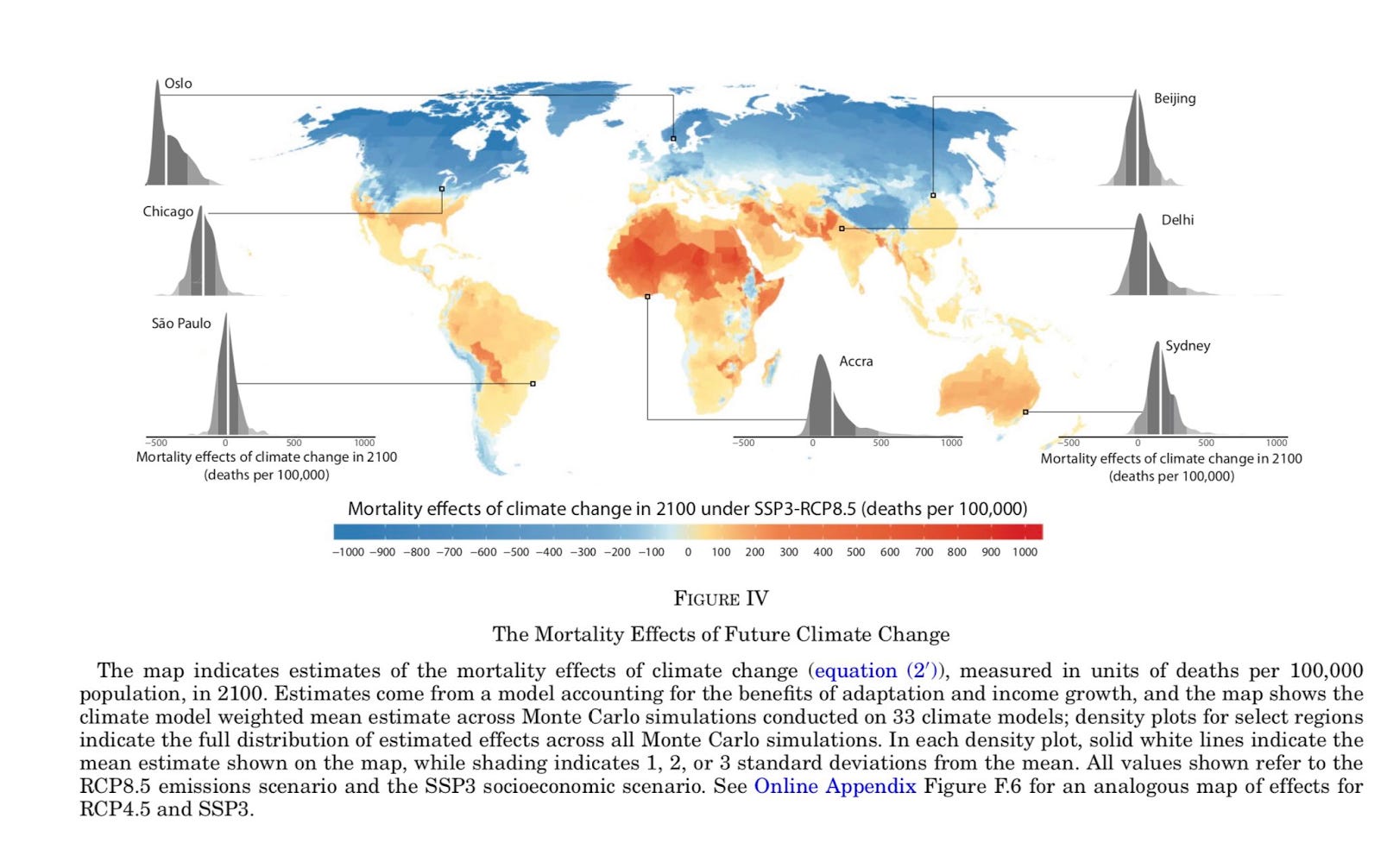
The hardest-hit region is the Sahara, which, thankfully, has one of the lowest population densities of any land. Still, Africa gets the worst of it. Mortality in northern countries might actually improve since climates will be milder.
11. Some countries win with global warming
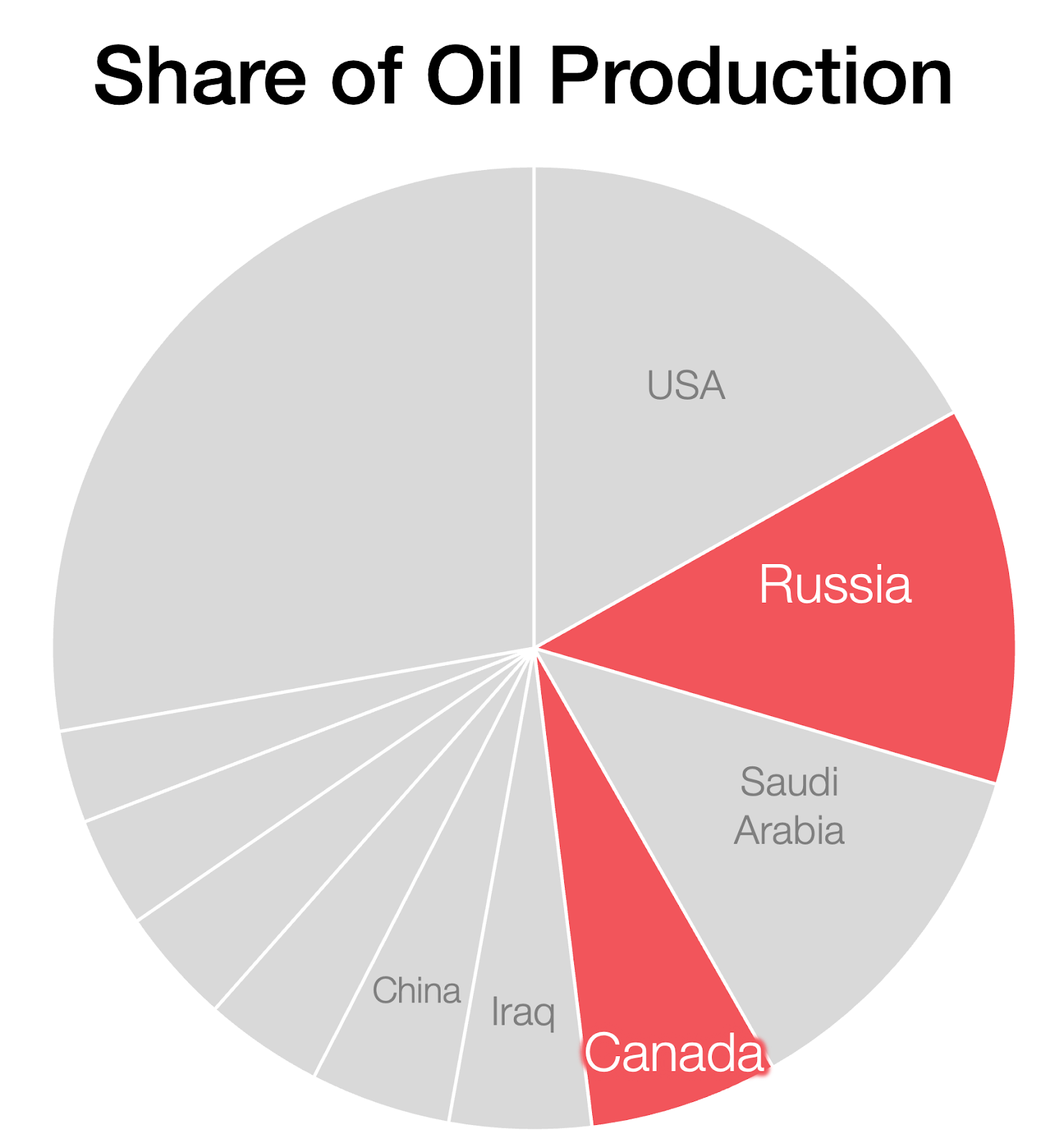
A corollary of poor countries suffering due to global warming is that Russia and Canada are two of the richer countries that have the most to gain from global warming. As we saw earlier this week:
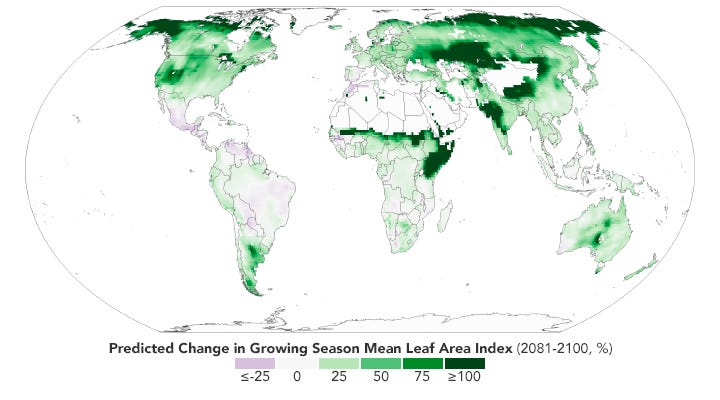
Coincidentally (?), they are also two of the countries that export the most fossil fuels.
12. China now emits more CO2 than any other country
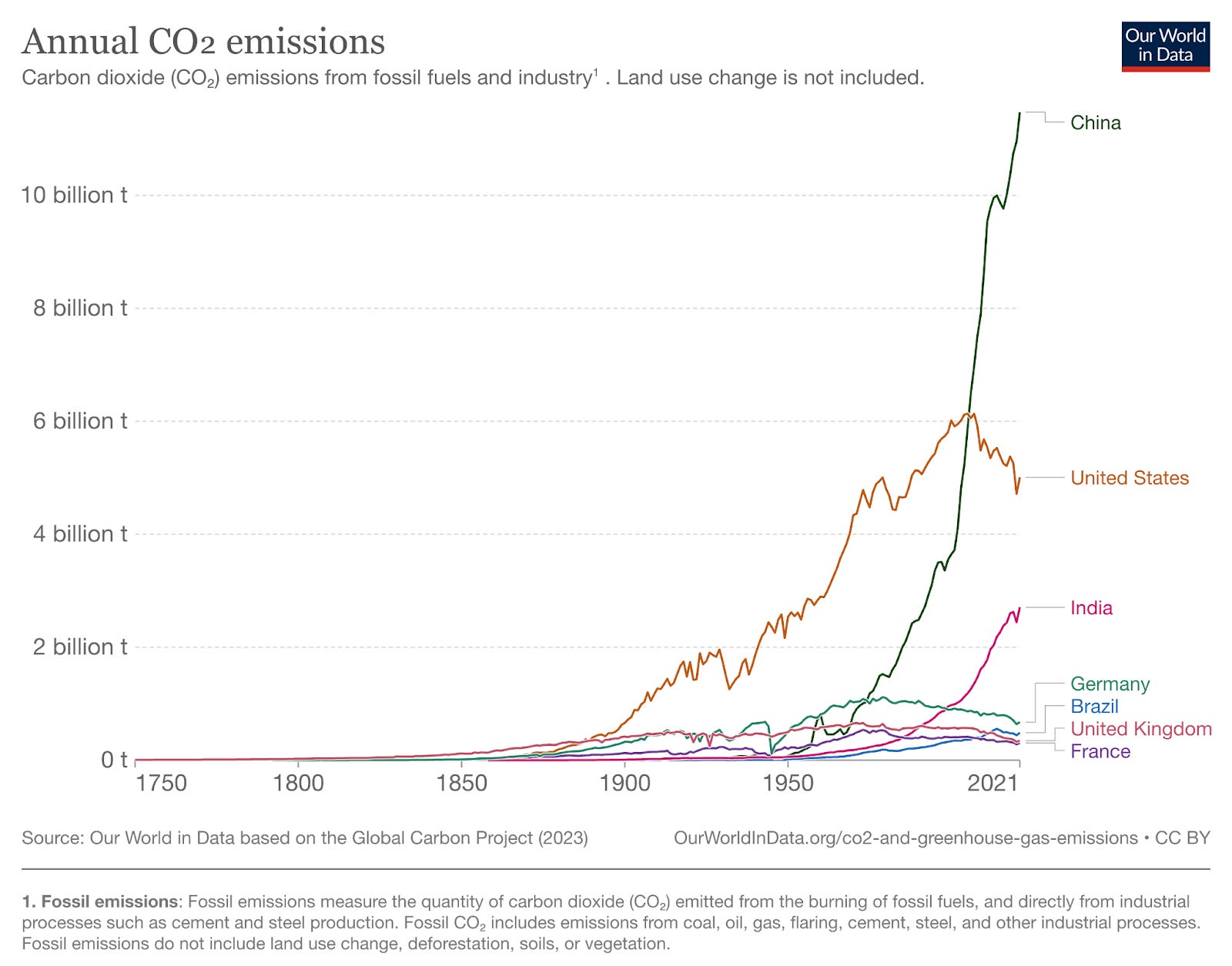
And that number keeps going up pretty dramatically. So much so that…
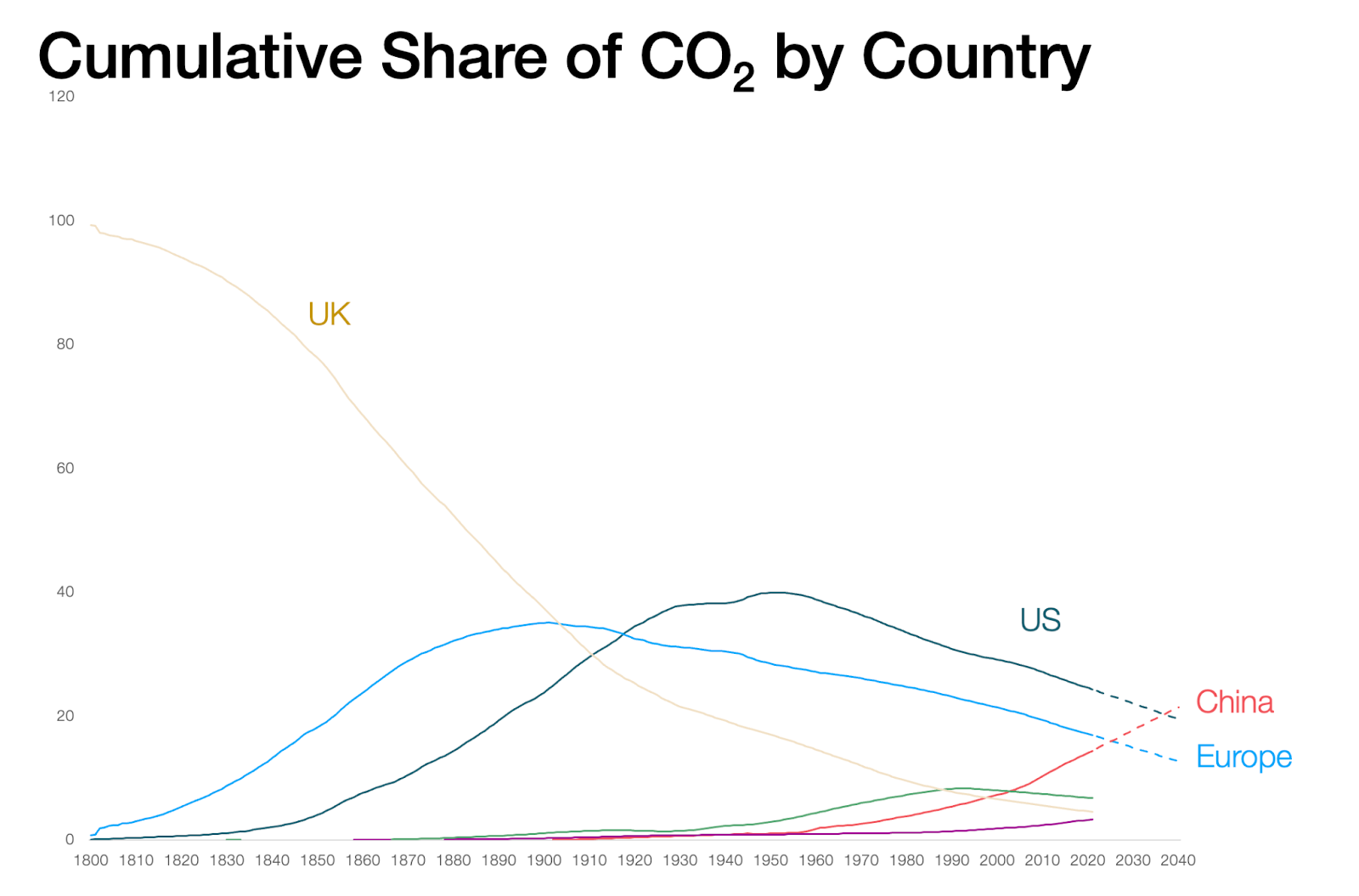
13. Soon, China will have emitted cumulatively more CO2 than Europe and the US
If things continue as they are, China will pass Europe in cumulative CO2 emitted in about 3 years, and the US in about 15 years.
But surely that’s because China has so many people right?
14. China emits more CO2 per capita than the European Union
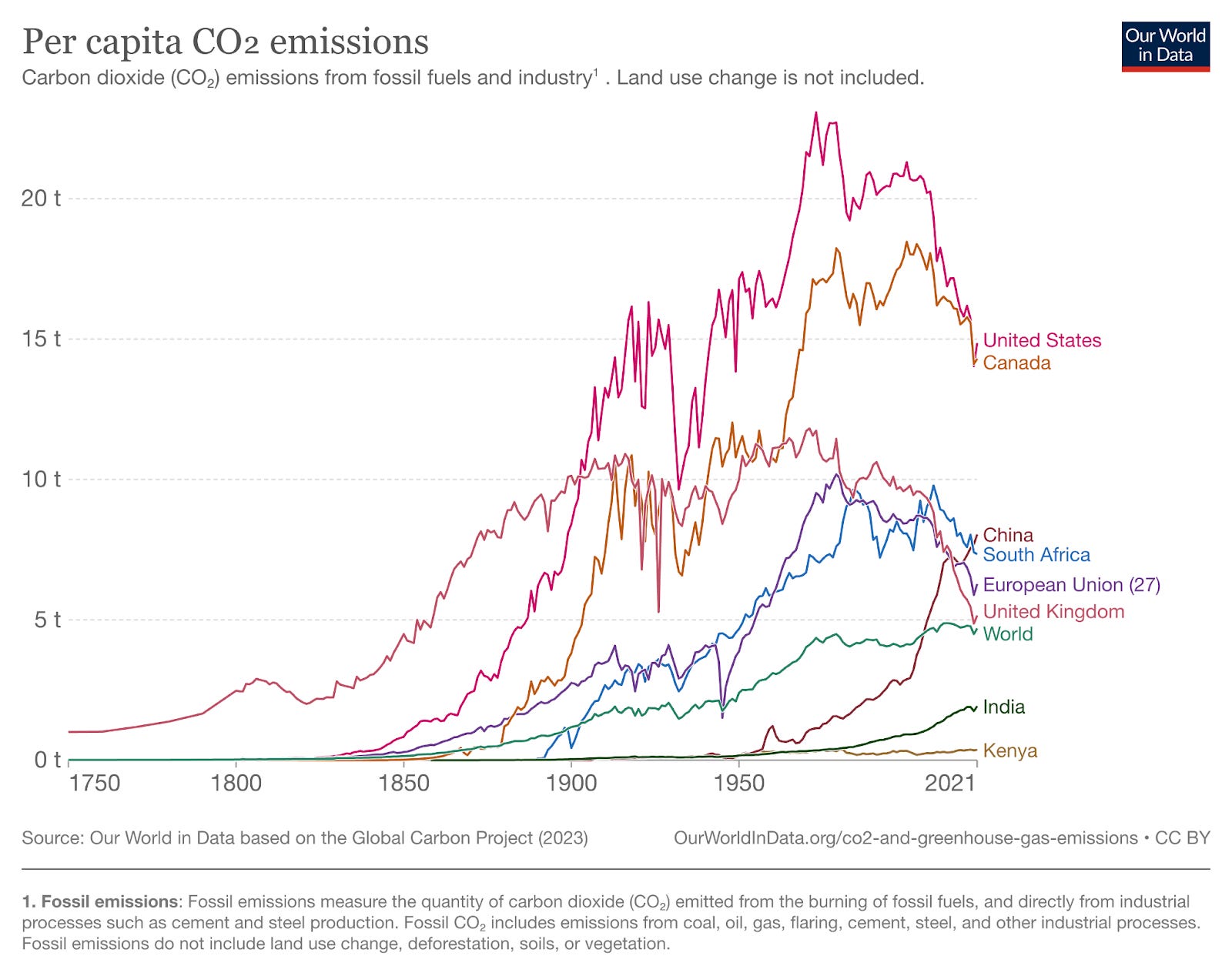
You could argue that maybe that’s because China produces all these goods that emit CO2, but then is shipped to the West where it’s consumed, right?
15. CO2 embedded in trade is usually relatively low
Here are three examples, including one of the most aggressive outsourcers of CO2, Sweden:
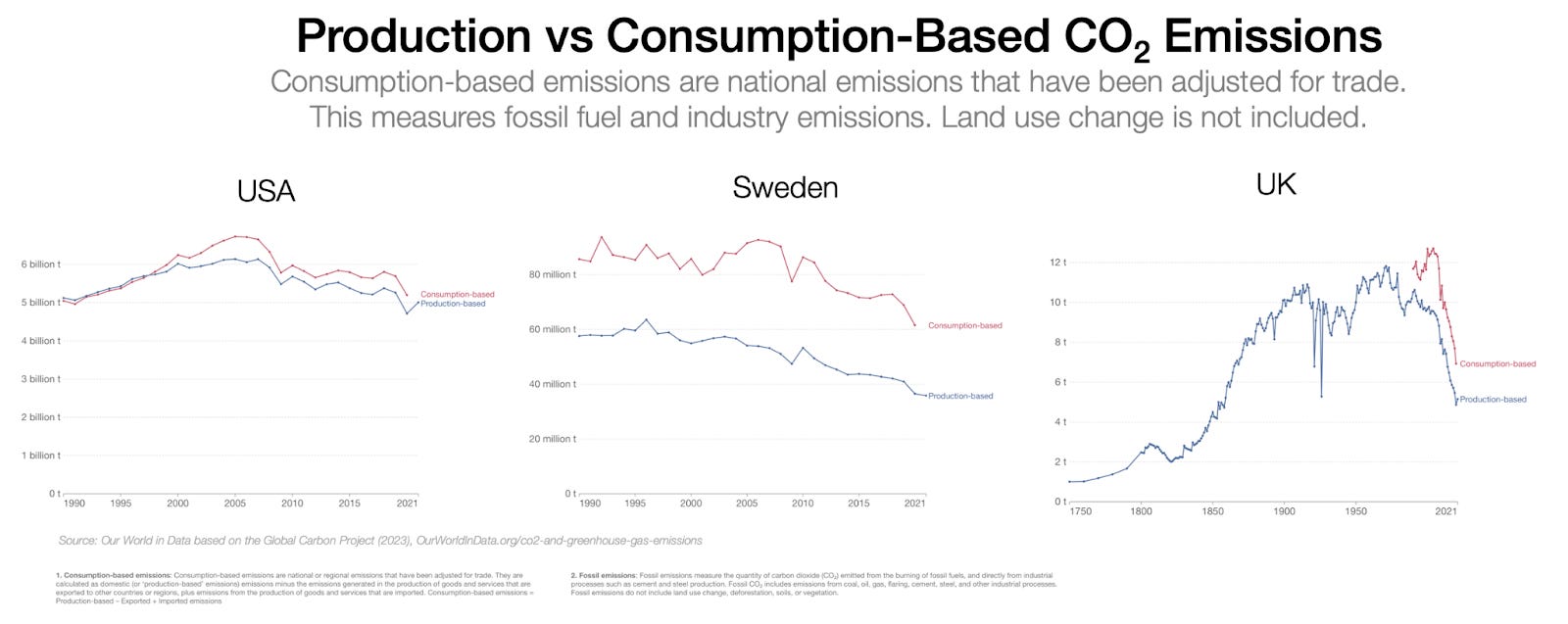
There are countries that outsource [2] most of their CO2, like Sweden or the UK. But for most industrialized countries, including France, Spain, or the US, accounting for trade only increases emissions by 10%-20%.
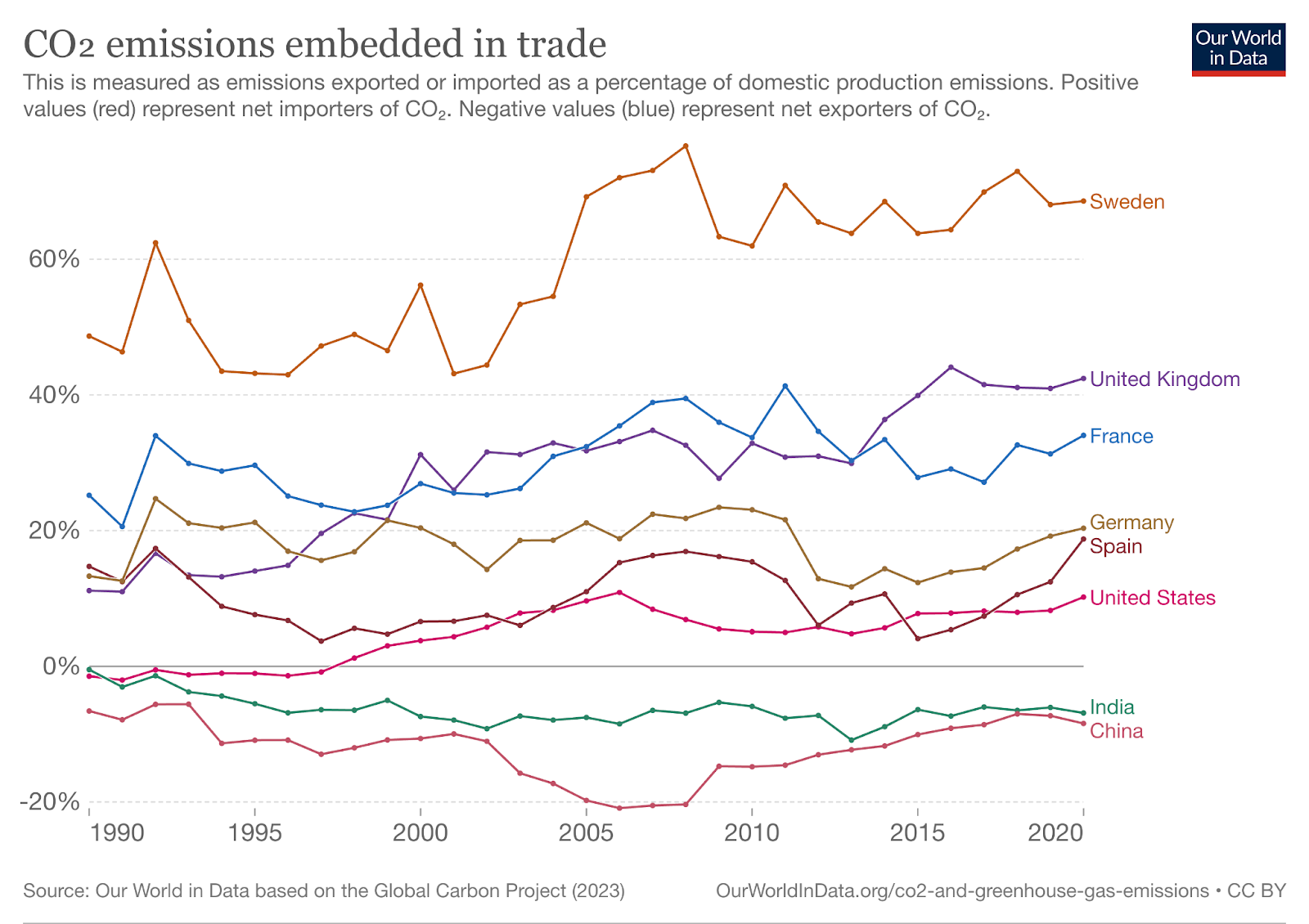
Conversely, 90% of China’s emissions of CO2 are due to internal consumption.
Correcting for these, emissions per capita in the European Union and China are broadly equivalent today, but since the EU is shrinking its CO2 emissions while China’s are increasing, China will soon pass the EU in emissions per capita. At the current pace, unless something changes, it will also pass the US within the next 20 years.
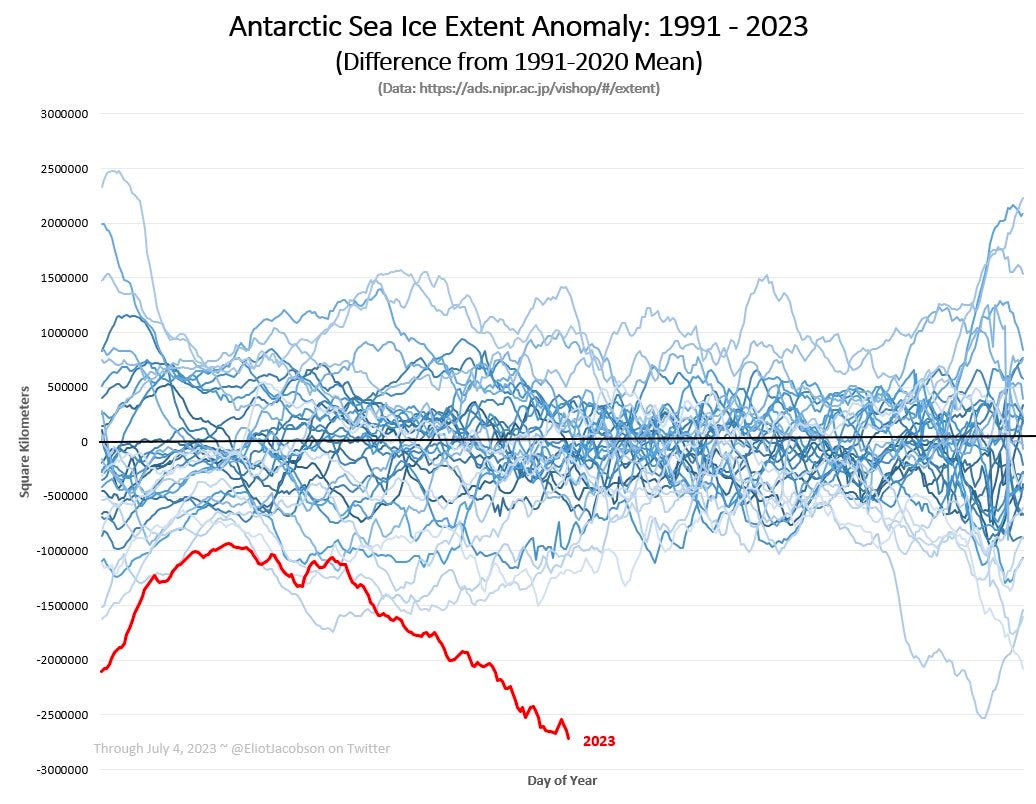
16. Polar sea ice is going down pretty dramatically
Summer ice has halved in the last 45 years in the Arctic Ocean:
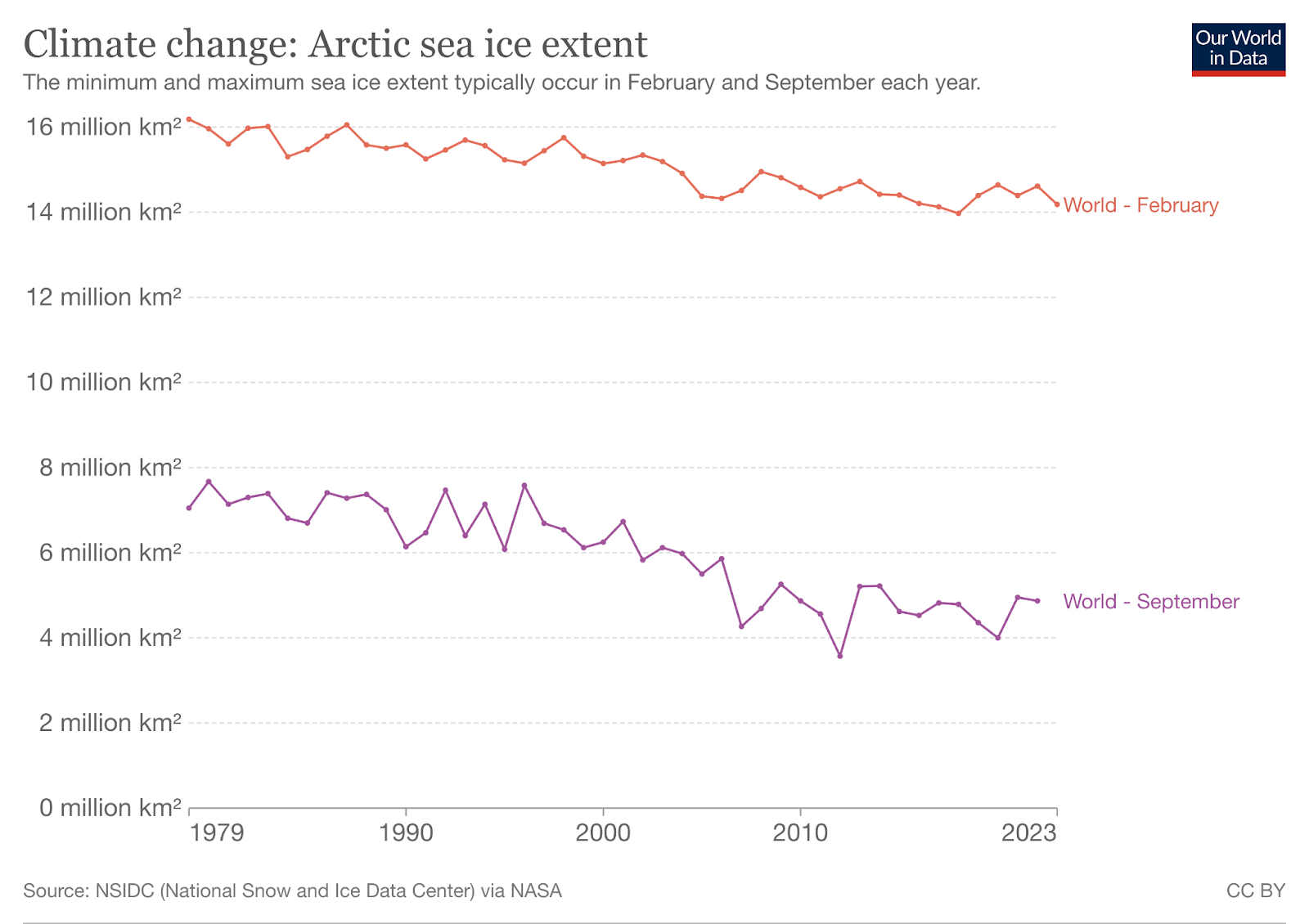
The Antarctic Ocean is not faring much better:
17. Oceans are becoming more acidic, but they were alkaline to begin with
At the current pace, it will take decades before the oceans even reach a neutral pH.
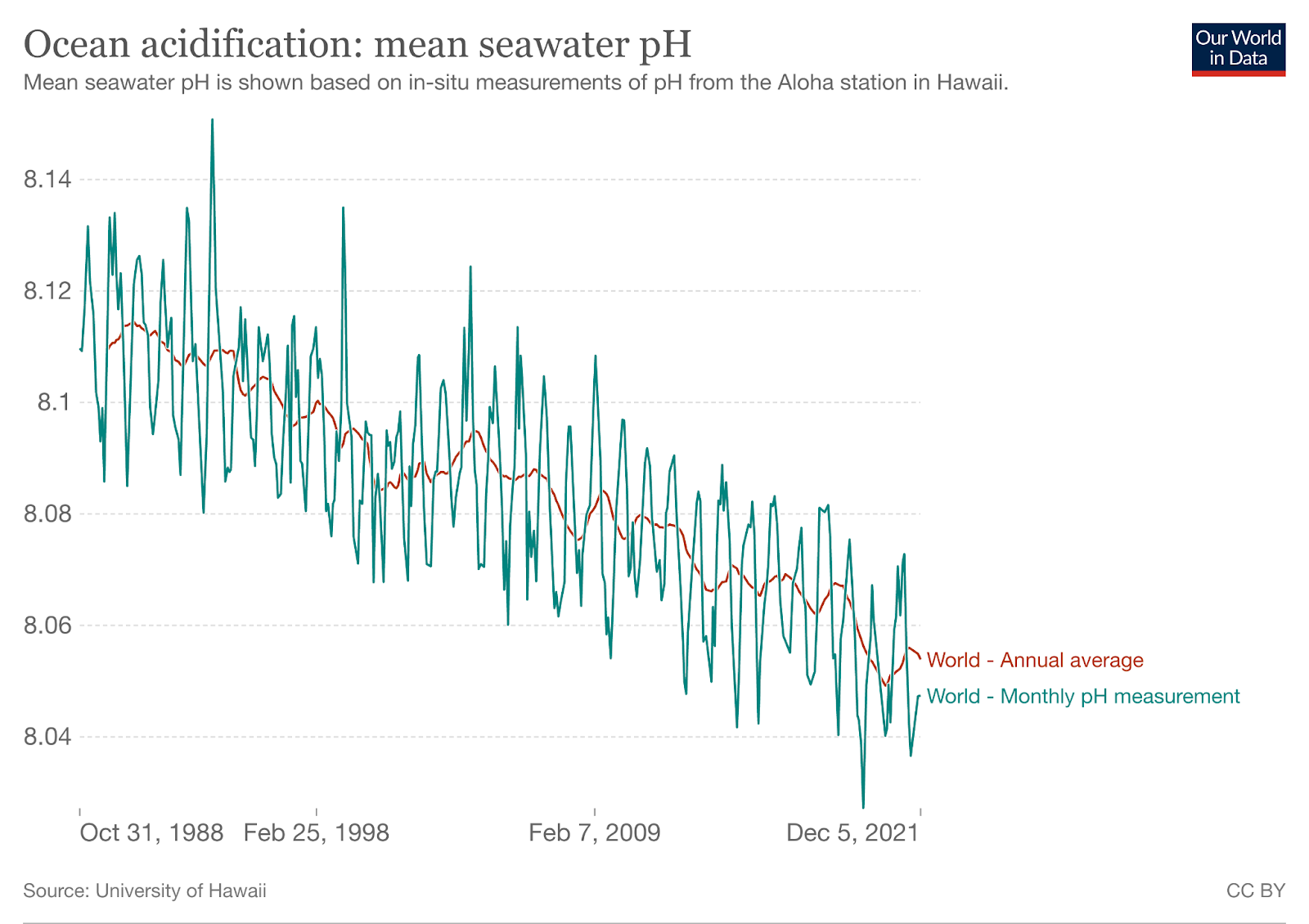
I couldn’t find Historic Ocean pH graphs that go past millions of years. This one [3] goes back about one million years.
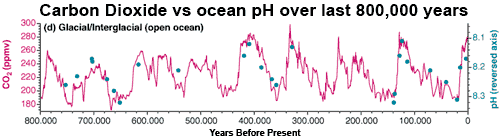
This tells me that ocean pH has been going up and down over history, and a few million years ago it was higher than today, so I’ll take this as a mild concern that comes from the fact that recent organisms are not as well adapted to the CO2 levels we’re heading towards. Bad for recent organisms that can’t adapt, but hardly an existential risk for Mother Earth.
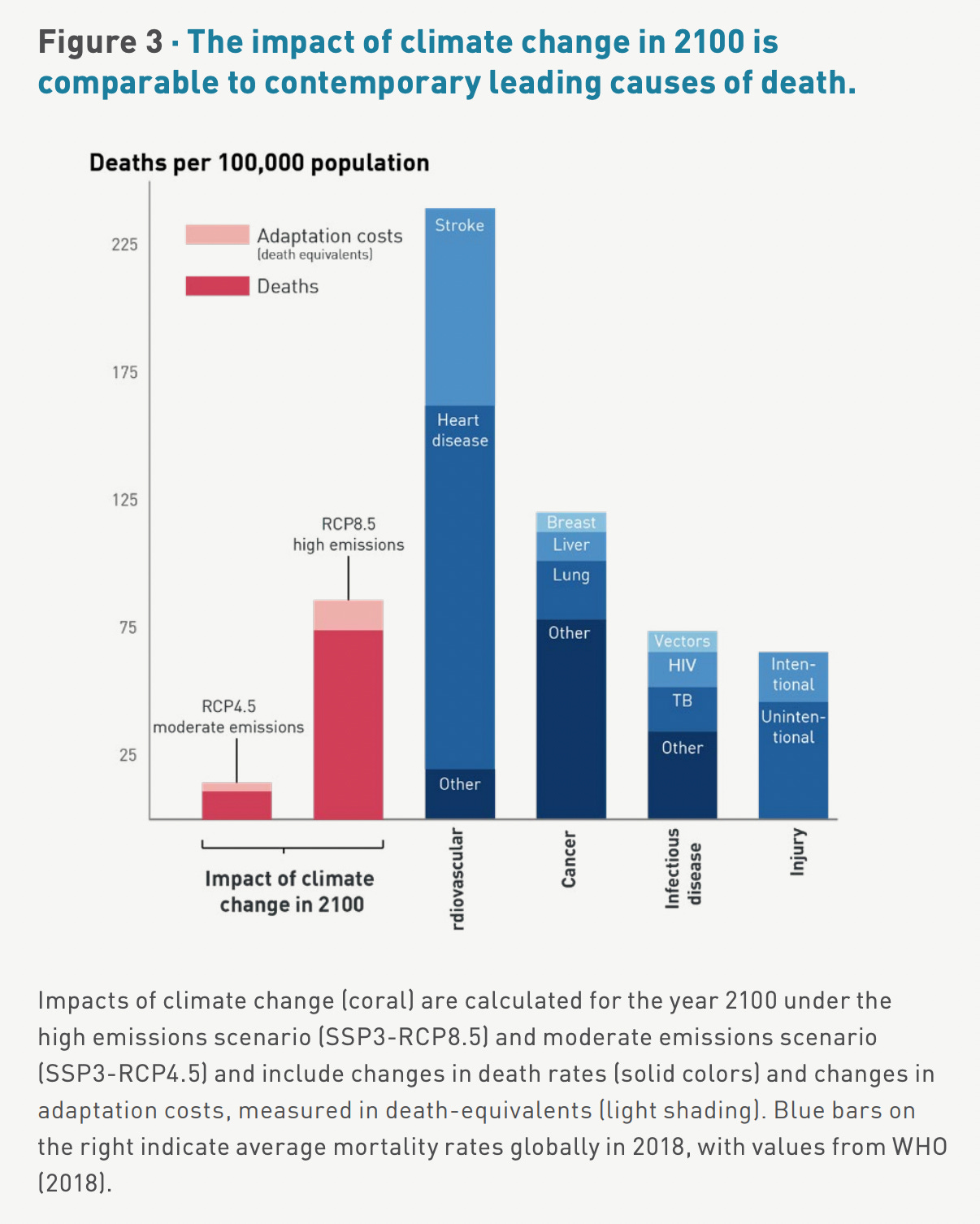
18. A scenario of high emissions could kill more people than all infectious diseases
Although I don’t think this includes the flu and COVID.
19. Heatwaves kill. But so do cold waves.
I used in the past this graph explaining why heatwaves will be much more frequent.
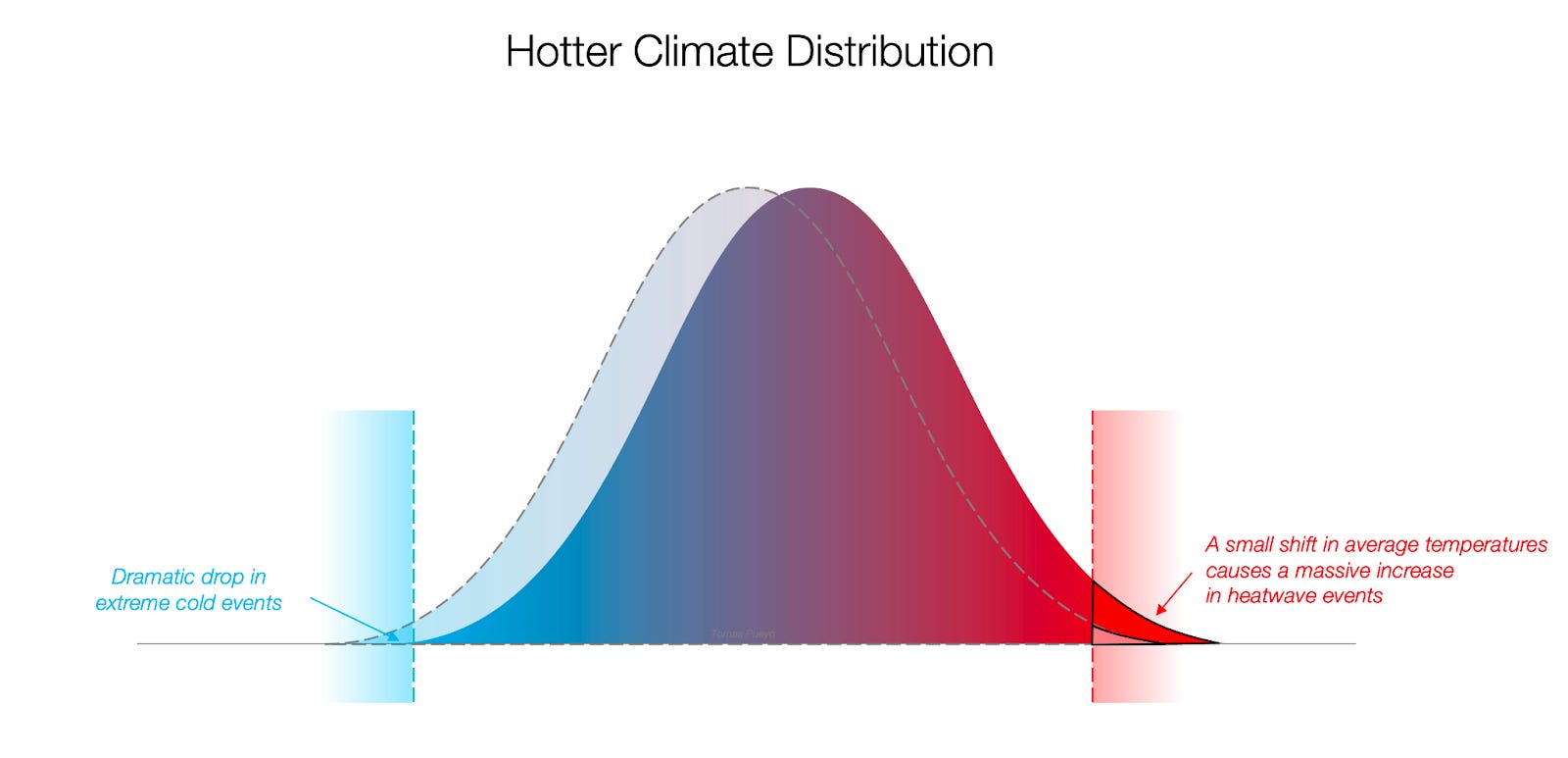
But how bad are these heatwaves?
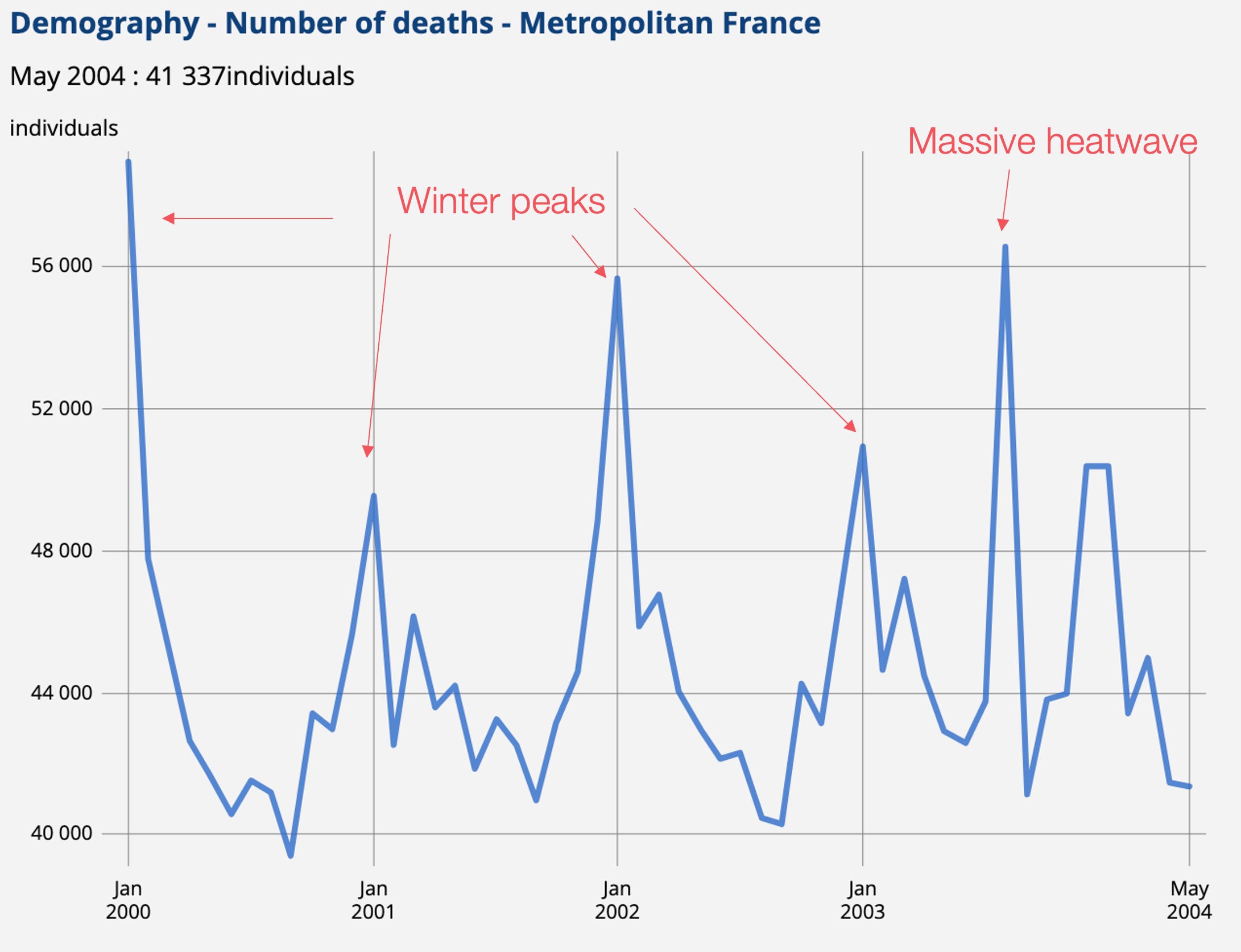
20 years ago, as a consultant, I worked for a European funeral homes company. What I learned there is that the biggest driver of deaths in any given year was determined by how cold were the winters and how hot were the summers [4] . For example, here’s what happened in France in the early 2000s:
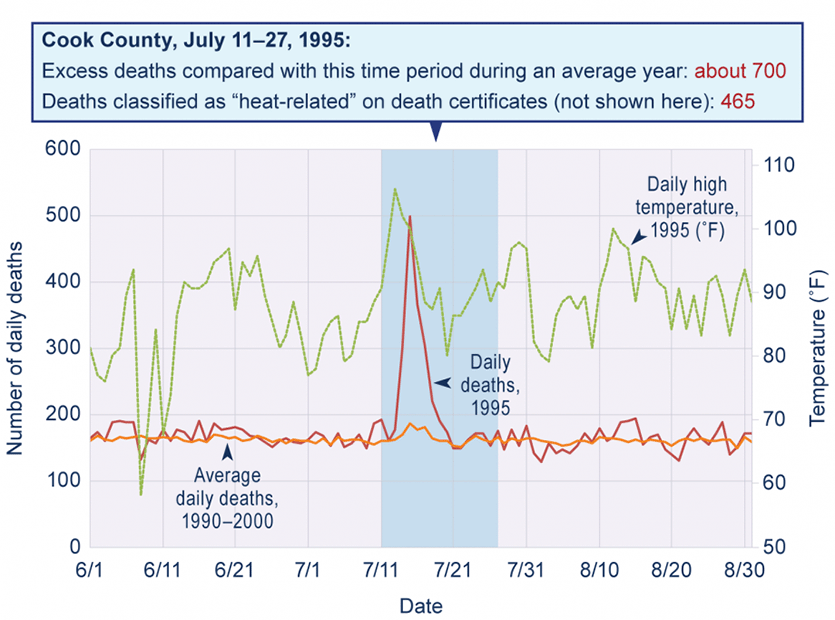
Something similar can be seen in other places. For example:
I had a hard time finding the right data on deaths from heat vs cold. The main issue is that stats go off of death certificates, but if grandpa has a heart attack during an extremely hot day, his death certificate will show heart attack, not hot day.
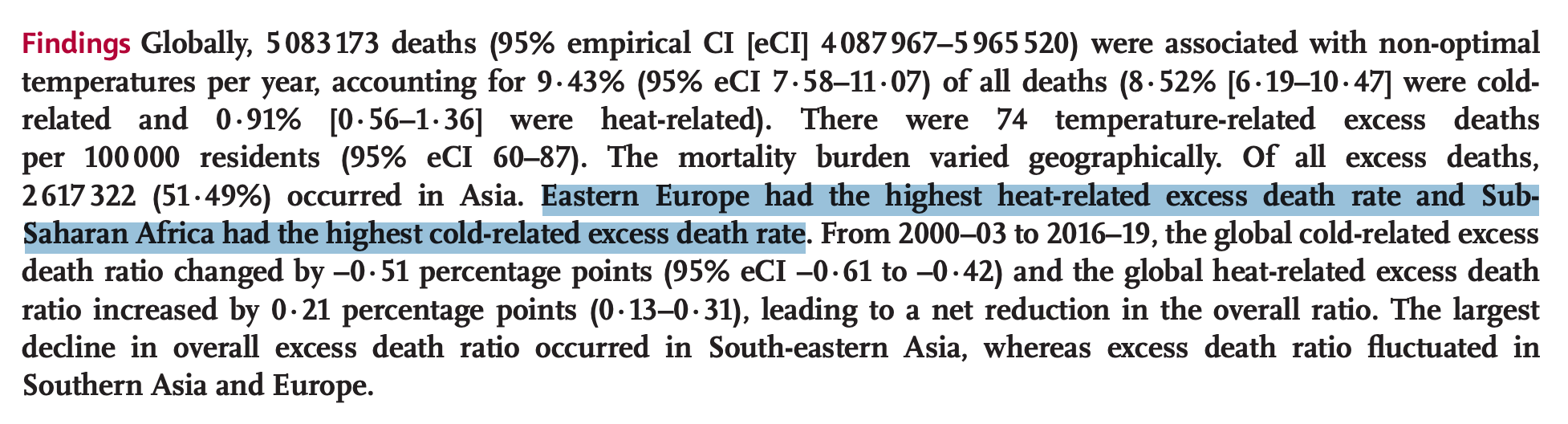
You need to look at excess deaths instead, and the best paper I could find is this one, which looked at over 700 locations in 43 countries and calculated the deaths from extreme temperatures. What did it find?
90% of deaths come from cold waves! Only 10% from heatwaves (8.5% of all deaths vs 0.9% respectively)
The place with the most deaths from heatwaves was Eastern Europe! Probably because they’re not used to dealing with this heat. Conversely, the place with the most deaths from cold waves was sub-Saharan Africa! Probably for the same reason.
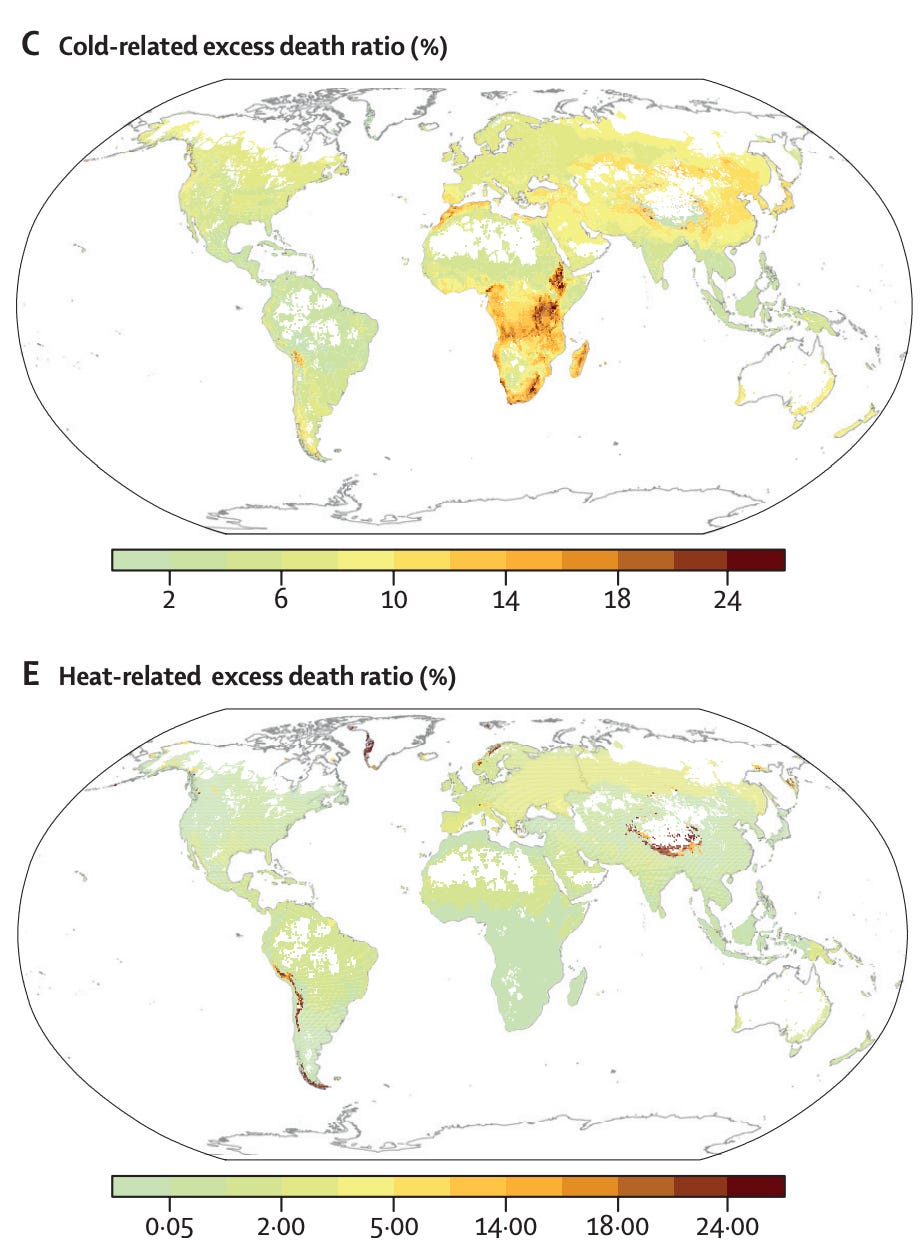
I was told that upcoming heatwaves from global warming were going to disproportionately affect the global south. It might be true. But so far, they don’t tend to.
How are these numbers changing?
20. We’re adapting faster than temperatures increase
We can see how cold-related deaths (more common) have been diminishing around the world faster than heat-related ones have been increasing.
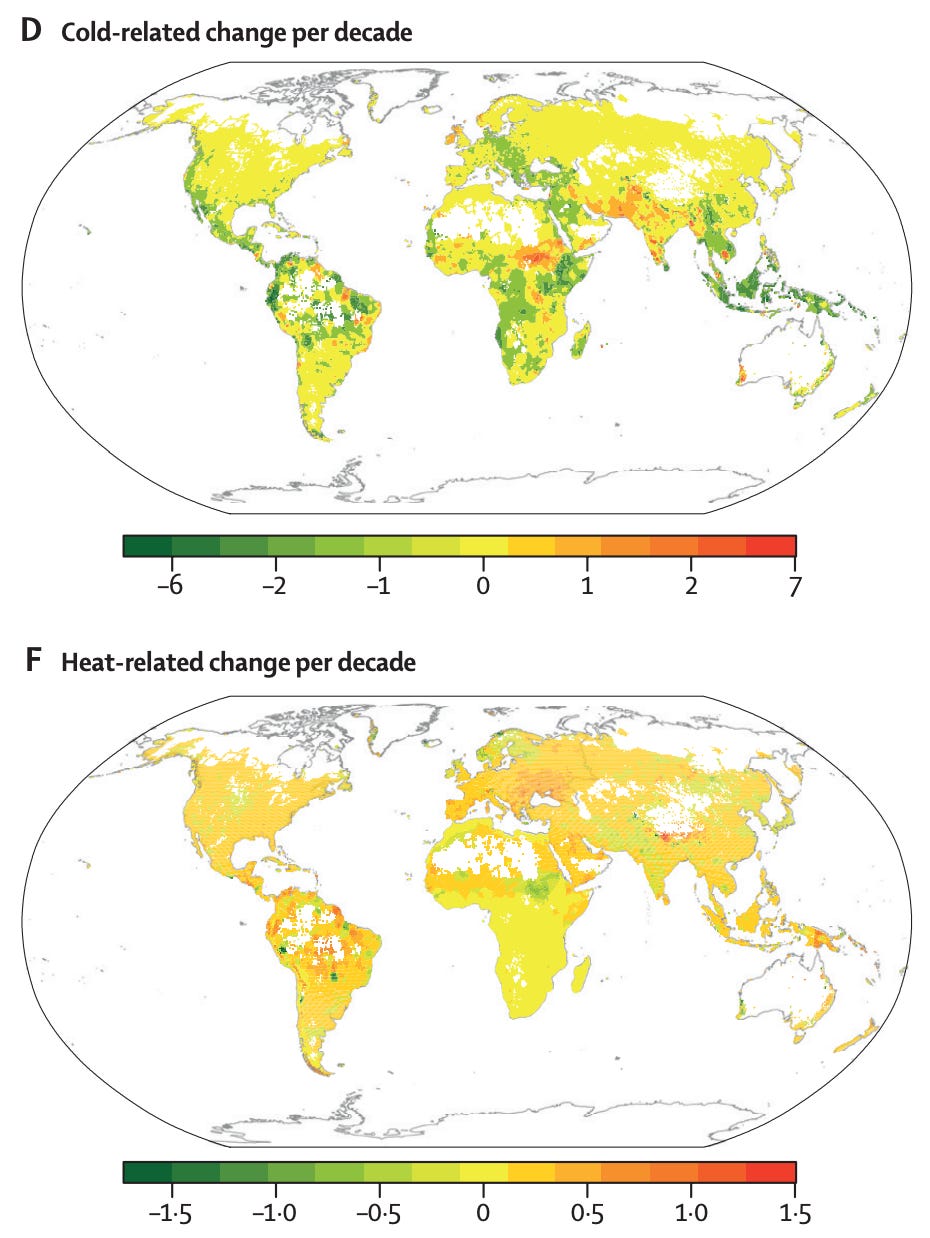
Here’s the same data, in graph format:
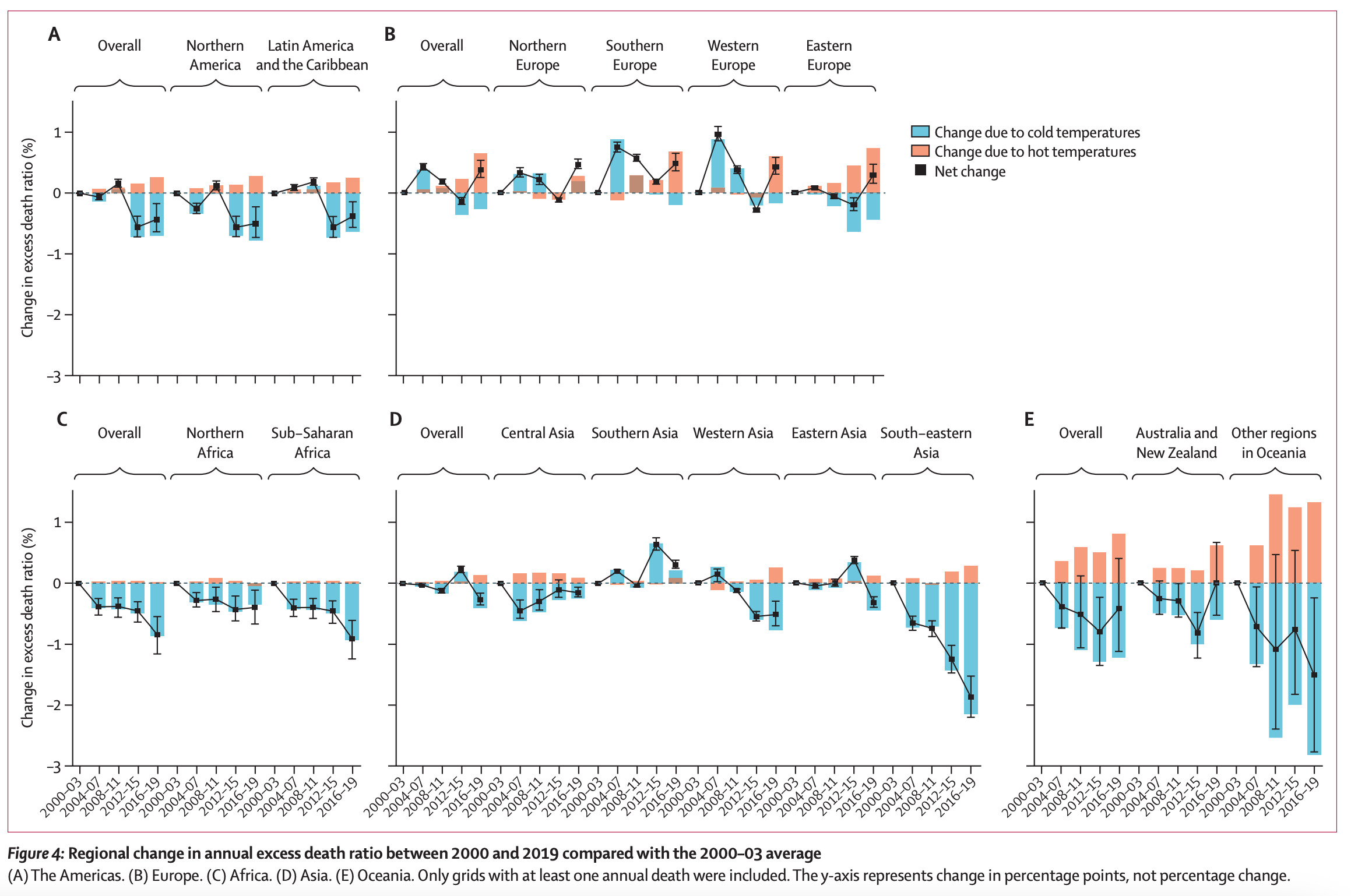
So cold-related deaths are decreasing faster than heat-related ones are increasing.
But also, interestingly, heat-related deaths are barely growing—and in some places, they’re decreasing. An interest case in point is Spain, where adaptation is faster than temperature increases: As temperatures go up, Spaniards are getting more used to it and are fighting with more care, hydration, and AC. The result is that fewer people die of heat than they used to. Maybe this is the harbinger of what might happen in the rest of the world?
21. The US Government is spending more than ever in the Green Economy
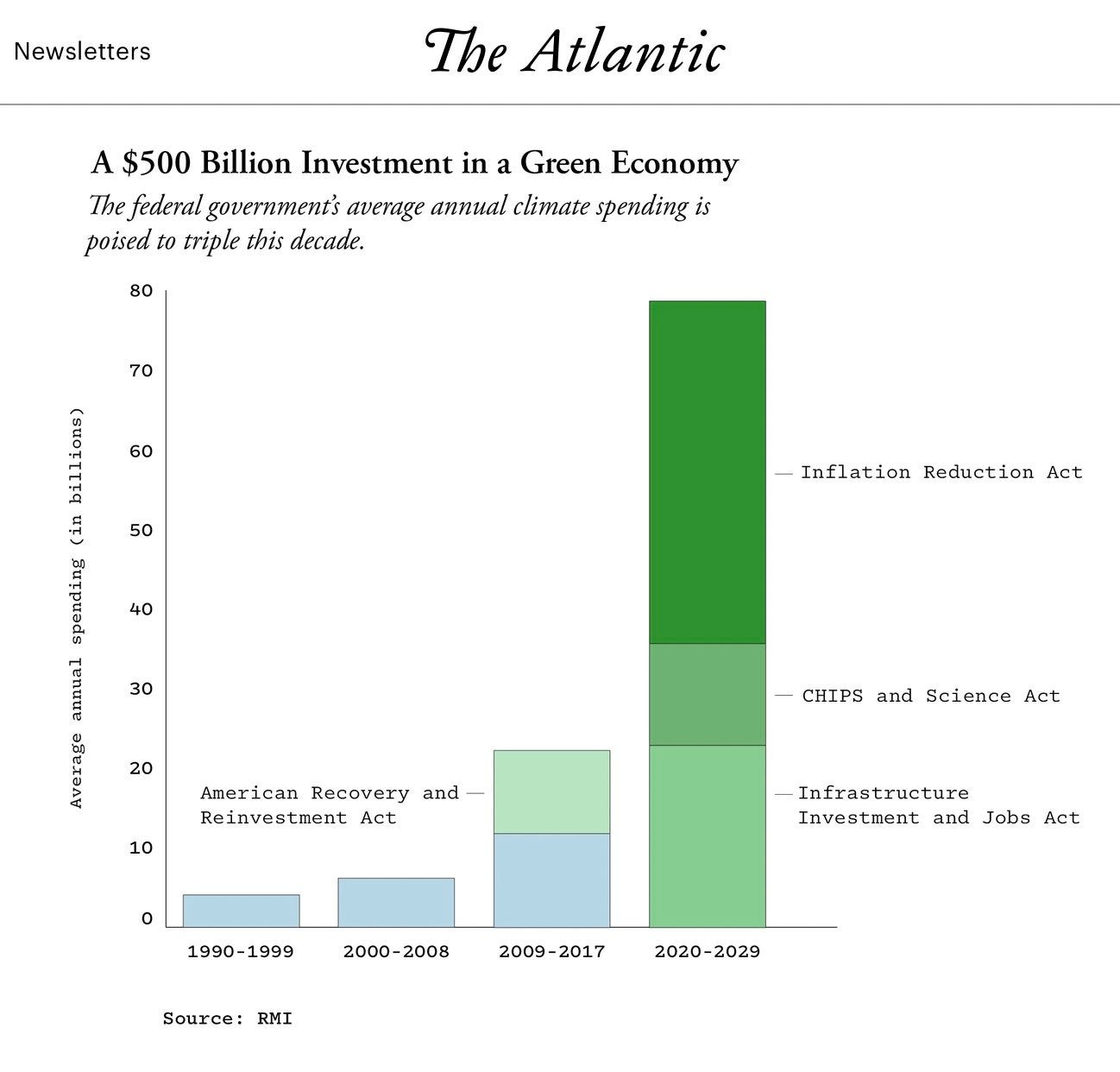
I had heard the IRA—Inflation Reduction Act—was amazing, but I hadn’t realized its impact was higher than everything else combined in the US. Good for the Green Economy!
22. People say they care about climate change, but their actions betray them
When you ask people if they think global warming is a major challenge, they usually say yes.
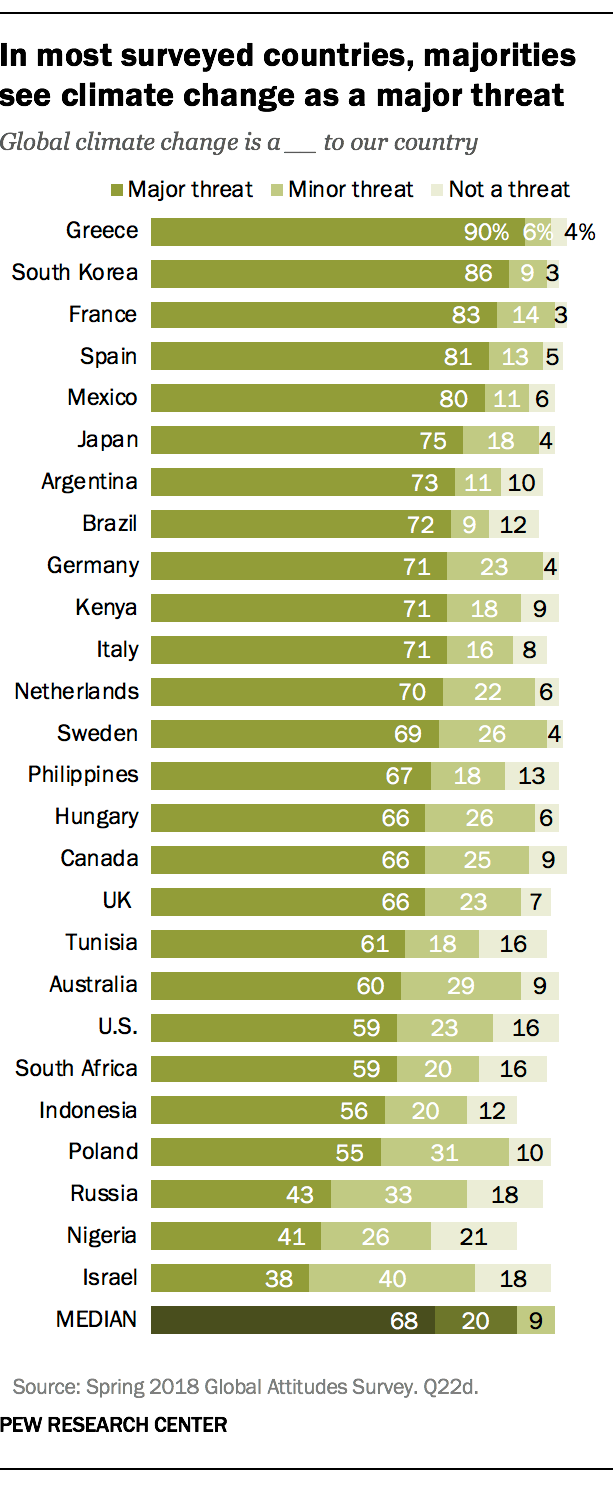
But when you ask them to identify their country’s biggest issues, they have a different opinion:
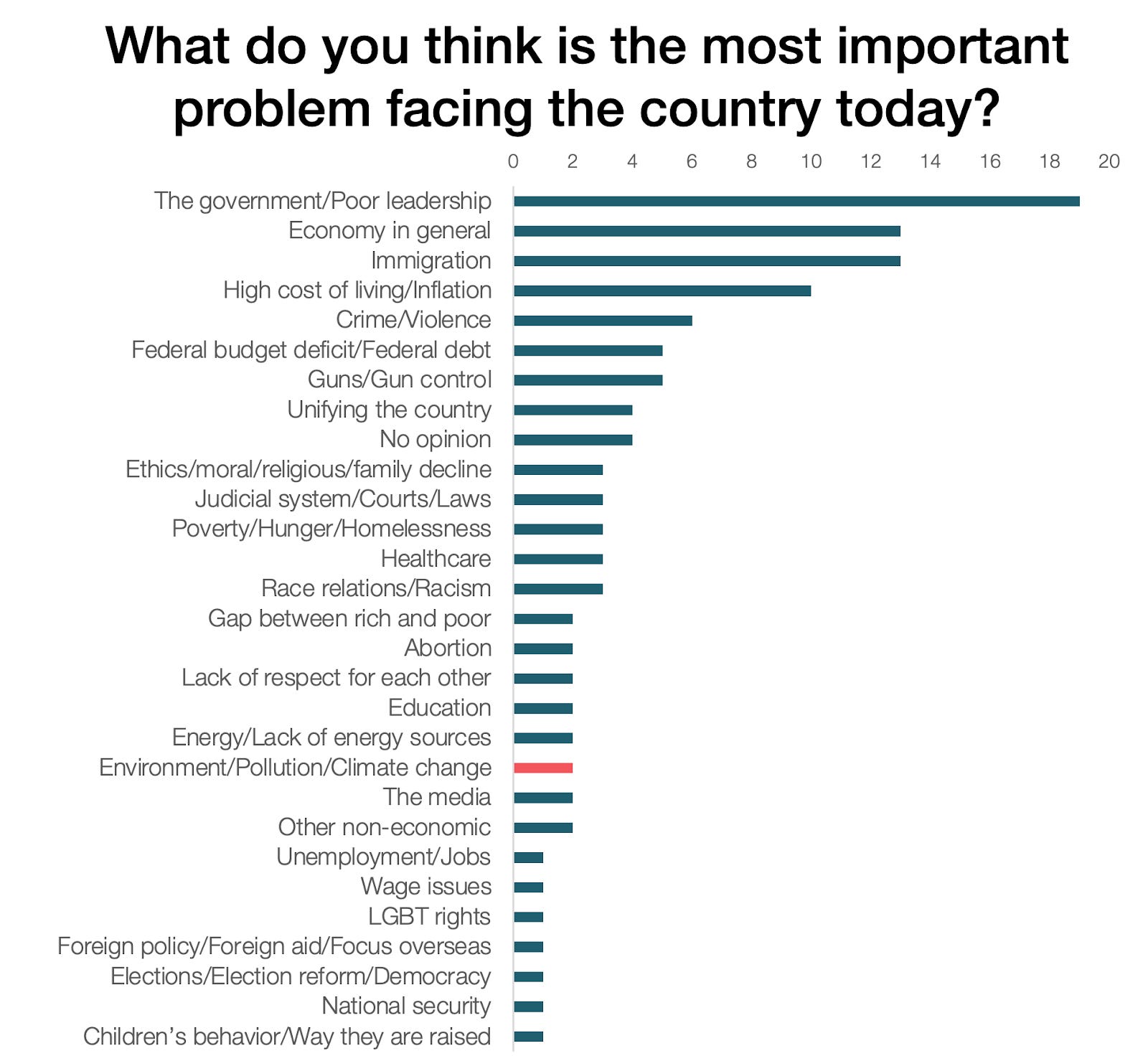
It’s the 19th biggest concern.
No wonder governments don’t do much about it.
23. Environmental measures hinder the transition to green energy
The US NEPA (National Environmental Policy Act) requires big projects to provide environmental impact statements (EIS). The average EIS report is 1,200 pages long, and the approval process typically takes 3 years.
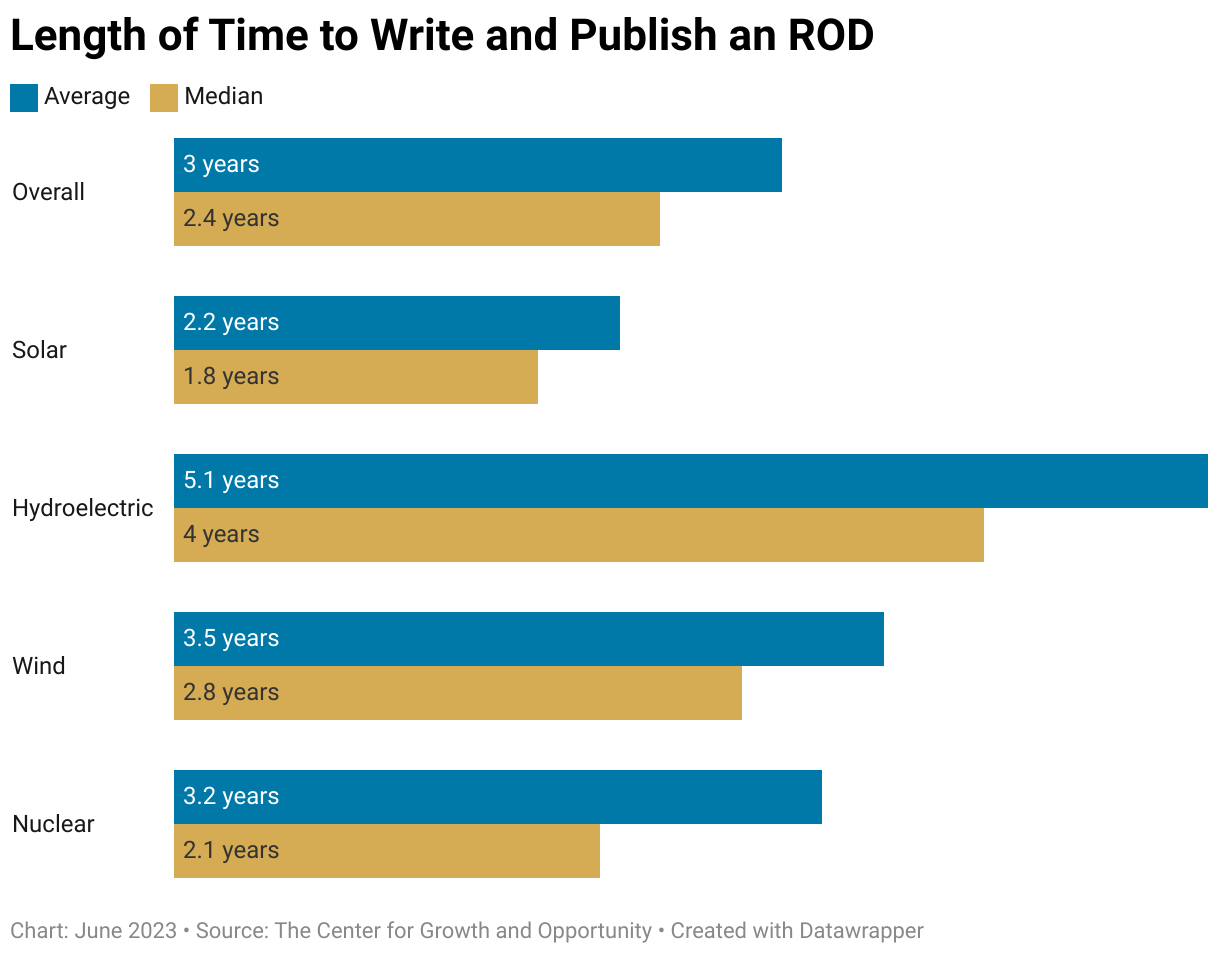
When you’re in a rush to save the planet, the worst thing you can do is take 3 years to approve a new energy project. This delay adds a tremendous amount in risks and costs, making many projects simply impossible.
24. We actually know how to stop climate change
Emit SO2 for a few years to quickly cool down the atmosphere. We could do this for only a few billion dollars—peanuts from a global spend standpoint.
Start using CO2 as a resource, not a pollutant—like plants do. We can generate methane from it, for example, or seaweed. I’ve talked about seaweed in the past, and will discuss methane in the future.
Capture some carbon while we ramp that up. Olivine weathering is a good approach.
I might write a future article about this.
Summary
After looking into all this data, the young me that had an existential angst about climate change has relaxed. I’ve adjusted my fears about global warming.
The Earth won’t disappear, nor will most animals, nor will most humans.
Global warming seems to be good for plants, although more CO2 in the future might not be more beneficial, and might not counterbalance heat increases.
Global warming seems to reduce human mortality, as there are fewer cold waves, which kill more than heat waves.
We can adapt to heat faster than it increases. This requires energy.
We won’t be submerged by rising sea levels.
This leaves a few key concerns:
There will be more heatwaves. They might kill more people.
There might be tipping points in the climate. They could be devastating.
The Earth has never seen such a fast temperature increase. Many of the evolutions that allowed animals and plants to adapt to climate changes in the past might be too slow to allow them to adapt now.
The challenge, then, is to increase our energy consumption just as we decrease the CO2 we emit into the atmosphere and extract what has been building up already, so that there are fewer heatwaves, we avoid potential tipping points, and we slow down temperature changes.
And we know how to extract this CO2 and reduce global warming. It’s a matter of execution now. This will be the topic of a few future articles. I hope you enjoy them!
Intergovernmental Panel on Climate Change
As in they are not the ones producing the stuff they consume—they outsource goods production—and similarly, they outsource the CO2 that goes with it.
Although “skepticscience.com” is not a very reassuring name, it’s reasonable to accept that pH and CO2 are very highly correlated, and we saw the CO2 graphs earlier this week, so I’ll take this at face value.
The average death rate doesn’t seem to be determined by temperatures, but rather underlying causes like cancers, cardiovascular diseases, and of course age. What temperatures did was shift deaths from one year to the other, because extreme temperature events accelerated the death of the weak—ie, old people.