Why Did Vikings Appear Out of Nowhere? - by Tomas Pueyo Why Did Vikings Appear Out of Nowhere?
Some content could not be imported from the original document. View content ↗
And How That Helps Explain Incels Today
2022年10月28日
∙ Paid
Geography and history shouldn’t be memorized. They should be understood.
I recall vividly the middle school class about Vikings. In French history and geography class, we had learned about the fall of Rome (But why did it fall?), the arrival of the Franks from the east (But why did they arrive?), their creation of the Frankish kingdom under the Merovingians (How come they triumphed while the powerful Romans disappeared?), and the expansion into a mighty European kingdom under Charlemagne.
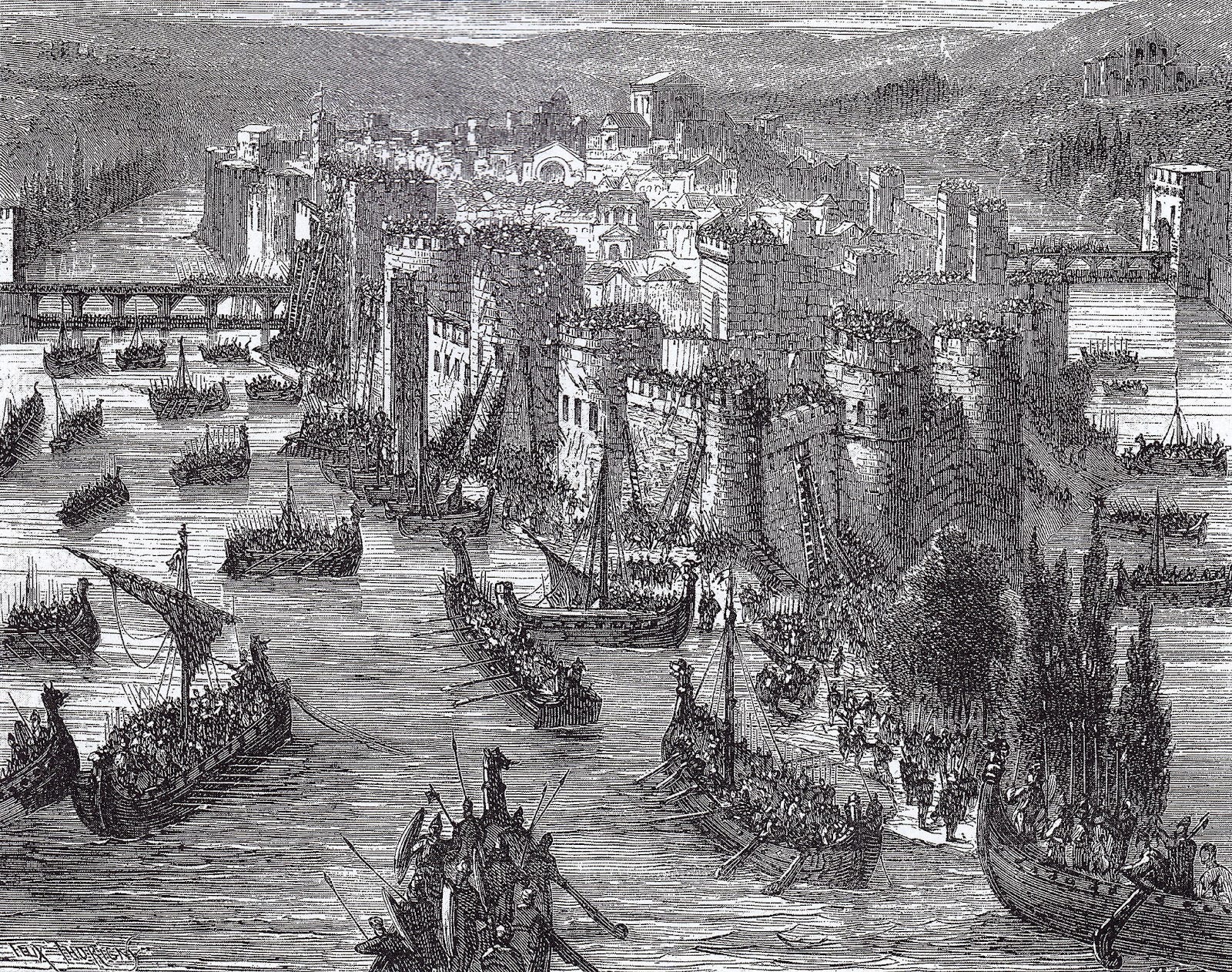
And suddenly: “Then one day, the Vikings come from the north, raid all the coasts, reach Paris (?!), settle Normandy, eventually take over England, Southern Italy (?!), and make it all the way to America and the Black Sea (!!).”

It felt weird, completely out of the blue, without any explanation. But as a kid, I didn’t know any better. I assumed this is how you learned history, so I just memorized it. But I had so. many. questions:
Why did Vikings appear seemingly from nowhere?
Why then and not before or after?
Why were they so powerful?
Why did they disappear just three centuries later?
So I looked into it and what I found was not only fascinating; it’s also a stark lesson for how we should manage incels today.
Why Did the Vikings Suddenly Appear in the 700s?
Up until the 700s, Scandinavians barely appear in European history. And then, they pour into it, using the North Sea as their playground. How was that possible?
This is the wrong question.
Here’s a better way to look at it: Every sea eventually gets colonized by one civilization. It happened with the Greeks with their Aegean, the Romans with their Mediterranean, Portugal and Spain with the Atlantic, Srivijaya around the Malacca Strait... After Rome fell, somebody was eventually going to take control of the North and Baltic Seas. The right question is then: Some region was eventually going to take over the North Sea. Which one was the most likely?
For a people to start expanding towards the sea, you need three requirements:
Population growth.
A system that pushes people to leave their homeland rather than stay.
Few alternatives to expand on land.
The Nordic regions were the perfect place for all three.
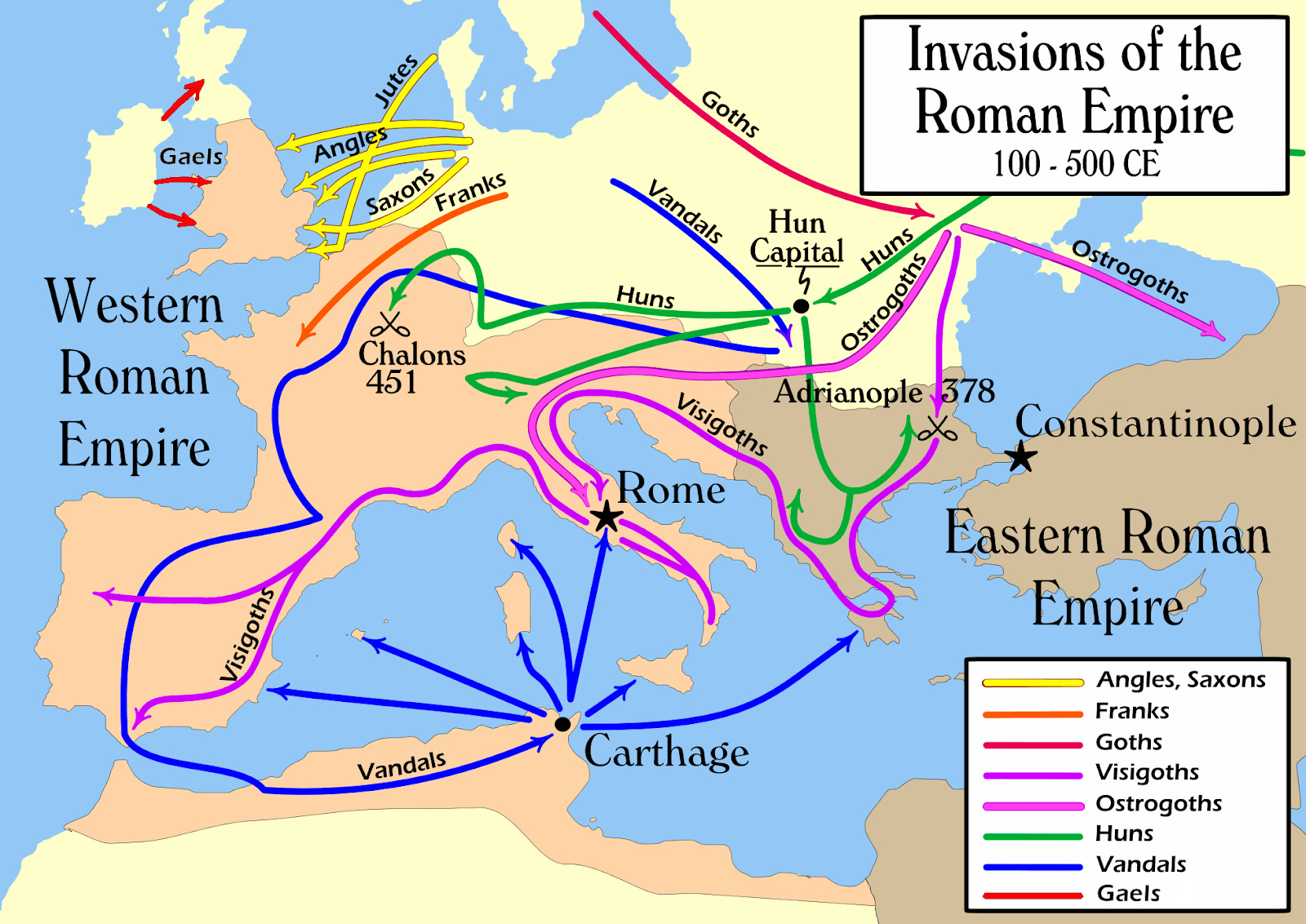
While the Romans were pushing north at the beginning of the first millennium, Germanic peoples were pushing south.

As I explained in A Brief History of the UK, the weak Romans left England in the 400s, a time when Germanic peoples were invading the empire from the east in what’s called the Migration Period.
The Romans were the main naval power at the time. Their disappearance created a void in naval power in the North Sea. But no other groups took advantage of this void, for several reasons:
All of Europe suffered from the Roman collapse. Populations shrunk at that time.
Trade disappeared with the Romans, so there was not a strong incentive to sail. Without trade to protect, piracy would disappear, and developing a naval power to counter piracy became worthless.
The Northern European plain is a vast and fertile region. Controlling it was more valuable than sailing the seas.
Most of the tribes in the Northern European Plain were either agriculturalist or nomadic herders. Either way, their main focus and experience was based on land.
Only coastal Germanic peoples like the Angles, Saxons, Frisians, or Jutes had any naval expertise, and for centuries after the fall of the Roman Empire, they mostly used it for invading England and the very occasional raid.
On the continent, the focus of politics was the Frankish kingdom, which kept growing in size and power until the 800s.
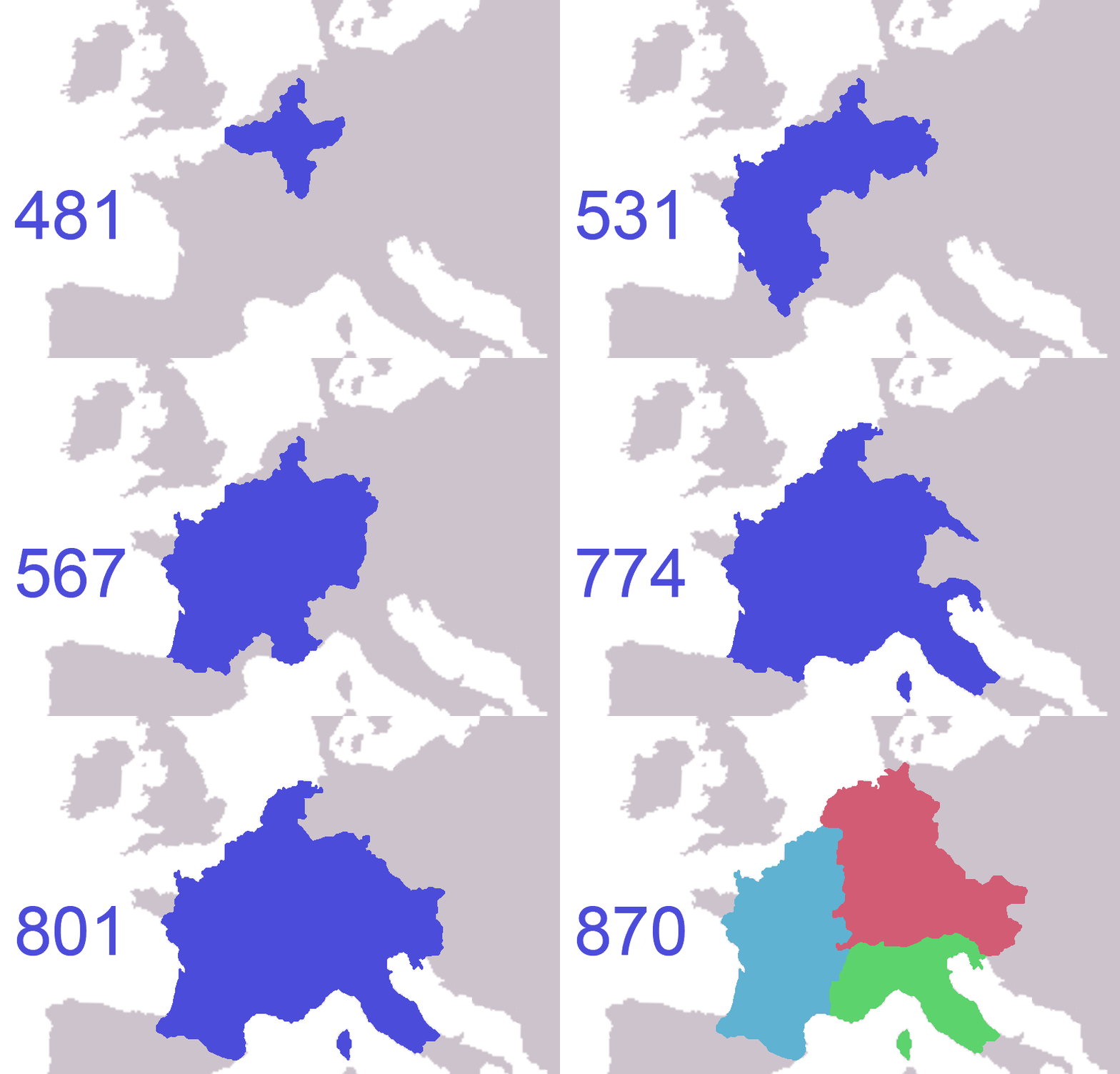
So England was a secluded backwater, the rest of the British Isles was barely populated, and the region of the Northern European Plain was busy with continental wars. None of them were in a position to control the North Sea.
And then you have Scandinavia.
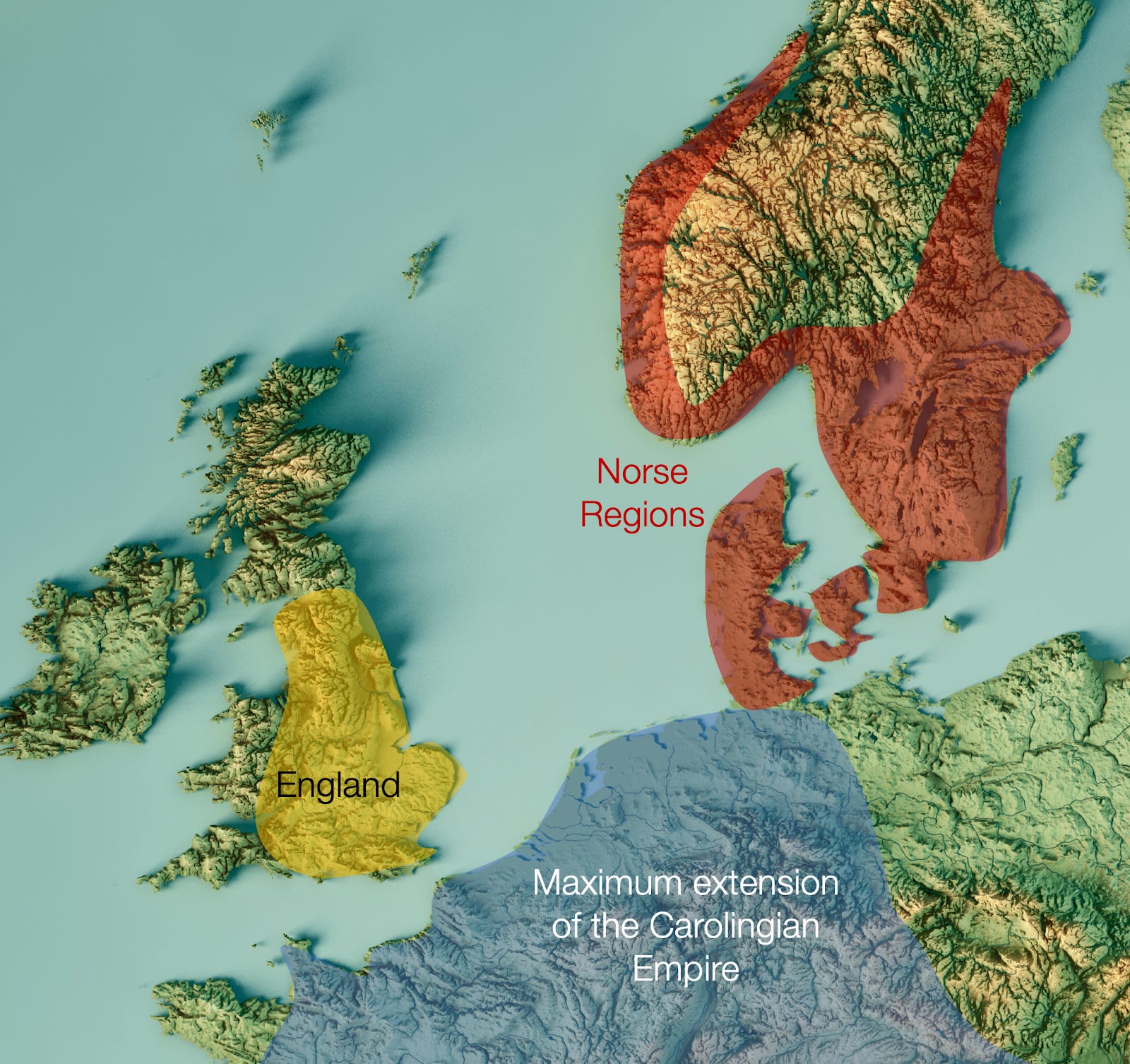
These regions did have a good reason to focus on the seas.
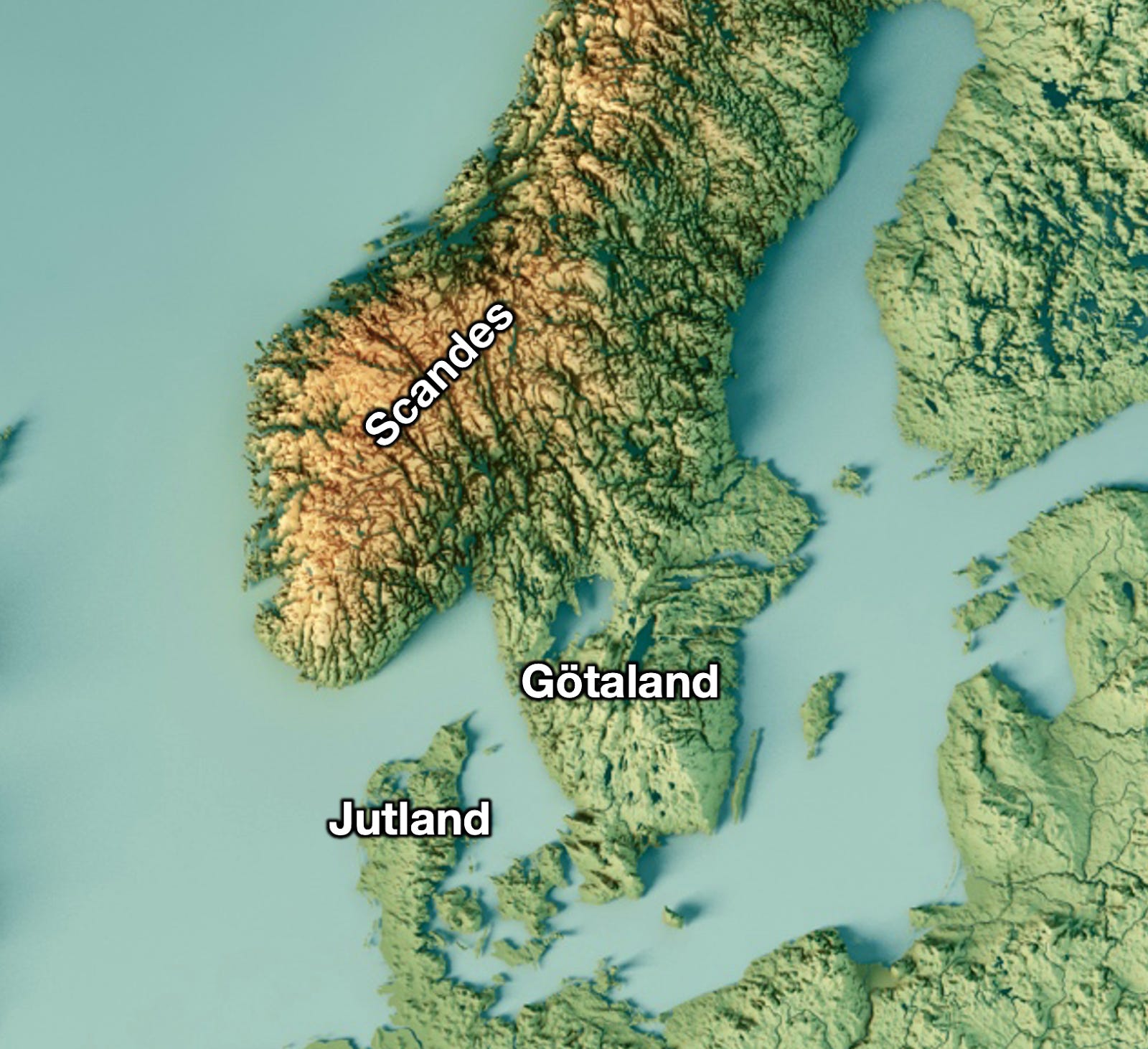
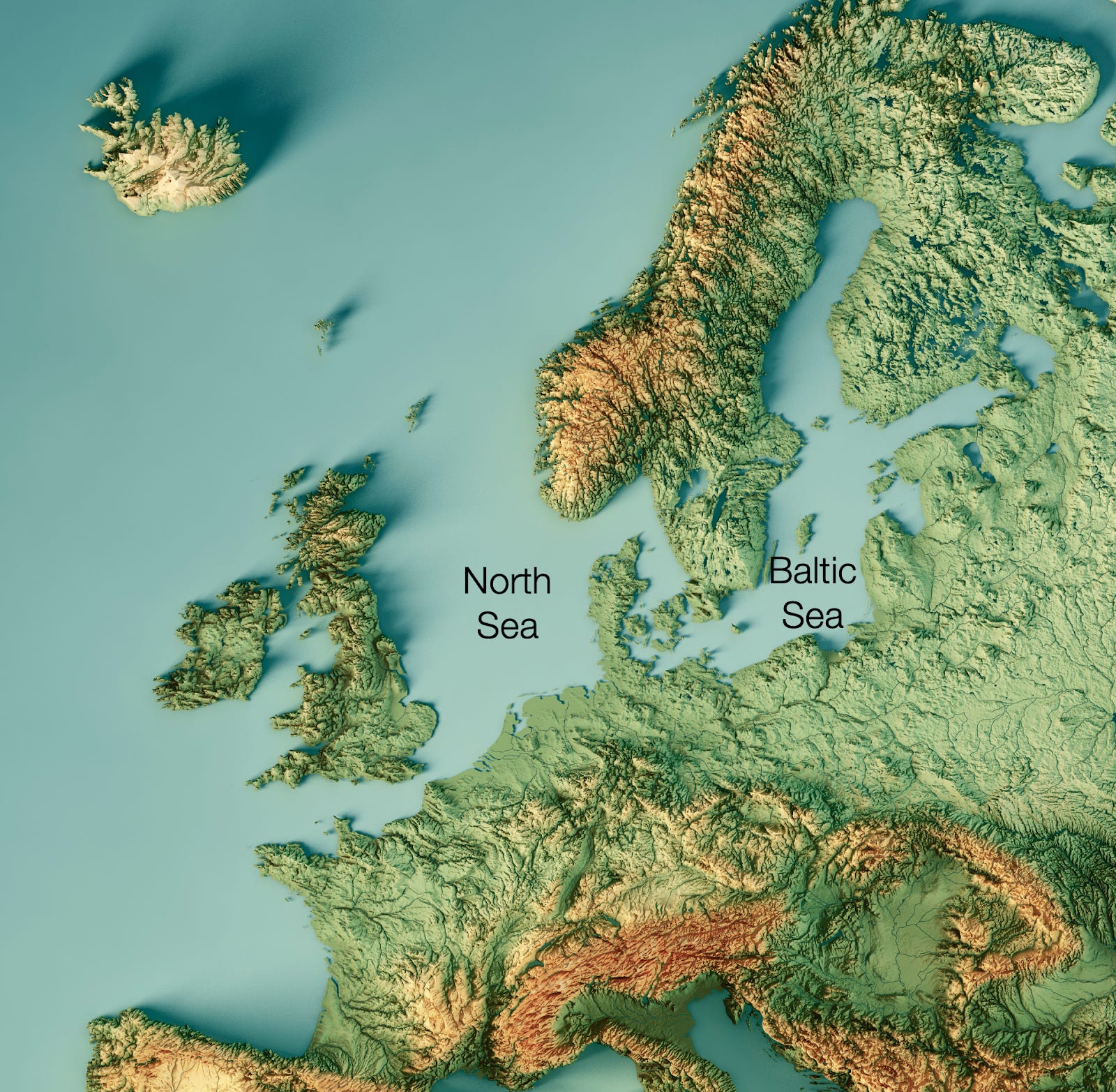
The mountain range in the middle of the Scandinavian Peninsula is called the Scandes. The mountains there fall straight into the sea, which means there’s very few fertile valleys there. Only fjords are inhabitable, and even then, they’re never that big.
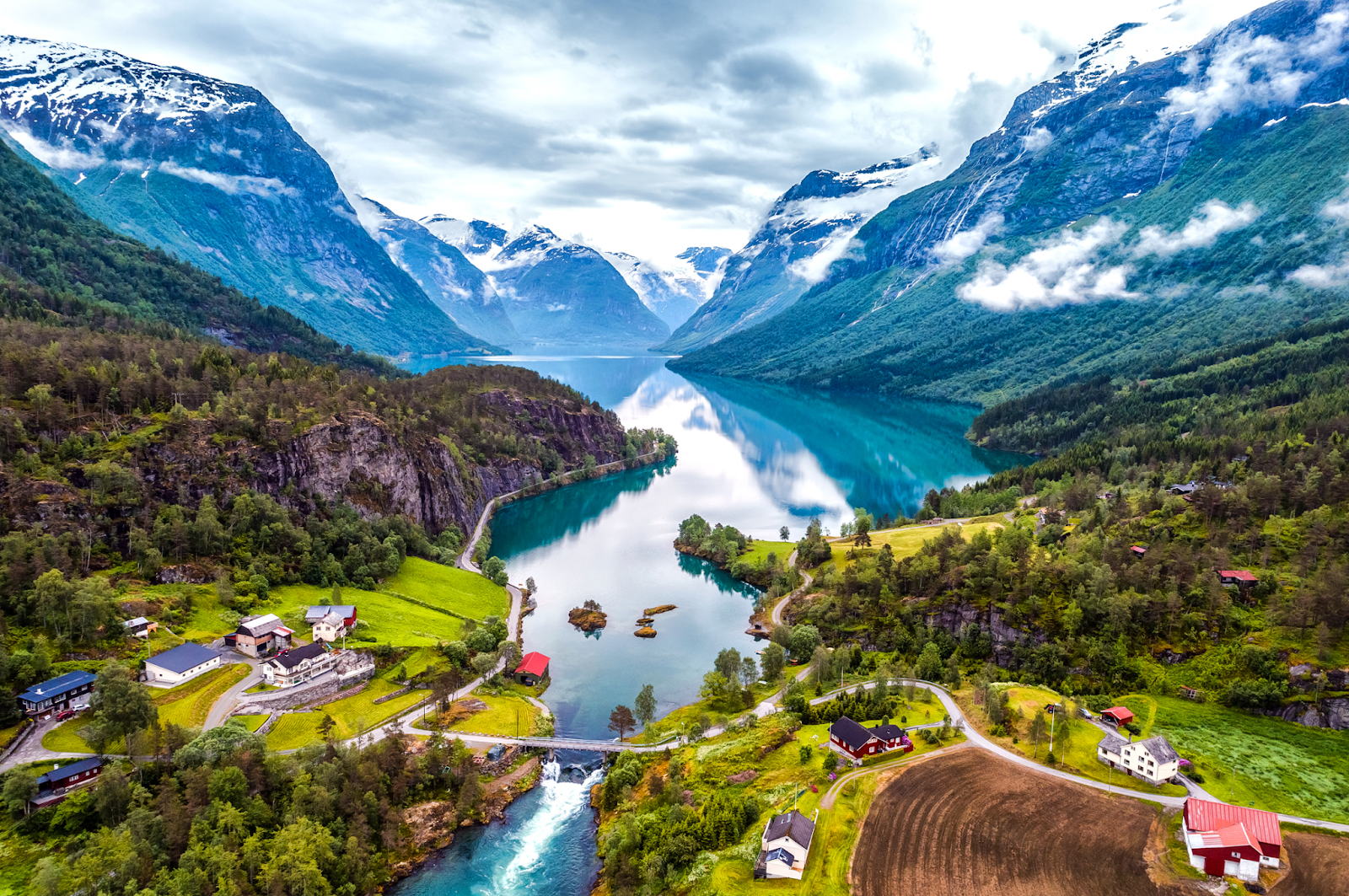
You can see that in the populations that exist to this day in what is today Norway: A few small points of light on the coast, and that’s it.
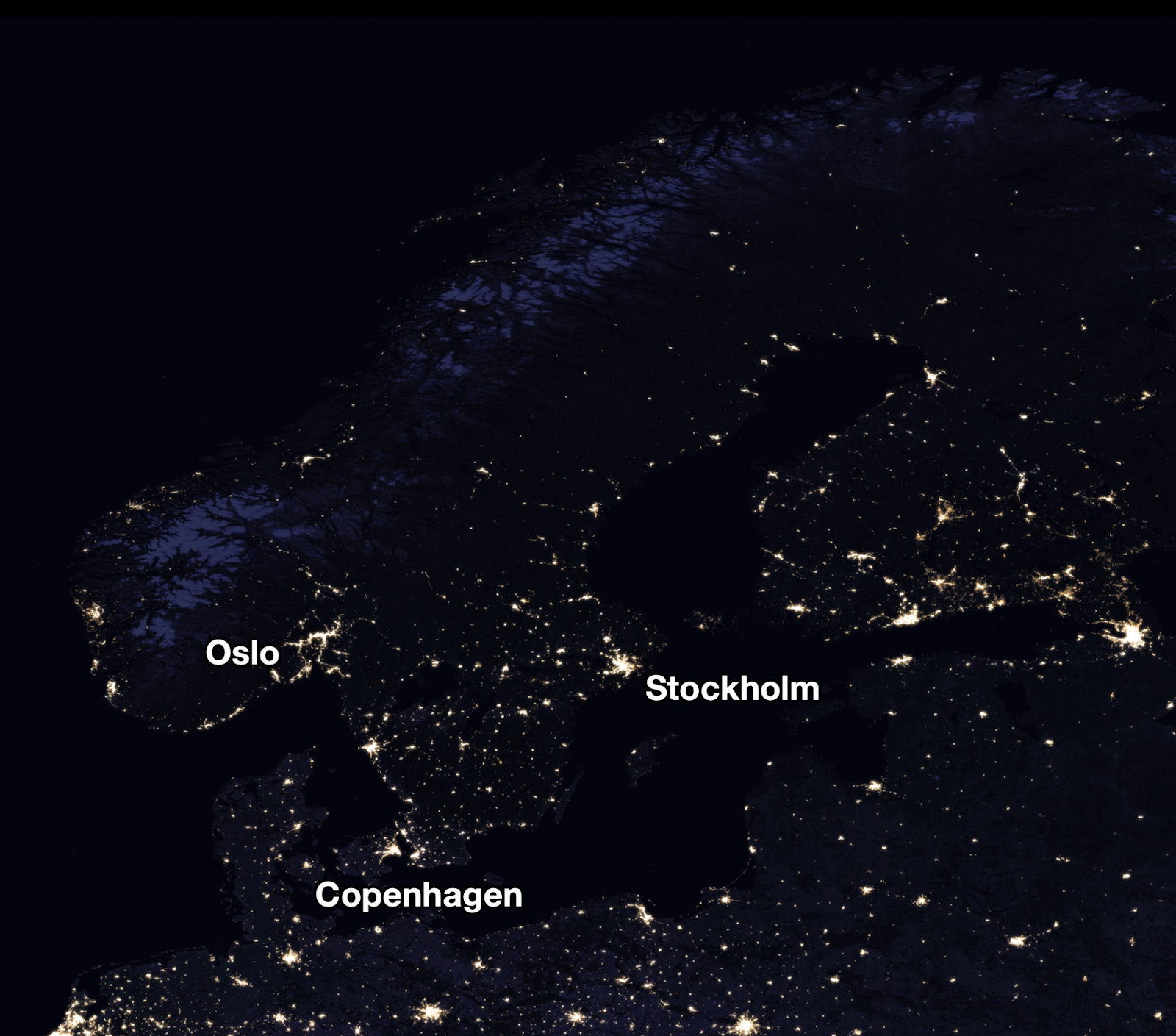
The people living in these fjords had big incentives to sail the seas.
Then you have the Jutland peninsula of Denmark, the Götaland region in southern Sweden, and the islands in between: All flat enough for some agriculture, and hence population. And because they were small, cold, protected by the sea, and hard to reach, they were much harder to conquer for peoples coming from southern regions. Protected and surrounded by the sea, they were prime candidates to focus on sailing. Indeed, there’s evidence of raids in the Baltic Sea in the early 700s.
With fertile land, they were also candidates to improve their agriculture. So a few centuries after the fall of the Roman Empire, the peoples living in these Nordic regions started improving and expanding their agriculture and livestock farming.

At the same time, iron mining expanded, increasing trade with southern neighbors, and bringing wealth to the region. With it also came better tools, which improved agricultural productivity.
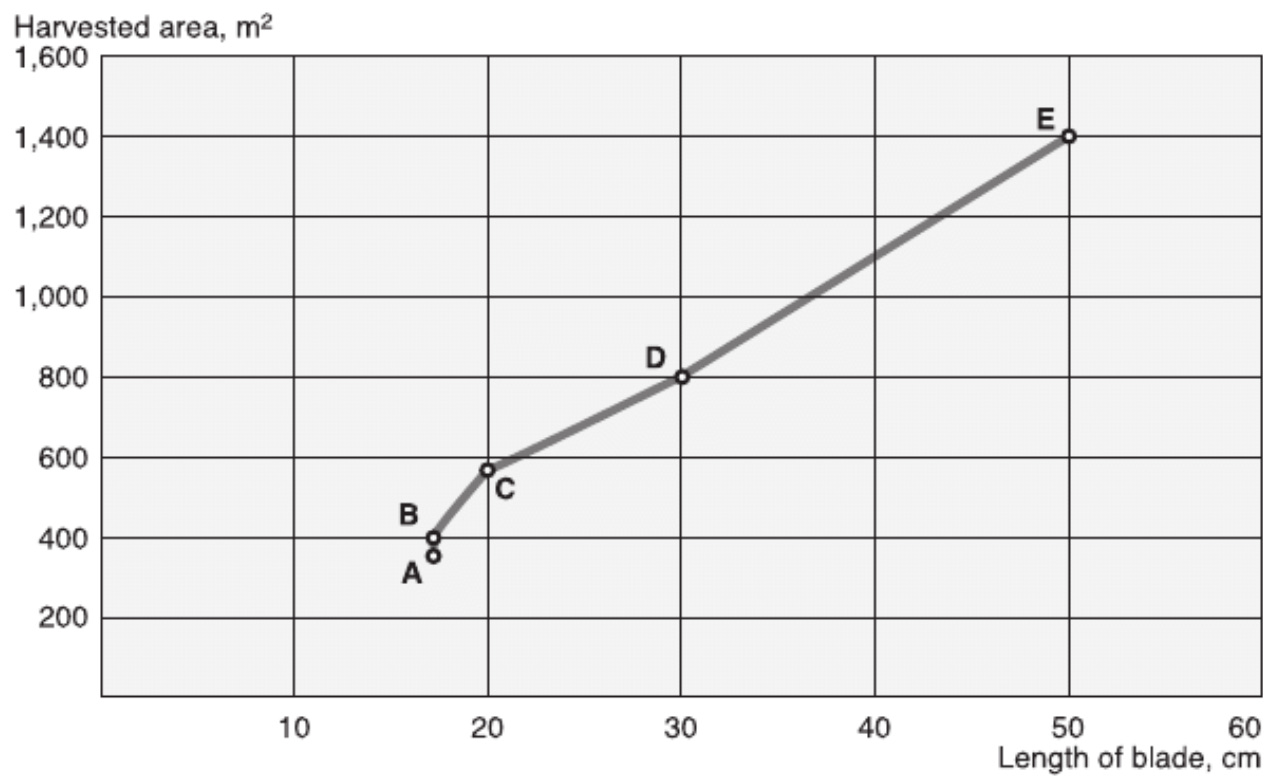
This also brought specialization, with some people focused on mining iron, and others on farming, which would have likely further increased the population.
The ingredients for Scandinavia to become the origin of North Sea invasions emerge:
1. A bigger population, thanks to better agricultural techniques and tools, and iron from regional mines.
3. A fertile but limited land, protected from southern invasions, but surrounded by sea, which pushed the locals towards the sea.
But why couldn’t Scandinavians stay put and keep growing in their own regions?
Sexual Inequality
The rise of agriculture and livestock raising across the world went hand in hand with inequality: People could start accumulating their wealth by storing grain or pushing their herds to reproduce. The people with the most fertile land made more money, could invest in better tools, and further increased their productivity. They then could store more grain and grow their wealth and social standing.
Another factor might have increased economic inequality: the 8th century equivalent of NIMBYism. Around that time, the new Odal land rule emerged which gave people the right to claim as theirs the land where their family had lived for generations, and that land could never be sold outside the family. This meant that the families with the best land would always be the richest too.
From all this increased population, wealth, and inequality, small kingdoms started appearing, further cementing that inequality.
But here’s the thing: Inequality was not just economic. In many societies, economic inequality led to sexual inequality.
Polygyny—one man with many female partners—consistently existed in agricultural societies. The wealthier the men, the more female partners they had.
Since the Germanic Peoples already had a tradition of accepting polygyny, the growth in economic inequality might have just boosted it.
Concubinage was part of Viking society. A woman could live with a man and have children with him without marrying; such a woman was called a frilla. Usually, she would be the mistress of a wealthy and powerful man who also had a wife. The wife had authority over the mistresses if they lived in her household. Through her relationship to a man of higher social standing, a concubine and her family could advance socially, although her position was less secure than that of a wife.—Status of women in everyday life Nordic culture during the Viking Era.
The 9th-century Norwegian king Haraldr Hárfagri had numerous wives and concubines at the same time. At one point in the narrative, Haraldr divorces nine women in order to marry the Danish princess Ragnhildr (...). In his description of the Rūs court, Ibn Fadlān observed that the king was attended by 40 slave girls who were “destined for his bed,” while his 400 warriors were each provided with two slave girls.—Male-biased operational sex ratios and the Viking phenomenon: an evolutionary anthropological perspective on Late Iron Age Scandinavian raiding.
If the average man had only one wife, but the richest had several, most men quickly run out of female mates. That’s a problem.
Imagine that there are 20 males and 20 females in a group. Imagine that 9 of the middle-class men have one wife, two aristocrats have three wives each, and the leader has five. You end up with twelve men with all twenty women. That means 8 out of 20 men (or 40%) remain unmarried.
This is a problem, because unmarried men are unhappy and commit more crime. Faced with more competition for females, they become violent. Agricultural societies solved this problem with a neat trick: attacking neighbors. “If you conquer the other tribe, you can kill the men and steal their wives and money!” They sent their young to war, so they could steal the wealth and women they couldn’t access in their homeland.
Male mortality in warfare is higher in polygynous societies than in monogamous ones.—Warfare, Sex Ratio, and Polygyny, Ember, 1974.
Polygyny is strongly associated with the capture of women for the purposes of marriage.—Causes of polygyny: Ecology, economy, kinship, and warfare.
This likely happened with the Vikings.
Researchers have suggested that Vikings may have originally started sailing and raiding due to a need to seek out women from foreign lands. Rich and powerful Viking men tended to have many wives and concubines; these polygynous relationships may have led to a shortage of eligible women for the average Viking male. Due to this, the average Viking man could have been forced to perform riskier actions to gain wealth and power to be able to find suitable women. Viking men would often buy or capture women and make them into their wives or concubines.—Viking Expansion.
There’s very little written history from that time, so most of what we know comes from other sources like archaeology, linguistics, or genetics. For example, 80% of the male ancestors of today’s Icelanders are from Scandinavia, but only 37% of the female ancestors. The remainder comes mostly from Scotland and Ireland.
So this is why Scandinavians started sailing the North Sea and raiding its coasts around the 8th century:
The Romans left a power vacuum in Europe in general, and the North Sea in particular. After them, most of the North Sea’s bordering peoples were not in a position to control it: England was still a backwater, and the Germanic tribes in Continental Europe were focused on controlling the Northern European Plain.
Technological diffusion and local innovation in Scandinavia slowly improved technology and wealth. Better agricultural techniques, tools, and investments increased the population. Scandinavians slowly improved their sailing technology.
This population didn’t have an obvious way to find their own path locally, because there was little land, and the available one belonged to families and couldn’t change hands. With this land, the rich became ever richer.
This led to economic inequality, which led to sexual inequality, which meant most low-status men didn’t have access to wealth or females.
There wasn’t land, but there was lots of sea. And nobody else controlled it. So Scandinavian males took to the sea to raid and plunder wealth and women, becoming what we have come to know as Vikings.
What happened next, and why did they disappear soon after?
The Viking Era
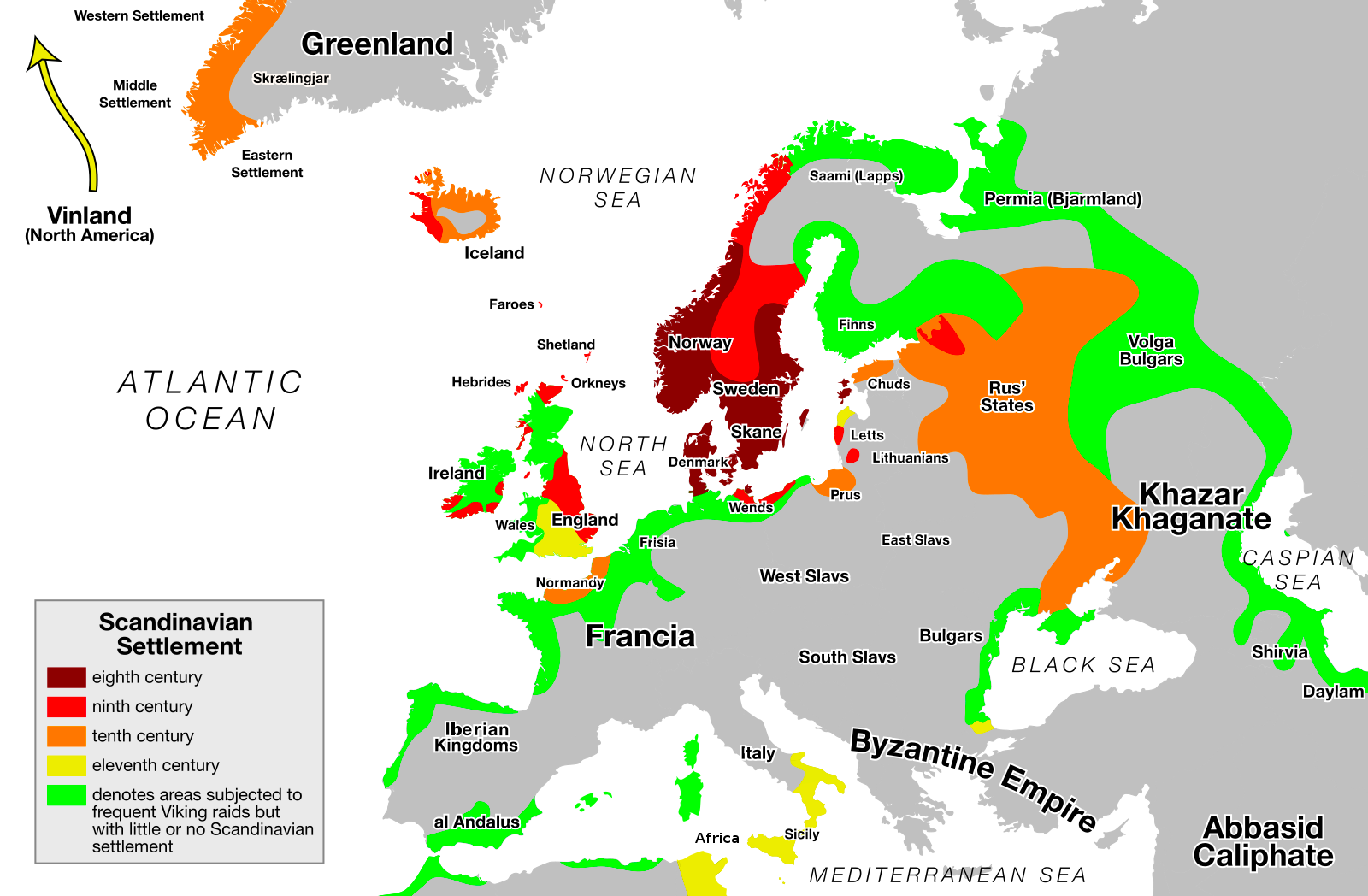
The dark red area is where Vikings came from. In the 700s (8th century), they started raiding the Baltic sea first, and then England and Scotland. Soon after, they started settling there.
Initially, they used hit-and-run techniques, targeting especially religious sites since they tended to be secluded and held lots of riches. But over time, as they succeeded more and more, they started settling the regions closest to their area of influence in the Baltic and North seas, including parts of England, France’s Normandy (which then would invade and conquer England), Pomerania (current-day Germany and Poland on the Baltic, just below Sweden), the Baltic countries.
You can see on the map that by the 800s and 900s they also made it to weirder regions: On the north, Iceland, Greenland, and even America. On the south, Italy, Sicily, and current-day Tunisia. On the east, what’s today Belarus, Russia, Ukraine, all the way to Constantinople! What happened?
Northern Heat
The Norse from present-day Norway were the ones with the least land and most used to the cold, so they tended to explore lands further north. They were the ones to settle Iceland, Greenland, and reached all the way to L’Anse aux Meadows, in present-day Canada. Why?
When looking for places to settle, they looked for three conditions:
Access to the sea, with a reasonable place to pull up a boat.
A patch of reasonably flat, well drained land suitable for a farmstead and with the potential for some grain cultivation.
Extensive grazing areas, as the carrying capacity would be rather low given the poor vegetation.
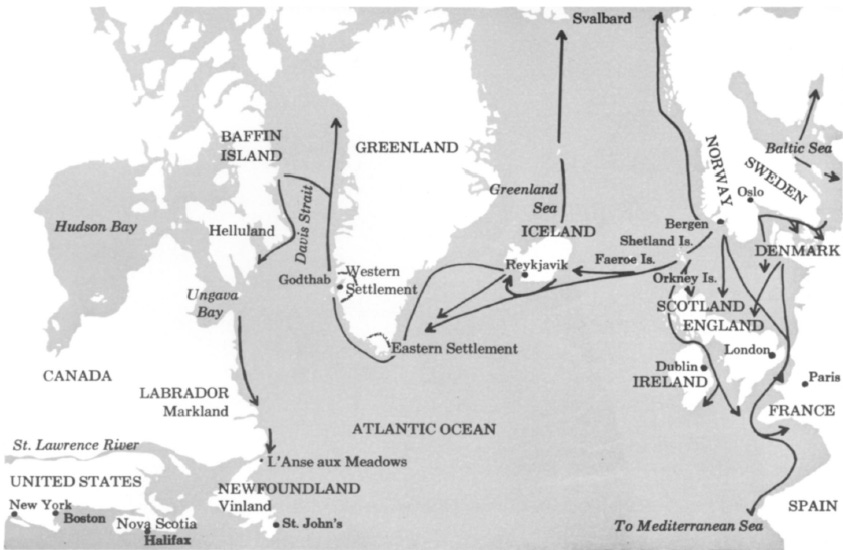
At the time, something happened that made these regions quite hospitable: Between 950 and 1250, the North Atlantic was 1°C hotter than today due to the Medieval warm period.
You can see the importance of natural heat in the colored map of their settlements above: The most settled areas of both Greenland and Iceland were on the southwest, regions bathed by the warm water of the Gulf Stream, which comes from America’s Gulf of Mexico and Caribbean Sea.
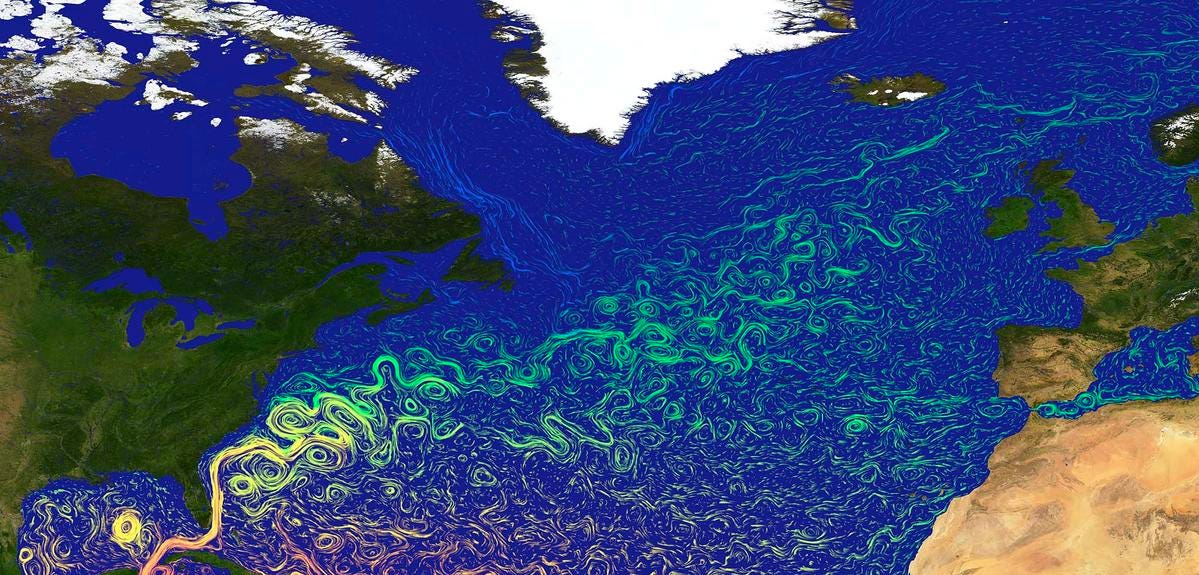
This warm-water origin results in a temperature warmer than would be normal this far north.
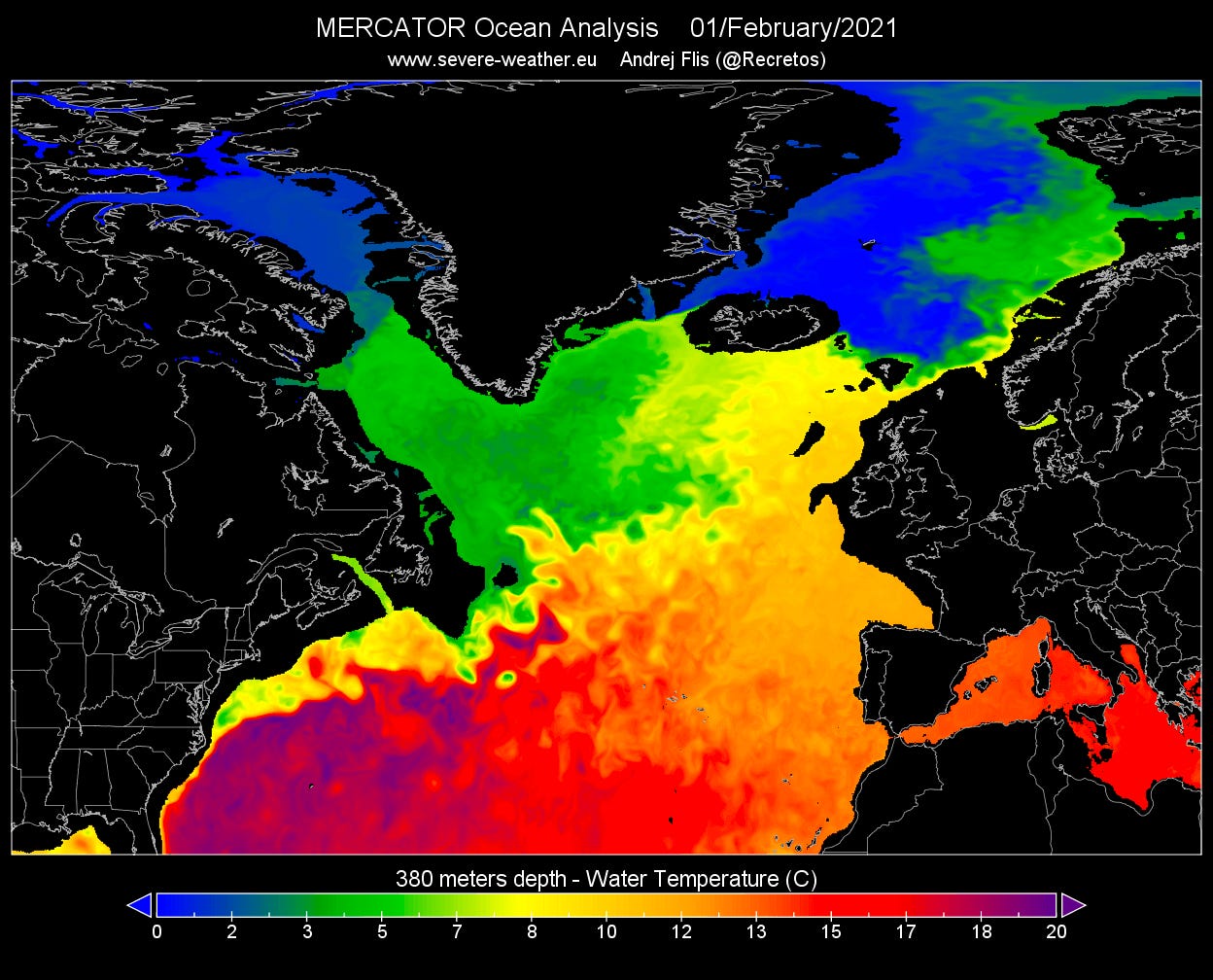
Since these regions were barely populated before their arrival, Vikings had no problem settling them. In Canada, they did find locals, which made it harder to settle, and eventually they left.
These warmer temperatures owing to the Gulf Stream continue to this day, but around 1000 AD, they were even warmer than usual. This not only meant a better climate for the settlers, but also quieter seas—ideal for more intense circulation in the North Sea.
Eastern Rivers
The Northern Sea is pretty shallow. There are frequent sand embankments. So Vikings had pretty flat ships, which were ideal not just for raiding coasts, but also rivers. This is why in the west the Vikings reached all the way to Paris—and even beyond. But western countries were challenging: Sea waters can be treacherous, and Western Europeans could fight back. Many raids ended in annihilation.
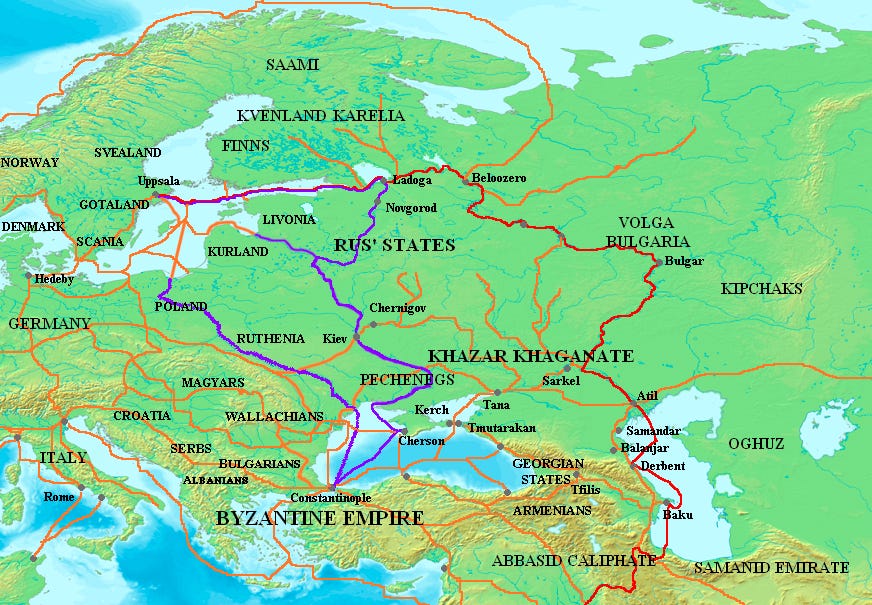
Meanwhile, rivers in Eastern Europe had easy access from the Baltic, were easier to navigate, and allowed both trade and raids in huge regions, all the way to the Black Sea and Constantinople.
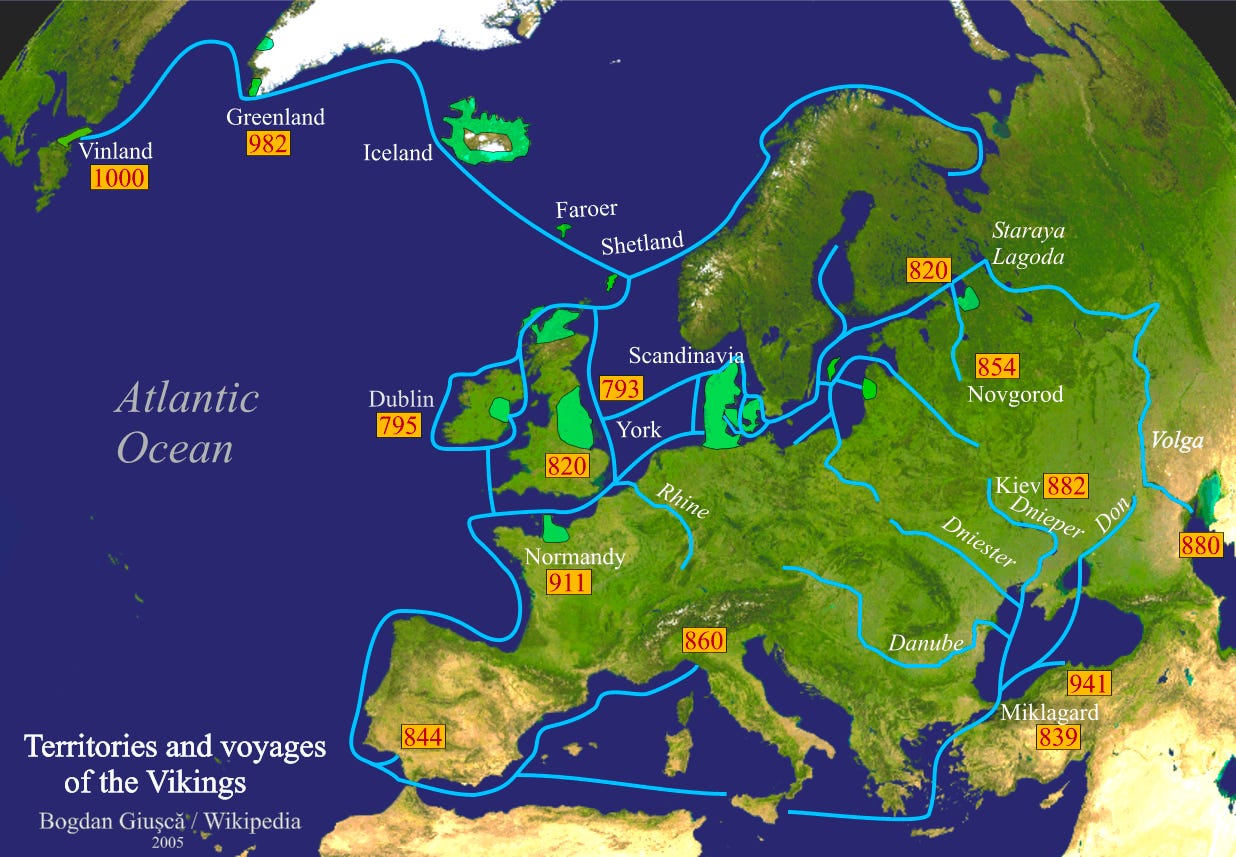

The Vikings in that part of the world were called Rus and settled a region that now sits across Russia, Belarus, and Ukraine. Russia today stands for the land of the Rus.
Vikings—called Varangians in the Eastern Roman Empire based in Constantinople—were the key trade connectors between Constantinople, Northern Europe, and the Abbasid Caliphate based in Baghdad, which could be reached through the Volga River and Caspian Sea. Lots of Islamic silver has been found in Sweden.
Kingdom of Sicily
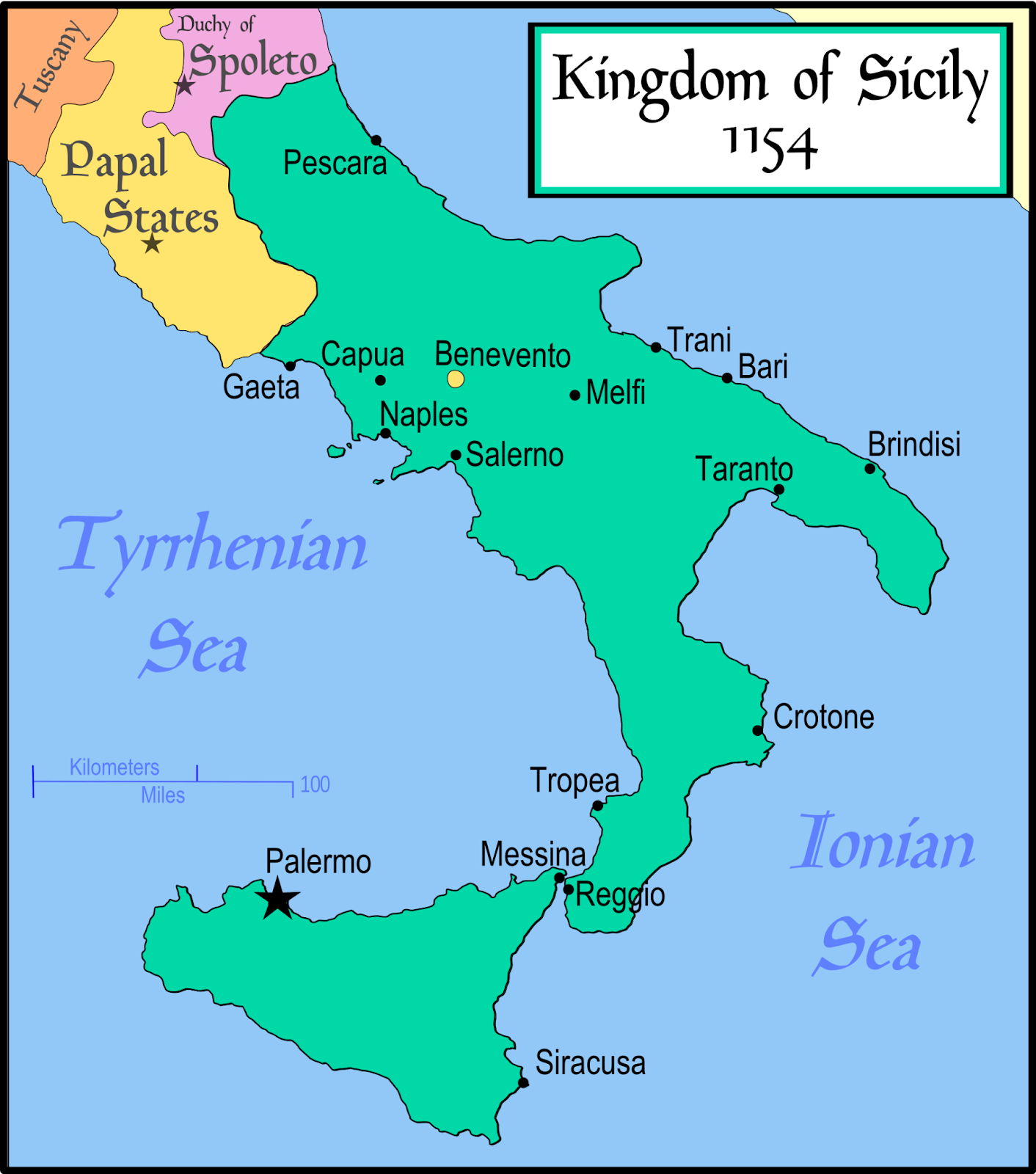
Some Vikings sailed down the European coast, raiding what’s today France, Spain, and then entering the Mediterranean to reach Italy and Tunisia. There, they witnessed the wealth they could earn through military support of local kingdoms. Over the centuries, more and more Vikings arrived as they were prized mercenaries. The same was true on the Eastern side: the Byzantine Empire employed Varangians (the Vikings from the Eastern Europe river system) who sometimes would even fight Normans (the Vikings from French Normandy).
Over time, Viking military power allowed them to conquer several regions in Southern Italy. So much so that, eventually, a Norwegian king was able to unite Southern Italy and Sicily, which had been previously occupied by Islamic Byzantine, or local Italian forces.
Why Did Vikings Disappear?
As fast as Vikings appeared in the 8th-9th century, they disappeared in the 11th-12th, about three centuries later. Why?
We’ve discussed one of the reasons: heat.
Heat
The Medieval warm period ended in the 1200s, slowly sliding into the Little Ice Age. Colder weather was not ideal for farming in Scandinavian regions. It would have likely reduced the population growth of Norse people, while the population of the rest of Europe was growing.
Another factor was religion.
Christianity
Over the centuries of interaction with Europeans, the Vikings lost their Nordic religions, adopted Christianity, and brought it back home. The problem with the Viking way of life is that you were not supposed to enslave fellow Christians. That was unfortunate for the Viking economy and customs based on raids, slavery, and female kidnapping. As Christianity expanded, pools of slavery candidates tapered off.
The Islamic world at the time was far away, strong, and getting stronger. Not a great source of slaves. Vikings did participate in Middle Eastern crusades, but these weren’t that successful.
Finally, another factor was probably the development of Northern Europe. The warm weather that benefited Vikings also benefited agriculture across Europe, especially the Northern European Plain. Until then, it had been underexploited for farming, but starting in the 8th century, that started to change. Several technologies helped increase agricultural production in Northern Europe.
Horses
Horses are stronger than oxen and eat the same or less. The use of horses for plowing fields meant more and better plowing for the same amount of food. Around that time, horse usage for agriculture expanded in Europe, with new horse collars appearing.
More horses meant more horseshoes and ironworks. This was convenient because around that time another technology appeared to change the face of Northern Europe: the heavy plow.
Heavy Plow
Since Northern Europe is so flat and crisscrossed by rivers, the soil is damp, compact, and heavy. The Roman plow, which was adapted to the drier, lighter Mediterranean soil, was not able to cut through the heavy soils of the Germanic and Scandinavian regions. As a result, Northern Europe was not that fertile during Roman times.
But around the 11th century, the heavy plow started proliferating in Northern Europe. Since it was made of iron, it was heavier and broke less often, allowing it to plow deeper into the heavy Northern European soil, and making it much more fertile.
Other Agricultural Technologies
Technological development starts picking up in the Middle Ages. Other agricultural technologies appear. For example, watermills start using the force of rivers to grind all the new grain. Farmers realized that they could grow their crops in a three-field system instead of a two-field system, increasing their productivity by 30% and reducing the risk of crop failure and famine.
Population exploded as a consequence.
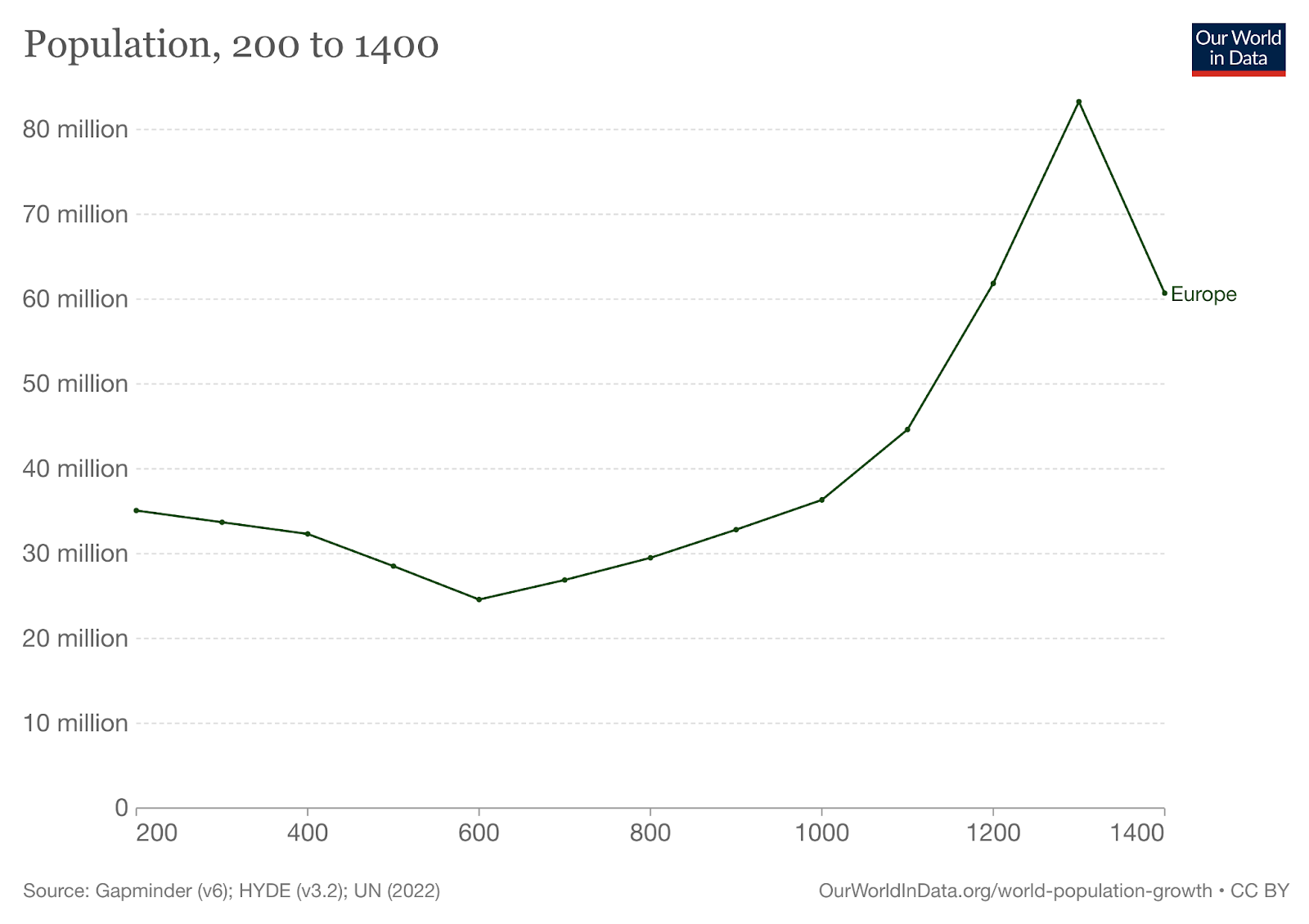
In a space of 200 years, the population of Europe doubled. Europe got more farmers, but also more soldiers. Hard to keep pillaging your way across Europe as it’s becoming more heavily populated and armed.
Europe in general kept developing from there on. Venice, Genoa, the Hanseatic League, the Holy Roman Empire, England, France, Spain… As their economies and military started growing in tandem, they became too strong to raid.
Takeaways
The Vikings didn’t suddenly appear from nowhere:
Scandinavia was the best-positioned place to take over the North Sea after the fall of the Roman Empire. Other regions were too poor or focused on land.
Weather and technological diffusion slowly made Scandinavian farming productive, which increased the local population.
The lack of available land, the presence of water, and technological diffusion pushed Scandinavians to the sea. The lack of competition made it easy to control.
The agrarian growth and lack of available land also created economic inequality, which caused sexual inequality. Young Scandinavian males were forced to sail abroad if they wanted wives and wealth.
This led to economic inequality, which led to sexual inequality, which meant most low-status men didn’t have access to wealth or females.
A social system emerged, in which young Scandinavian males had a strong incentive to raid and plunder their way to success, and they had little foreign competition to stop them.
This Viking expansion continued unabated for centuries, propelling Vikings to places as far away as present-day Canada and Iran.
But while good conditions initially favored Scandinavian control of the North and Baltic Seas, as these conditions changed, their power dwindled:
Their neighbors learned from them, increasing competition.
Weather got colder, likely reducing farming yields and population growth compared to the rest of Europe.
Conversely, Northern Europe exploded in population, mainly thanks to technological improvements.
At the same time, the expansion of Christianity made it morally untenable to live off of enslaving your neighbor.
I initially started looking into this topic simply curious. But after reading the literature on the topic, what pops up is the same lesson as always: Big Men don’t matter that much; battles don’t matter that much. There are some forces that push everything around us, whether we realize that or not. In the past, these forces were mostly geographic, climatic, or something like that. Over time, technology has been taking over. For us to understand the future, we need to understand how these forces defined our past.
For example, we’ve been recently hearing about incels—involuntary celibates—who are angry at a social system that doesn’t give them access to sex. The Vikings are an interesting precedent: For them, too, inequality, local conditions, and their social system prevented access for younger Norsemen to sex and wealth. Their way to solve that was to send them abroad.
Today, we also have increasing inequality and social conditions that make access to wealth and sex hard for many young males. This should be concerning, as we can’t really send them abroad to conquer or die. If trends continue, this problem will only get worse. What’s our answer as a society?