Society Is a Brain - by Tomas Pueyo - Uncharted Territories Society Is a Brain
Some content could not be imported from the original document. View content ↗
2021年9月19日
∙ Paid
In this week’s free article, You’re a Neuron, we discussed why we can see ourselves inside our networks as neurons inside a brain. It follows that societies are brains, too.
This lens can shed light to some of the biggest questions of our time:
Where does creativity reside in a network?
Growth vs. Degrowth: should we keep growing the human population?
Individual Rights vs. Network Value: should we sacrifice the few for the many?
Centralized vs. Decentralized Management: do we need central gatekeepers?
DAOs: What are they? Are they good?
Does consciousness emerge from the complexity of networks?
Let’s start!
Distributed Creativity
“Don’t reinvent the wheel.”
Or as Mark Twain said:
“There is no such thing as a new idea. It is impossible. We simply take a lot of old ideas and put them into a sort of mental kaleidoscope. We give them a turn and they make new and curious combinations. We keep on turning and making new combinations indefinitely; but they are the same old pieces of colored glass that have been in use through all the ages.”
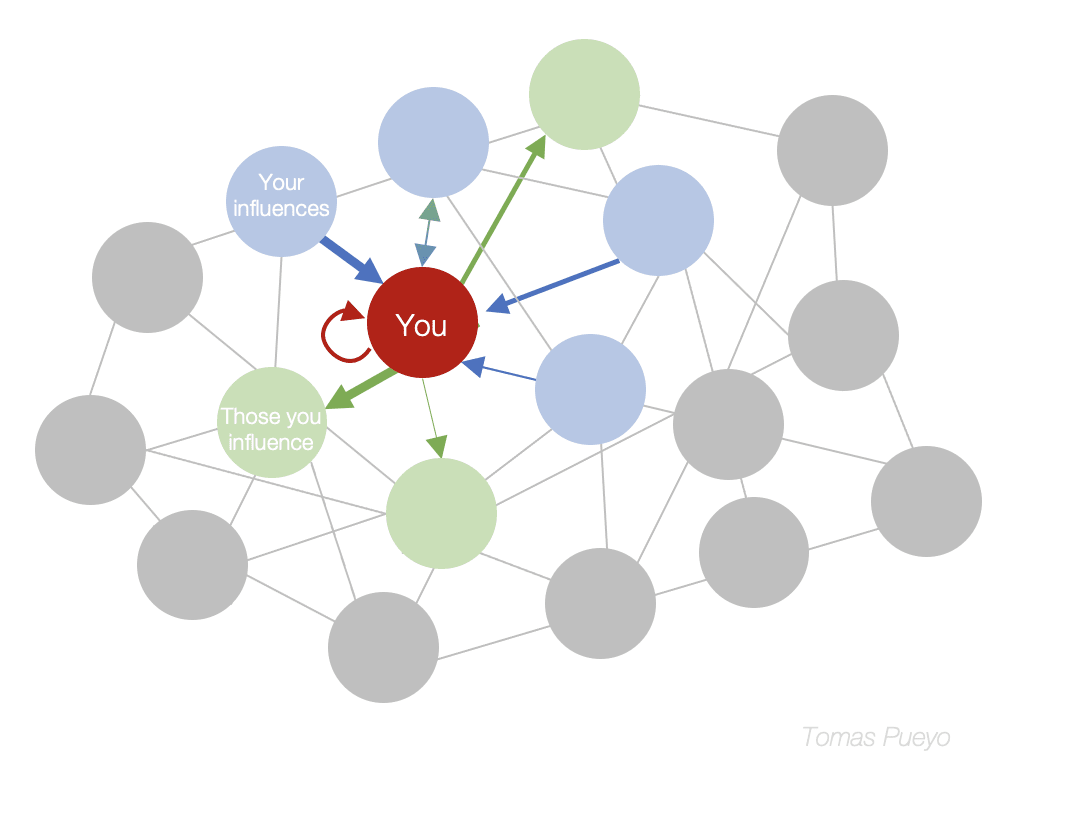
Creativity makes much more sense when considered as the byproduct of a network. Other people feed you ideas. Your experience is unique, because no other neuron—no other person—has had the same experiences as you, nobody has had the same inputs from the same neurons. If your input from these other neurons is interesting, combines well, and you process it in an interesting way, you can just repurpose what others already know and create something new out of thin air.
This vision of creativity is refreshing because it means it’s ok to not have new ideas, it’s ok to just repurpose in your own, unconventional way what’s already been said .
If we connect this to our skill stacking concept, you can visualize yourself as a neuron that connects to distant network areas that are not usually connected to each other.
For example, there’s a neurodiverse condition called synesthesia. Brains of people with it connect senses that aren’t usually connected. As a result, they can taste a symphony, hear a smell, see numbers with colors and personalities...
The brains of people with synesthesia have a unique perspective because of these unique neural connections. This is how, for example, Anne Patterson created such a unique installation in San Francisco’s Grace Cathedral:
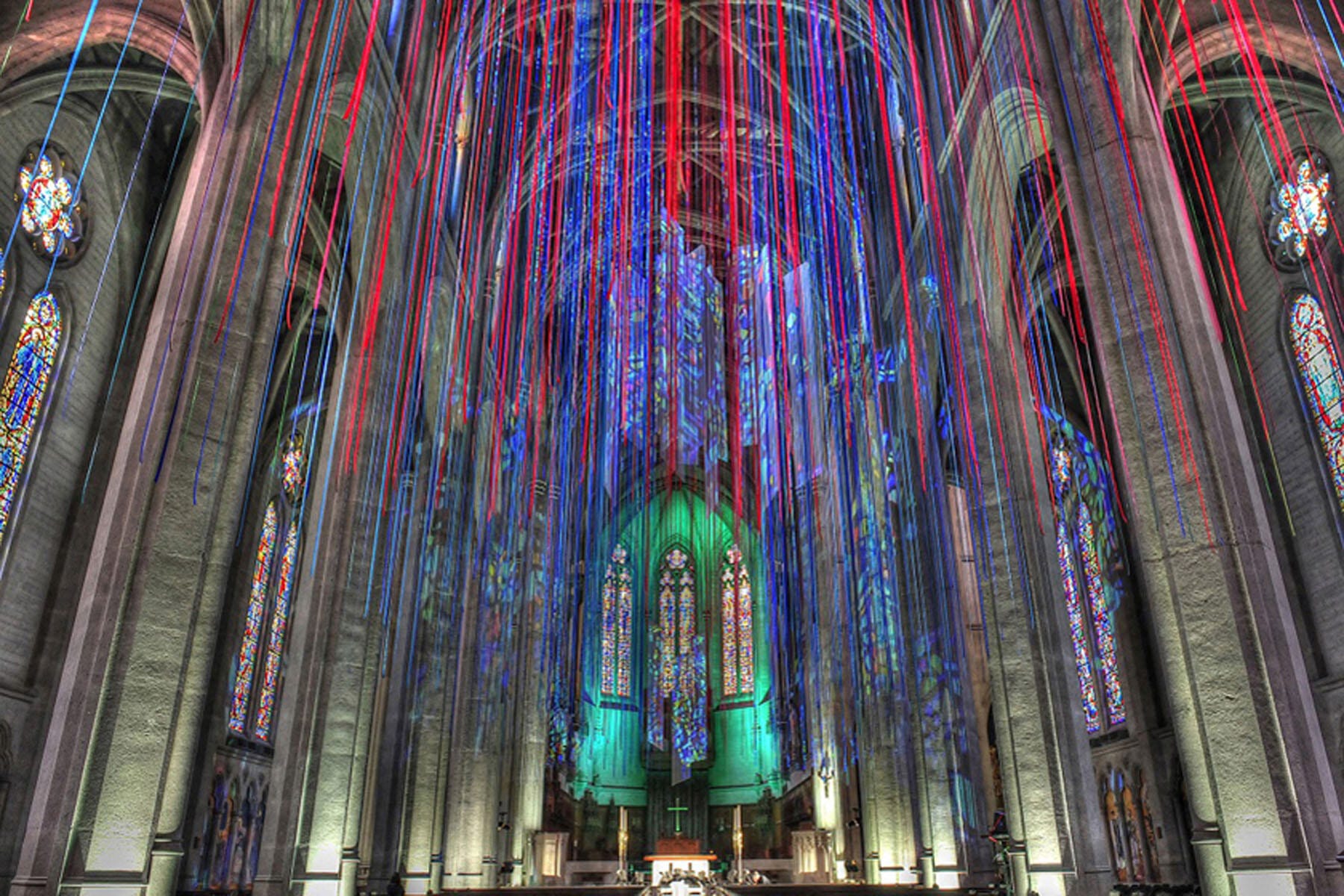
Similarly, if you connect areas of the world that are seldom connected, you as a neuron will have a unique perspective that can generate creative thought by the simple act of being uniquely connected to these distant neurons.
2. Bigger Networks Are Better
For brains, quantity has a quality of its own. The more neurons and the more connections between them, the more intelligent the network. This is as true for brains as for ant colonies or neural networks in artificial intelligence.
A fantastic illustration of this comes from Robert Wright in Nonzero:
“The larger and more dense the island’s population [in Polynesia], the greater its division of economic labor, the more advanced its technology, and the more complex its polity.”
Something similar happened in Tasmania:
“The melting polar ice caps severed Tasmania and Australia. Tasmania’s small population promptly fell culturally behind the more numerous Australians. Modern explorers, on contacting the Tasmanians, found them to lack such Australian essentials as fire-making, bone needles, and boomerangs.”
Generalizing:
“The story told by these and other such cultures on the ethnographic record—these “living fossils” of cultural evolution—is repeated by the archaeological record. During the Middle Paleolithic, as the human population grew slowly, the rate of technological innovation (not just the total number of technologies) also rose slowly. Then, around 40,000 years ago, both of these trends passed milestones. The human species was for the first time large enough to encompass the Old World, occupying virtually all inhabitable parts of Africa and Eurasia; population growth would hereafter raise population density. Meanwhile, cultural evolution reached a level that warranted a new archaeological label—the Upper Paleolithic. During the Upper Paleolithic, the average rate of technological change would be one innovation per 1,400 years, compared to one per 20,000 years during the Middle Paleolithic. Then, after 10,000 B.C., during the Mesolithic, with population growing faster than ever, the rate of technological innovation reached one innovation per 200 years (including such gifts to posterity as combs and icepicks). Hunter-gatherer societies, as we’ve seen, reached a new level of social complexity.”
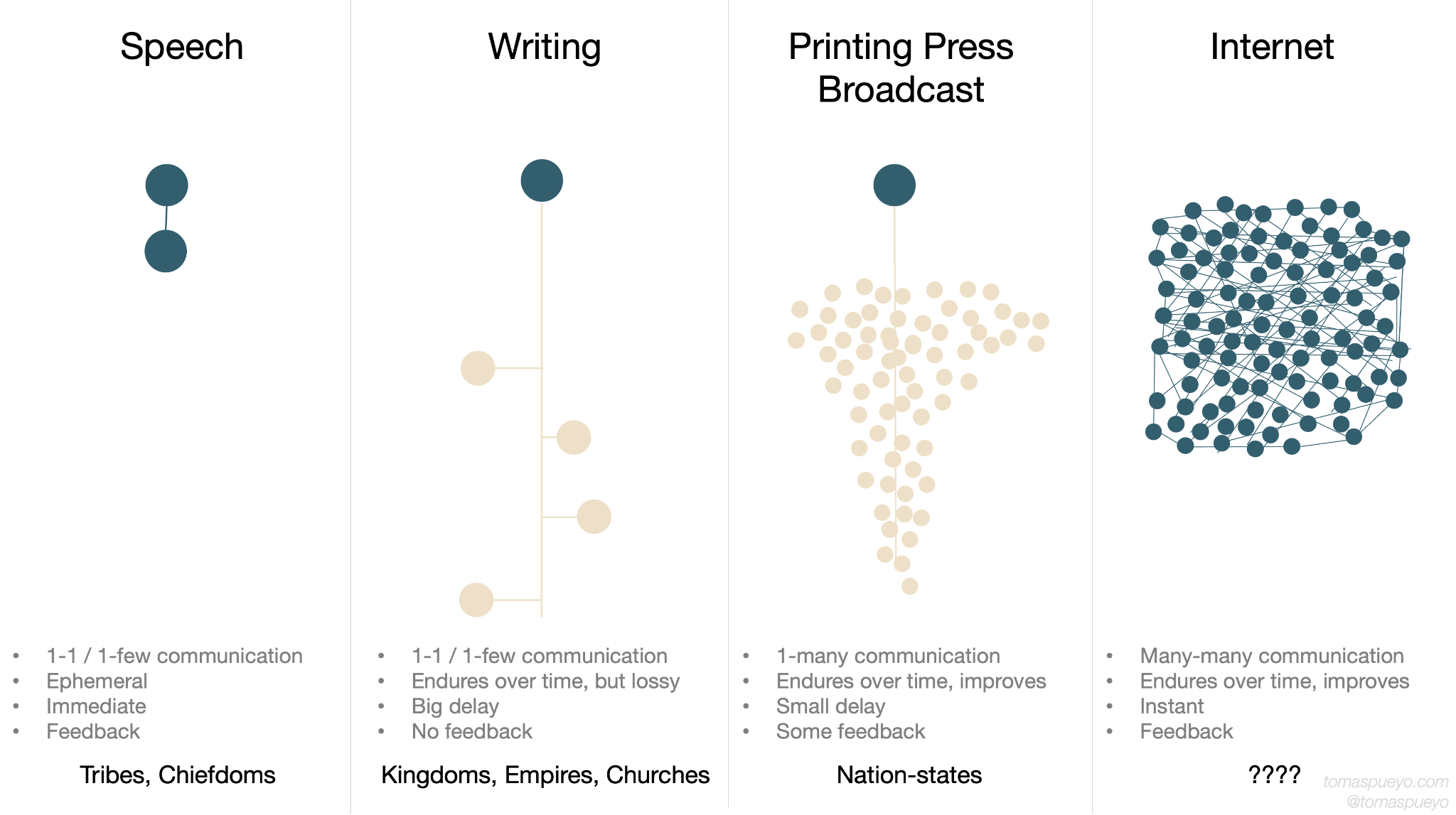
Remember how we compared networks at the time of the printing press, broadcasting, and internet:
Before the printing press, the Church had the strongest network, and so was the most powerful.
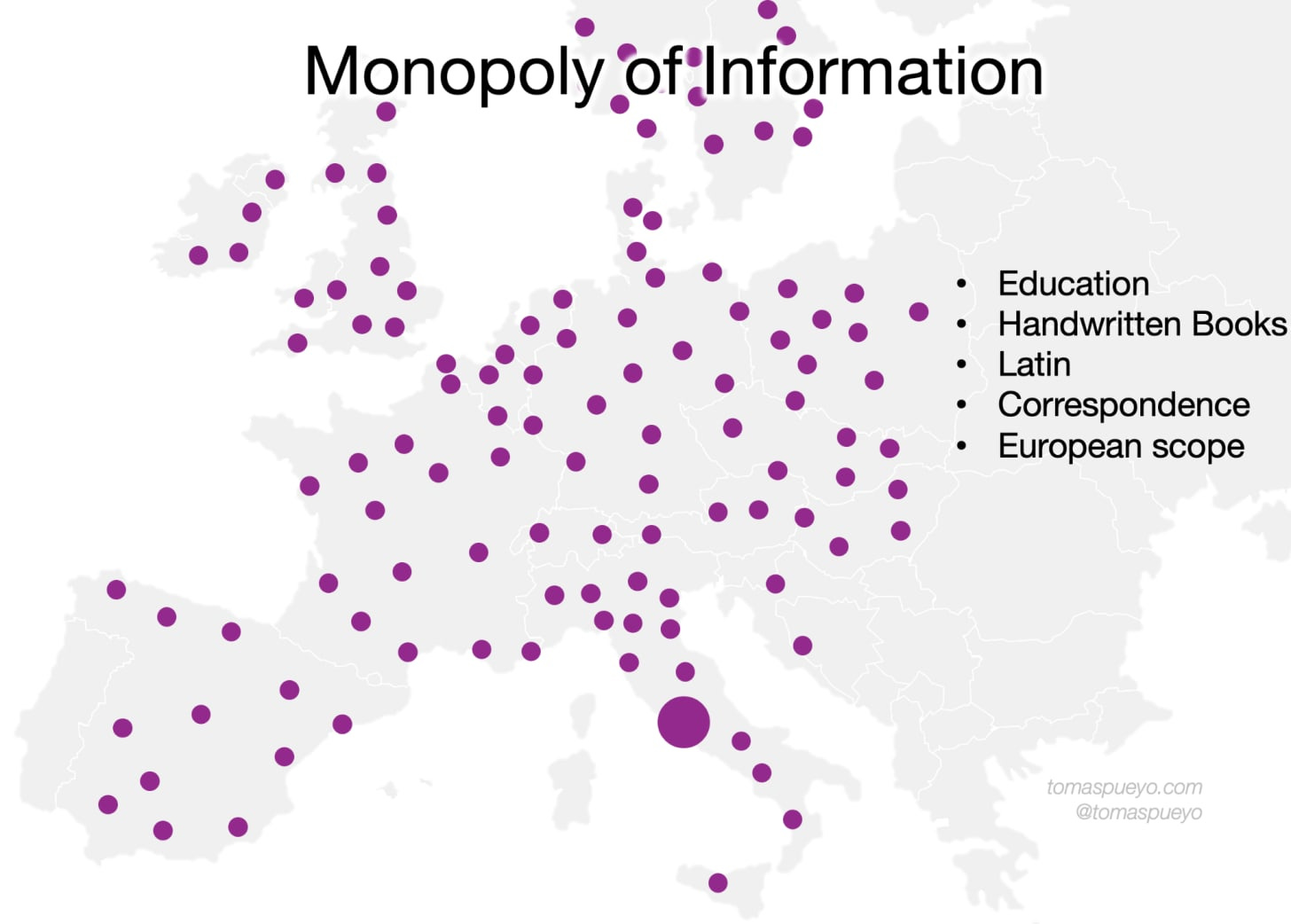
But as technologies of information change, they rewire our societies (brains) and connect them with much more density, making them better at “thinking”.
Is it a surprise that the time of the biggest growth in population, the 19th and the 20th century, were also the times when human wealth has grown the most per capita? Is it a surprise that the Western country that was growing the most through immigration, the US, also became the most powerful?
That’s why history has network effects.
Some content could not be imported from the original document. View content ↗
What are the takeaways of all of this?
We should all learn to speak English.
We should accept more immigrants.
We should have more babies.
And we should work to slow down aging.
More generally, the Degrowth movement is a catastrophe that needs to be fought. Of course, climate needs to be addressed, but for mankind, not at its cost. I’ll write much more about this.
3. Individual Rights vs. Network Value
In a brain, neurons don’t matter. Only the brain does. This is the best way to ensure the brain thrives.
But Western societies enshrine individual rights. Neurons are sacred.
Does it mean that our individual rights are at the expense of faster development for the overall society?
We can see how this is the case, especially in innovation. We are very wary of approving new drugs, allowing cryptocurrency exploration, tinkering with our genes with CRISPR, testing drone delivery… We don’t want people to die. We want to be cautious.
But how much faster could Tesla learn if we allowed a few deaths a year in its autopilot? How many more deaths would be saved this way, by accelerating the advent of self-driving cars that avoid stupid human accidents?
If we were much more open for people with terminal illnesses to try new drugs, it could shorten their lives, but we would find out much faster which drugs work and which ones don’t. Wouldn’t that solve many more lives in balance?
The problem is most obvious with masks: they’re an objectively cheap and easy solution that could save thousands of lives. The only costs are a few cents per mask and some whining. And yet some countries haven’t mandated them.
In many cases, individual rights do reduce network value. When that happens, societies should reconsider their policies.
However, it doesn’t mean individual rights should be superseded by social rights. What if the rules that govern our interaction between us were flawed? Think of Communist China or the Soviet Union: they had much more rigid rules for the interaction of neurons, and the result was catastrophic.
We don’t know yet how to optimize the interaction between people. Individual freedom gives you a failsafe, a way to get crazy ideas, to explore new things, and to make sure the entire network isn’t brought down. It’s a much less efficient system than we could have, but since we haven’t discovered something much better, we should still keep individual rights as superimportant.
However, the majority has substantially fewer individual rights than our ancestors: you can’t sell what you want to whomever you want, you can’t pollute as you wish, you can’t kill, or aggress, or oppress a minority as you wish… This limit in what we can and can’t do has opened up even more opportunities that were unachievable before, so the loss in freedom is worth it.
But the further in time you go, the fewer laws they had, the fewer things were forbidden for the citizen majority. As we have more people, we need more coordination between us, and we learn better what works and what doesn’t to coordinate us. This should make us more efficient.
All of that means we will probably continue losing individual rights to gain network value. We will become more and more like neurons, sacrificing our freedom for the sake of the brain—society.
4. Centralized vs. Decentralized Management
You could argue that this is what China is doing: sacrificing neurons (citizens) for the power of the brain (the state). But the approach they’re taking is completely flawed.
There isn’t a central planner in the brain who decides what different neurons should do. Power is distributed. The magic of the brain happens because the neurons specialize in their areas, and the rules connecting the neurons are magically productive. That’s the equivalent we should strive for.
For example, you, right now, reading this article, are participating in the brain network or global knowledge, in the small part of the brain called “Uncharted Territories”. It’s a piece of the global brain, the global computer.
But in China this doesn’t exist. They firewall foreign content away from the country, they limit what people can consume and say. The brain is impeded, information doesn’t flow, neurons don’t connect to their full potential. Instead, the government forces neurons to connect to specific neurons—party members—which gives these much more power than they would deserve otherwise. All of this tinkering with the Chinese metabrain makes it less efficient.
According to this, the decentralization of information should be better for human progress.
If we combine this point with the previous one, it means we’re going towards a world where individuals relinquish freedom for the good of society, but do so in a decentralized way: we create the rules and enforce them together.
5. What About DAOs?
That’s really what Decentralized Autonomous Organizations, or DAOs, try to achieve. They are thoughtful about codifying the relationships between people so that no central coordinator is needed.
This is revolutionary.
The idea comes from the Bitcoin paper, which developed the concept of the Blockchain. It taught us that we didn’t need a gatekeeper for everything. We can agree on rules and write them on code so we all know exactly what they’ll decide in every situation.
It’s a bit like trying to make us into proper neurons, with good, well-codified connections between us.
You can imagine where the problem lies: figuring out the right rules is devilishly complicated.
But this system also allows us to quickly iterate, because when there are problems, we can “debug the code”, look into the specifics of why the law is wrong, and correct it. That means our social codes can evolve faster. And one organization can easily copy the code of another organization that’s working well, which means that the knowledge of good organizations can travel much faster than before.
We’re in the early days of DAOs so we can’t know where they’re going yet. But I can’t wait to see how they evolve in the coming years.
6. Automating the Brain
And if we code our relationships, isn’t it a good idea to automate a good part of them? What if we grew our networks by adding not babies and immigrants, but also artificial intelligence nodes [1] ?
It’s useful to think about the role of automation in society as a brain.
Wherever software is better than humans at sucking information in and spewing out something valuable, it will replace human nodes (jobs). Computers have a major advantage for that: they can consume substantially more information from substantially more sources at a substantially faster pace than humans.
Their only handicap is processing quality. For now. There’s a branch of AI called Neural Networks which uses similar concepts as the brain to generate intelligence. But so far, most neural networks have substantially fewer nodes and substantially less information than humans.
Think about it: not only do you have 100 billion neurons and 100 trillion connections. You’ve been training them for your entire life. Hundreds of millions of seconds with inputs to learn from.
But as neural networks get close to this level of complexity, they will start replacing us. GPT-3, from OpenAI, is going in this direction:

Today the world changed forever.
Why? Because a group of Artificial Intelligence researchers released something called "GPT-3".
In short: it's a computer program that can interact like a ridiculously intelligent human.
And it will blow your mind 👇
GPT-3 can do law, coding, design, strategy, poetry, philosophy... It’s still in its infancy, but what it can do well is jaw-dropping.
So one thing automation will do is replace nodes in the network. The other thing it can do is manage the network itself.
It’s already what’s happening in social media with all the recommendation algorithms. But you can imagine this happening in other aspects of our lives soon. An algorithm that stirs you in the right direction for the right jobs, that manages complex problems that a DAO didn’t take into account, that helps us decide what’s moral and what isn’t...
How much distance is there from such a complex network able to do these things and… consciousness?
7. Are You the Only One Conscious?
Can a neural network be conscious? Is an ant conscious? Is the colony?
You know you are conscious—that’s the only thing you can be sure of. But where does your consciousness come from?
We don’t know yet. What we do know is that it doesn’t come from some specific area of the brain that creates consciousness. That’s called the Homunculus Phallacy.
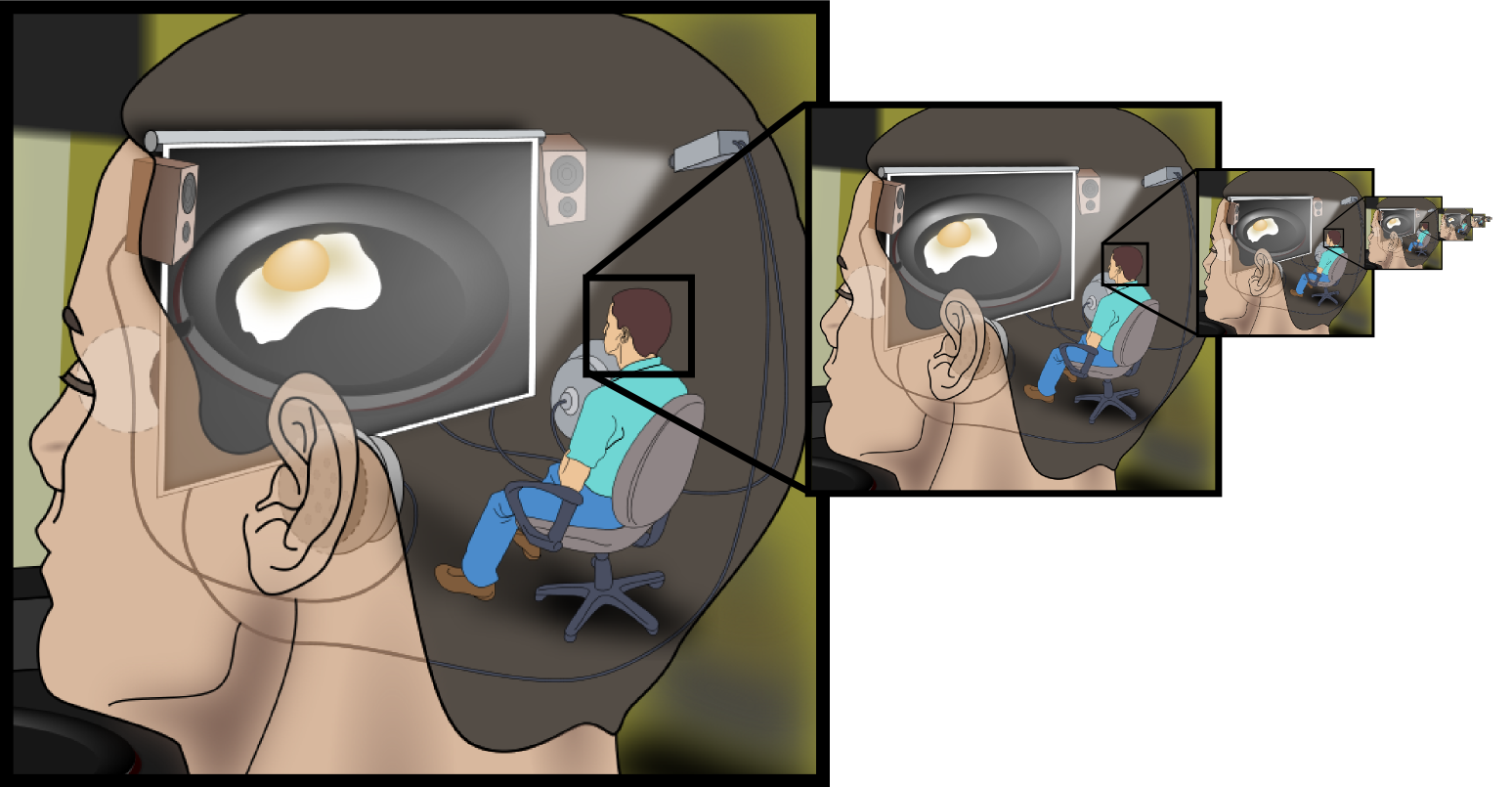
If there’s no specific area that creates consciousness, then it needs to be distributed. It must emerge from the connection between neurons.
But why is it that, of all the levels of emergent complexity, the brain is the one level of the stack that is conscious?
How do you know your cells aren’t conscious? Maybe your phagocytes are hangry today because of the COVID attack? Maybe they just want to police the hell out of the body until they drive these deplorable COVID viruses out? Would you know it if your cells were conscious?
How do you know countries are not conscious, like kids in a playground trying to steal from each other and beat each other and hang out and trade and befriend each other?
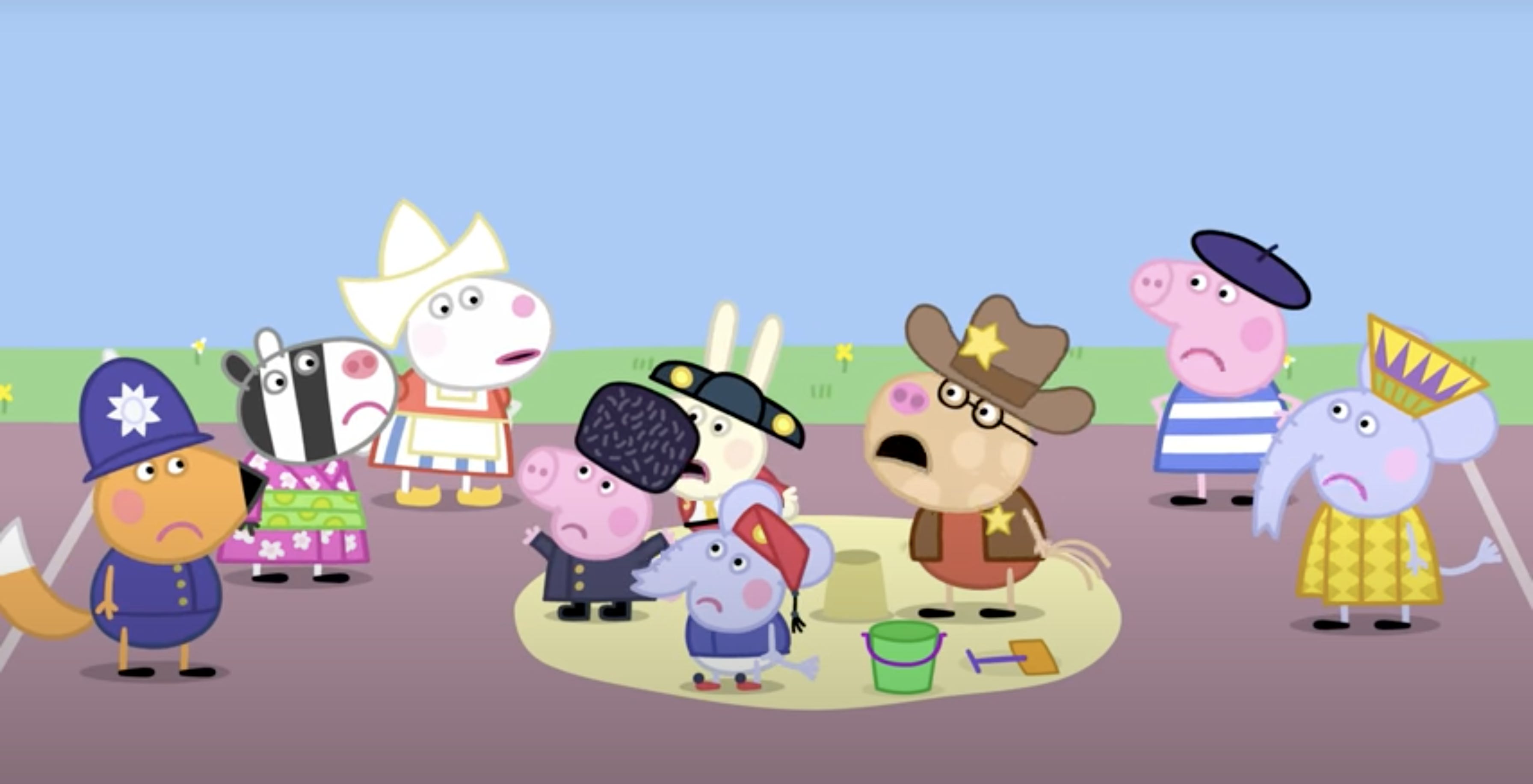
How do you know mankind is not conscious? Maybe it’s thinking right now:
“Ugh I really want to go to Mars but I’m always so tired! I used to have so much more energy when I was younger and went to the Moon. But now, a few dozen turns ago (around the sun), I’m just lazy.I need to build up the energy to go and conquer Mars! I’m sure I could settle there. OK, let’s build some good rockets. Let’s spend a few cells focusing on that.”
This is in fact one theory of consciousness. It’s called Integrated Information Theory. According to it, consciousness exists in all connections between things. The more connections, the more consciousness emerges from the complexity of the network [2] [3] .
What if the universe was the most conscious brain?
I hope you liked today’s newsletter! Some of these topics might seem a bit weirder to you than others, but they’re fundamental to the world we’re building together.
One of the key insights I’m trying to convey in this newsletter is that humans are just pieces inside a system. The design of the system matters much more than the individual pieces. Unfortunately, nearly all the coverage of news we have today is around stories of individuals doing specific things. That is not going to get us to improve our lives, because we see ourselves as jointly optimizing the system, rather than pushing for one or the other narrative.
If you agree with this type of lens, make sure to spread the concept!
Benedict Evans has an interesting article about the role of humans and automation in social networks.
The actual theory is debatable, because it tries to quantify consciousness in a way that’s hard to falsify and sounds counterintuitive. But it doesn’t mean it’s in the wrong direction. It might simply mean that the current iteration is flawed.
Tim Urban, from Wait But Why, has an amazing series of posts that talk about the complexity emerging from individuals. Don’t miss it!