The Rise and Fall of Civilizations—and What It Means for the US The Rise and Fall of Civilizations—and What It Means for the US
Some content could not be imported from the original document. View content ↗
2021年7月5日
∙ Paid
The conversation around last week’s article History’s Network Effects is fantastic. Keep it coming!
Enough of you have asked for GeoHistory articles about India and China that I’ll write them soon. I’m enjoying writing them! Here’s a sneak peek.
Today, I’ll go deep into some aspects of the last GeoHistory articles: why civilization in Europe appeared in Greece and not in Northern Europe, why the Roman empire fell, a quick touch on why hunter-gatherers became farmers, and what all of this has to teach us about today. Notably, I see parallels between Rome’s fall and the decline of the US, and we can trace it back to a specific policy from today.
Later this week, I’ll go deeper in some areas of recent articles: remote work and S-curves. This is one of the goals of our premium articles: go deeper, explore different aspects, and make them useful to our everyday lives. Enjoy!
The Birth of Civilization in Europe
Civilization in Europe appeared first in Greece. But Greece is not that fertile. It’s super hilly. Why not in Italy? In the Rhine Valley? In the amazingly plentiful northern plains of France?
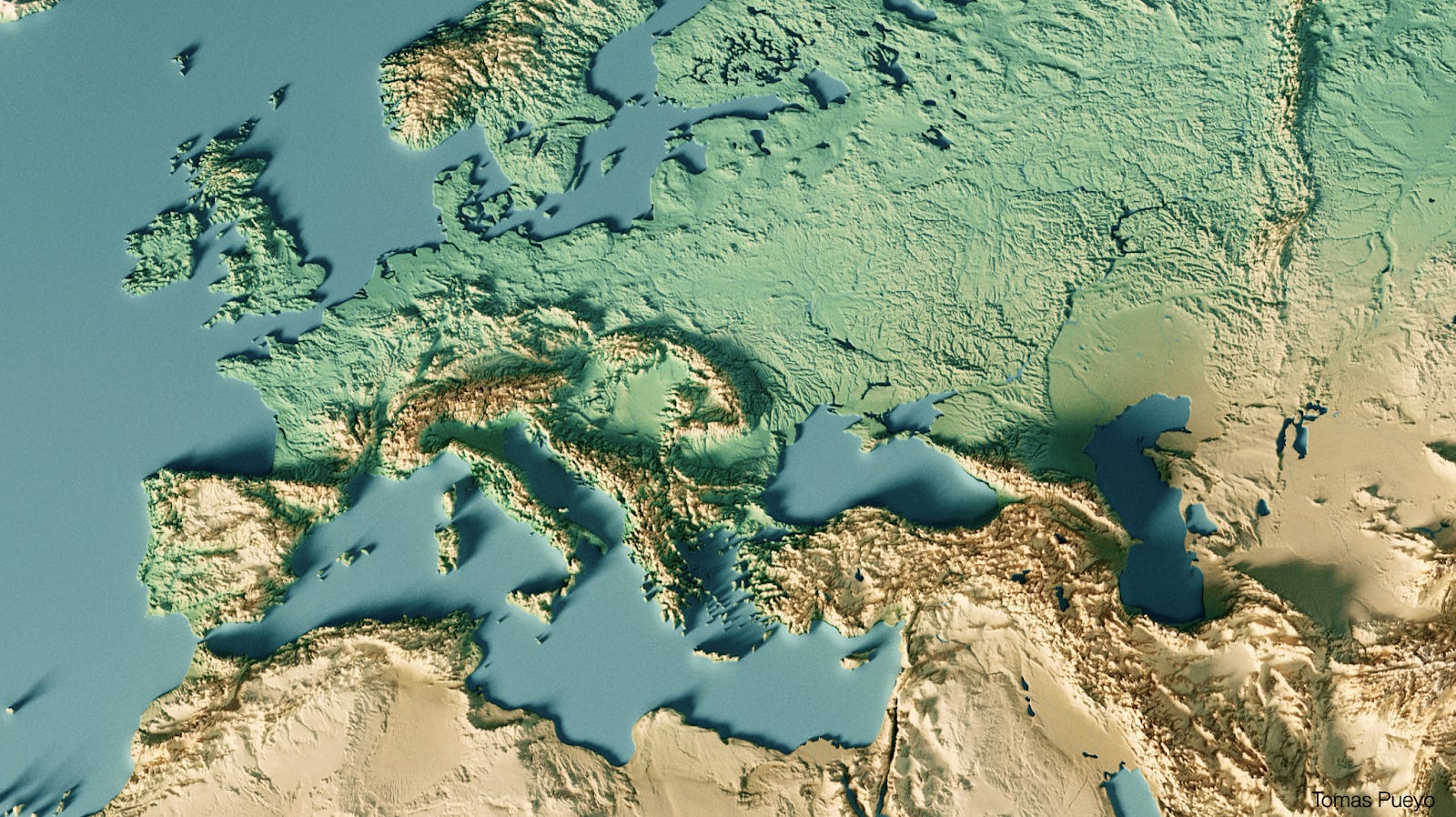
It’s because Greece is the closest European area to Mesopotamia.
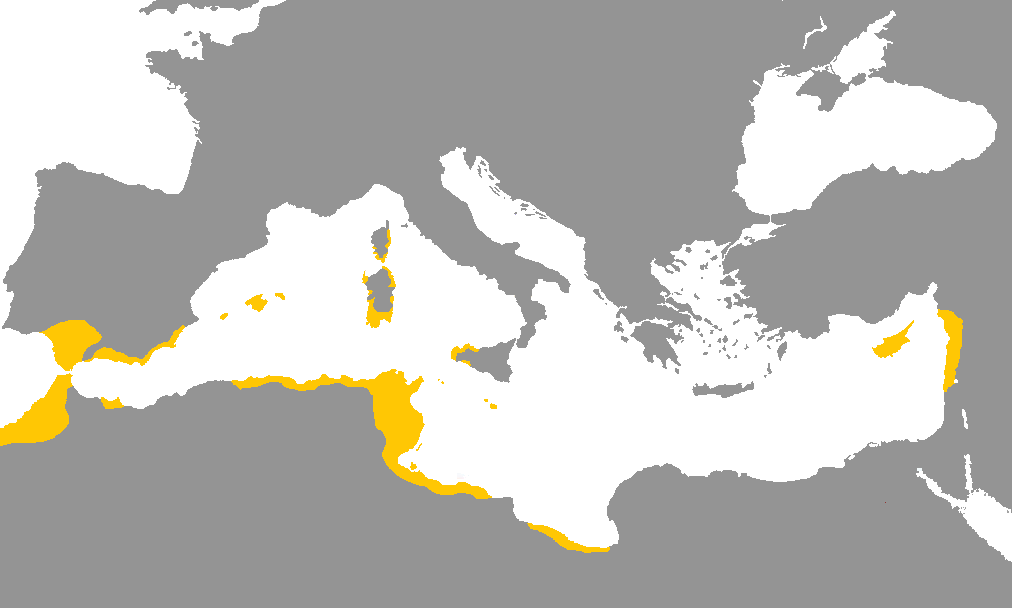
Look at the first city in Europe: it’s Knossos, in 1,800 BC, in… Crete, the Greek island. Crete is not that great a piece of land. What it is, though, is close to the Levant, what is now Lebanon. Just before Knossos was founded, many cities were founded in the Levant. And these, in turn, emerge after those in Mesopotamia.
It’s not a coincidence that these Levant cities belonged to the Phoenicians, the first thalassocracy [1] of the Mediterranean. Minoans (the civilization from Crete) were also a thalassocracy, and then the Greeks, and then the Romans. They all inherited their civilization from each other, going back to the Phoenicians for seafaring tech, and all the way to Mesopotamia for the key technologies of agriculture, money, and writing—among others.
In Europe, we frequently speak of Romans as the most important civilization from antiquity, spanning 1,000 years and spreading civilization to the four corners of Europe. But the Phoenicians were equally important. They spanned nearly 2,000 years, and brought their civilization across the Mediterranean.
Another piece of evidence showing this expansion of tech from the Middle-East is that most languages spoken between Portugal and India are of the same Indo-European root.
So in some ways, the Greek were nothing special. They were the first ones in Europe because they were in its lower-right corner—the right one. They were just the continuation of the civilizational spread that had started in Mesopotamia.
The Plight of Agriculture
This leads me to a very interesting comment in response to History’s Network Effects:
This statement caught my eye: "Sedentary life comes with huge benefits. For one thing, you may have much more time in your hands since you don’t have to search for food and move. More importantly, you can accumulate wealth." I am listening to an Ezra Klein podcast with James Suzman where he describes "hunter-gatherer societies like the Ju/’hoansi spent only about 15 hours a week meeting their material needs despite being deeply impoverished by modern standards." He goes on at some length but points out that settling down and farming is way more labor intensive and the concept of "wealth" is a cultural one. Interesting hearing both sides, I highly recommend the podcast.
I think the power of such a statement is in what it entails, which I’ll dare to paraphrase as “Farming societies were wrong to leave their hunter-gatherer lifestyle: as hunter-gatherers, they worked little, had their needs met, were harmoniously equal, and did so while being sustainable.”
If this is what is implied—it might not!—I am not sure I agree with it.
First, farming was not a choice that one generation made between one lifestyle and the other. It was a series of millions of little choices leading from one to the other. It was the hunter-gatherers who started to visit the same fruit-bearing bushes. Who started protecting them with fences against other animals. Who started watering them. Who moved them to be close to where they lived. Who learned to plant them again. Who learned that if they planted the best ones, they’d get more of these. Who did that for thousands of years, increasing their yield. Who made irrigation easier by digging small canals. Who learned to scare away birds. Who….
In areas where farming was more productive than hunting and gathering, the more farmers tended to appear. Trade would accelerate that trend by rewarding specialization. The trend towards farming became inevitable.
Which leads to a second question: why did humans take each one of these steps from hunter-gatherers to farmers? It had to be because farming met their needs better. For example, more variety of food was pleasurable. It was also great for trade. It also reduced substantially the risk of disappearing if suddenly food disappeared. Hedging their risk with different types of sources of food diversified risk.
It’s also unlikely they actually worked just 15 hours a week. From Nonzero:
The seminal calculations of the !Kung workday—two or three hours, then party time—have been put to skeptical scrutiny and found wanting [2] . The calculators forgot to include time spent processing the food, making spears, and so on. It now appears that these hunter-gatherers, at least, work roughly as hard as horticulturalists.
All of this suggests that the layperson’s common-sense notions about life among prehistoric hunter-gatherers is on target: adversity was part of life, shortage loomed over the horizon, and fortune favored the prepared. Between the quest for status and the quest for sheer survival, we have a powerful impetus behind the evolution of agriculture.
The impetus gets even stronger when we add one more factor: war. How would war encourage agriculture? In primitive war, few things come in handier than sheer manpower. And agriculture supports much larger settlements than hunting and gathering does. One of the earliest known farm towns, the ancient, excavated village of Jericho, housed hundreds of people on around six acres. Not huge by modern urban standards, but compare it to what lies beneath: remnants of a hunter-gatherer camp one-fifth as large. Imagine a battle between these two villages, and you’ll see that farming was a compelling lifestyle. Whether or not early farmers thought about the military edge their lifestyle offered, war would have helped the lifestyle spread.
Violence was, indeed, a huge part of hunter-gatherer societies.
“To be sure, there are hunter-gatherer societies that don’t exhibit the elaborately organized violence denoted by the term “war.” But often what turns out to be lacking is the organization, not the violence. The warless !Kung San were billed in the title of one book as The Harmless People, yet during the 1950s and 1960s, their homicide rate was between 20 and 80 times as high as that found in industrialized nations. Eskimos, to judge by popular accounts, are all cuddliness and generosity. Yet early [in the 20th Century] century, after westerners first made contact with a fifteen-family Eskimo village, they found that every adult male had been involved in a homicide.”
So it doesn’t look like they worked less, or that they had more needs fulfilled, or that it was even a choice to move away from hunting and gathering...
Why Not Northern Europe?
Going back to Greece, we now know why it was the first civilization in Europe—it inherited the tech and civilization from Mesopotamia—but not why civilization couldn’t emerge in Northern Europe around the same time it emerged in Mesopotamia. Why, for example, this transition from hunting and gathering to agriculture didn’t happen in Northern Europe too, given the great land it has?
My guess is there are two reasons. First, humans had been in Mesopotamia for longer. They arrived in the Middle East around 100,000 years ago, while they arrived in Europe around 40,000 years ago. Those traveling from the Middle East to Europe would take with them some technology, but maybe not all, so Northern Europe was likely technologically delayed compared to Mesopotamia.
Second, they arrived in Europe in the middle of the last glacial period, which lasted between ~100,000 BC and ~10,000 BC. Northern Europe was under snow at that time, while the Middle East likely had better weather to thrive and accumulate tech for tens of thousands of years.
The agricultural revolution happens around the time of the end of the last glaciation. I assume the weather was simply better. A few thousands of years later, around 3,000 BC, we see the first Mesopotamian cities. Tech probably evolved in between to allow for a farming settlement like Jericho. From there, as we know, network effects picked up and whatever state tech was in Northern Europe was never going to be as advanced as that coming from Mesopotamia. The clash was going to hurt.
That leads us to Rome.
The Rise and Fall of the Roman Empire
One of the things that has always bothered me about arguments for the fall of Rome is that they suggest it was the consequence of many different factors, including a weaker and more unruly army, not enough slaves, an overextended empire, internal corruption, the split with the East, christianity, the appearance of barbarians….
What a coincidence would it be that all of these factors met in the middle of the first millennium! But wasn’t the empire overextended in the 2nd century?
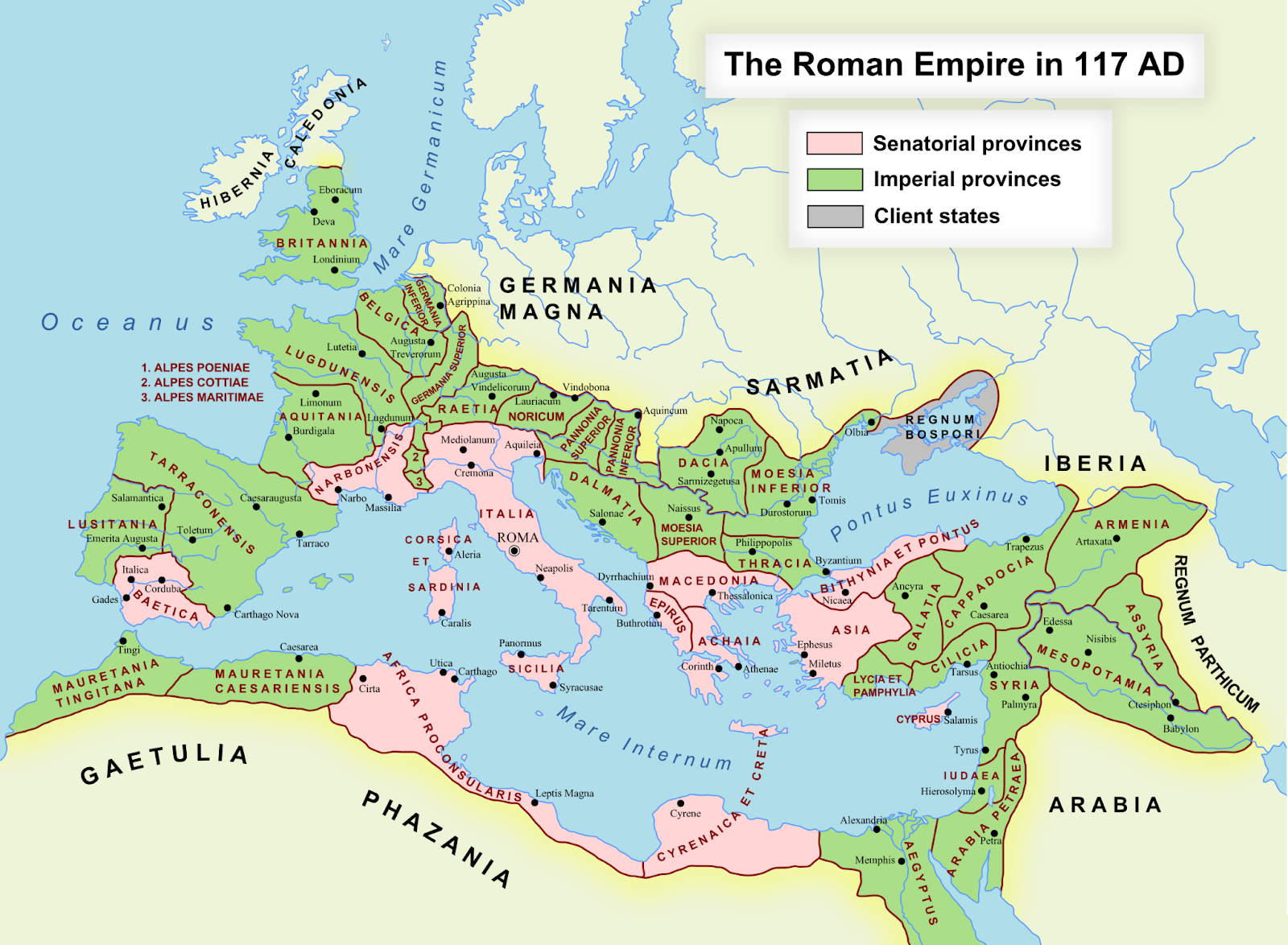
Weren’t the Gauls barbarians that Julius Caesar conquered around 50 BC?
When there’s dozens of factors causing something, you can be sure they’re not all independent. What would be the odds? Usually there’s only a few big drivers. It’s called the Principle of Parsimony (or Occam’s Razor).
What if it was just a question of civilizational spread?
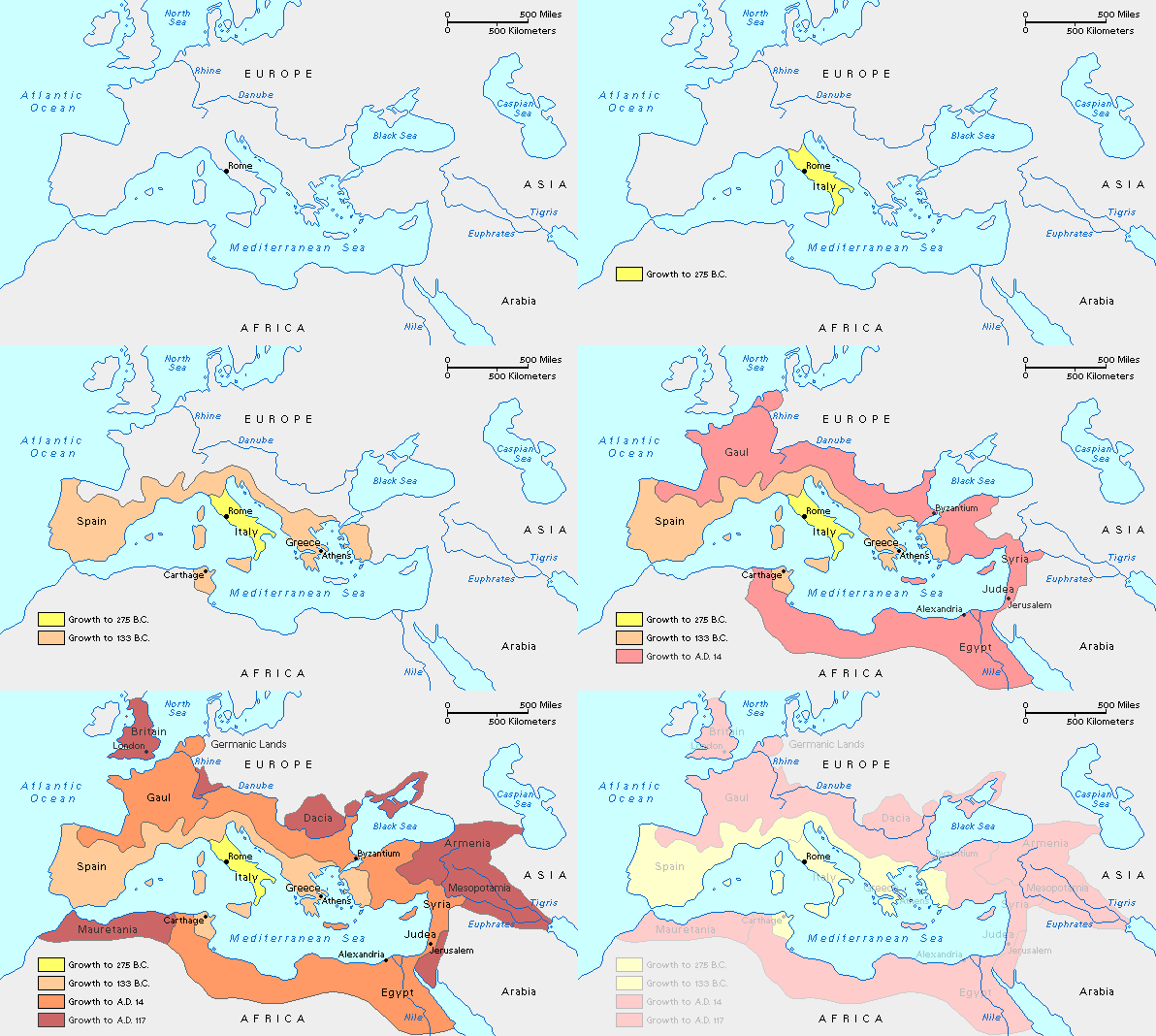
Because Rome inherited the technology, trade, governance, and other civilizational advances from the Greek, they had a massive advantage over all their neighbors. Since they also had land of amazing quality with the Po Valley and the rest of Italian valleys, they had both the land and the tech to take over the entire Mediterranean. They spread mostly unimpeded.
In the South, up to the Sahara.
In the West, the Atlantic.
In the East, they had actual civilizations they couldn’t beat, such as the Partians and the Sassanids. They didn’t [3] .
In the North, and North-East, they went as far inland as they could. You can see it in the last areas they conquered, between 14 AD and 114 AD.
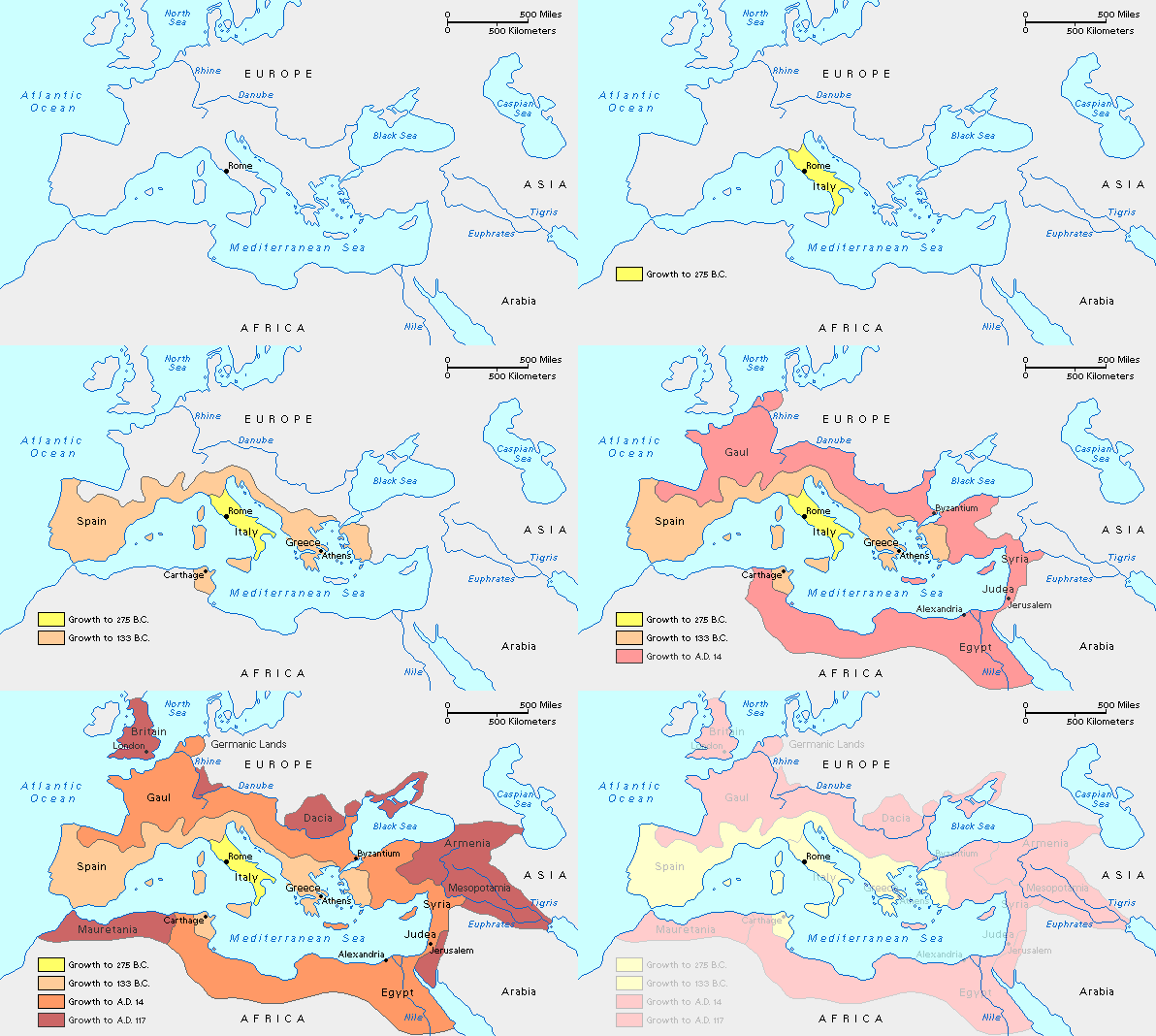
During that spread, they annihilated locals. Many of them likely went extinct. They extracted a lot of wealth, which helped fuel the empire the way wealth from America fueled the Spanish empire. The loot fed and paid for the army. The slaves fueled the economy.
Now fast forward a few centuries. Technology spreads little by little to all the provinces. The barbarians you could easily beat centuries earlier now know you. They have learned from you. They have the same weapons, the same organization, the same agriculture.
Meanwhile, you don’t have as many slaves anymore, because you haven’t been conquering for centuries. Your armies are not paid the same way. And their battles are not a piece of cake like they used to, conquering uncivilized tribes. They’re facing their equals. With less success abroad, politics at home are shakier. It’s harder to keep control. Politicians bicker. There’s not one clear person with authority, the way Julius Caesar could impose himself just because he was a successful conqueror.
Now you’re overstretched, so you start by losing the areas that are farthest from your core competency (the Mediterranean): Germany, Central Europe, Britain. And from there, it keeps going.
All of this can simply be seen as the story of civilizational spread: Romans used it to overpower everybody else in their surroundings, and as technology and know-how spread everywhere around them, it was a matter of time before they disappeared and in their place emerged polities more adapted to the technology of their time—the kingdoms of the Dark Ages.
Why does all this matter? Because once we understand these patterns, we can see them everywhere.
The Sunset of the United States
For example, the US is very much like Rome was a few centuries ago.
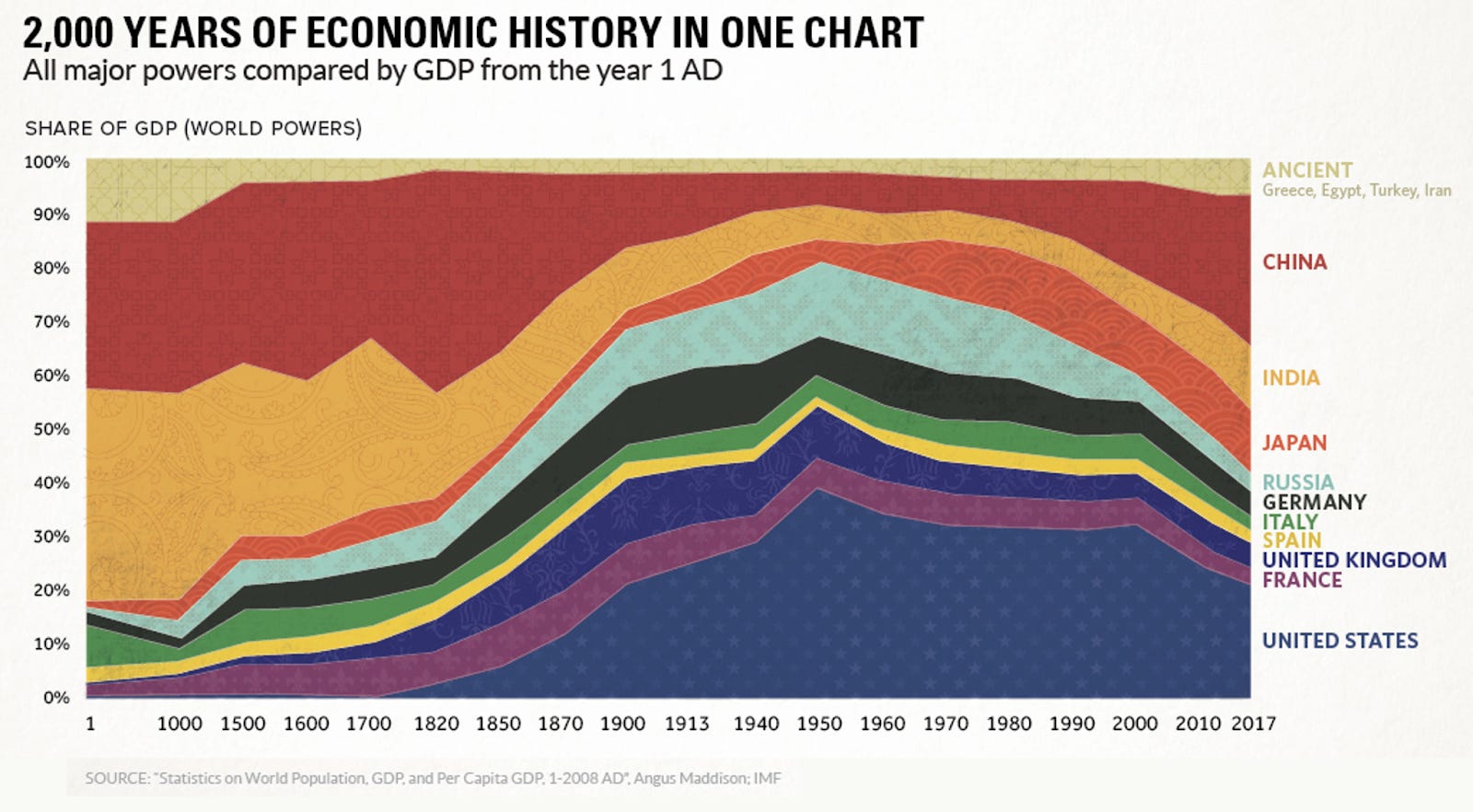
The story of the US is the story of its rise between 1850 and 1950.
GDP is your population multiplied by your GDP per capita. A little bit of the US’ growth came from a higher GDP per capita—which, as you know, is in a big part due to its geography.
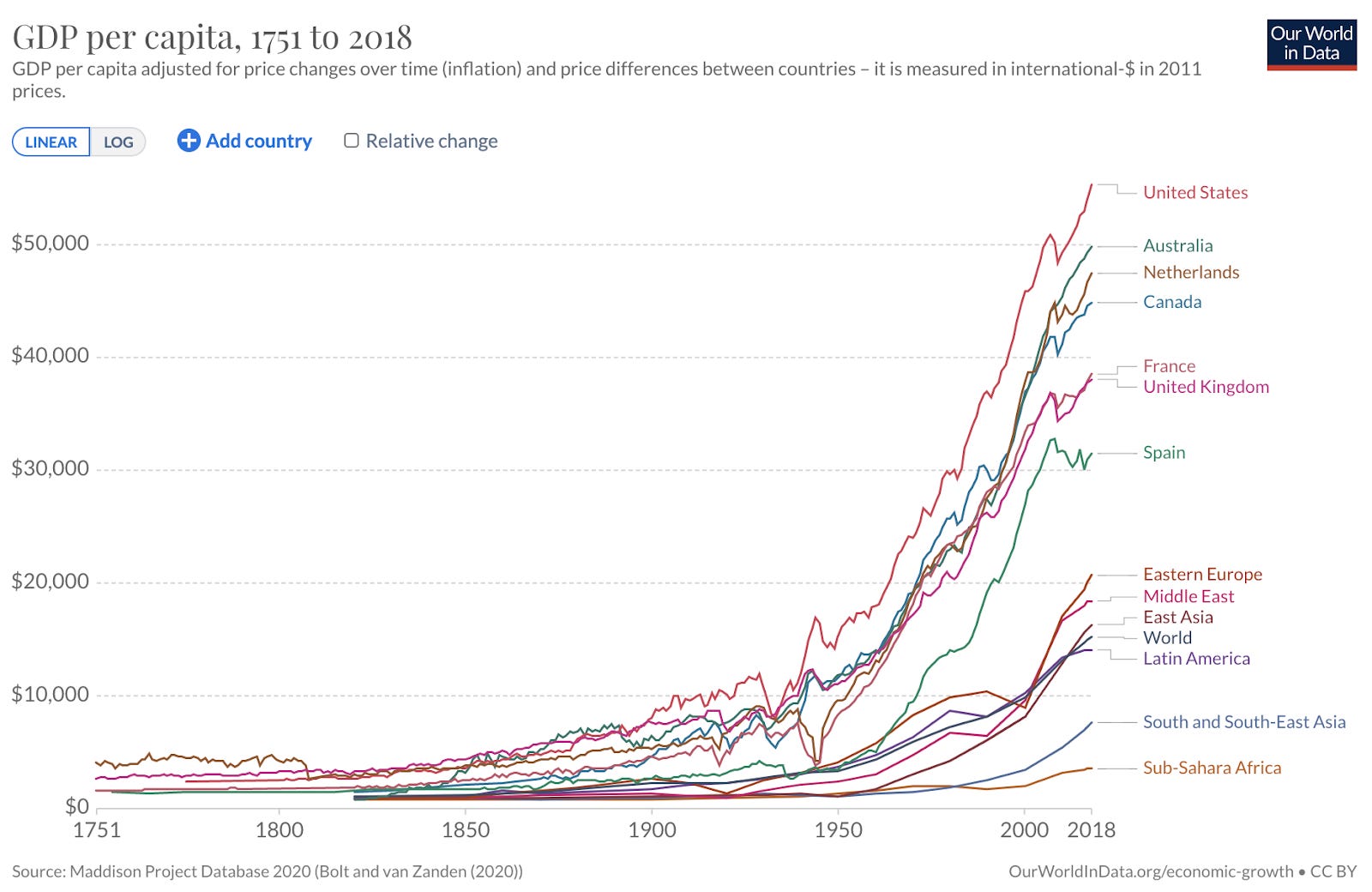
But its GDP per capita was not orders of magnitude higher than in Europe. What was growing much faster is its population.
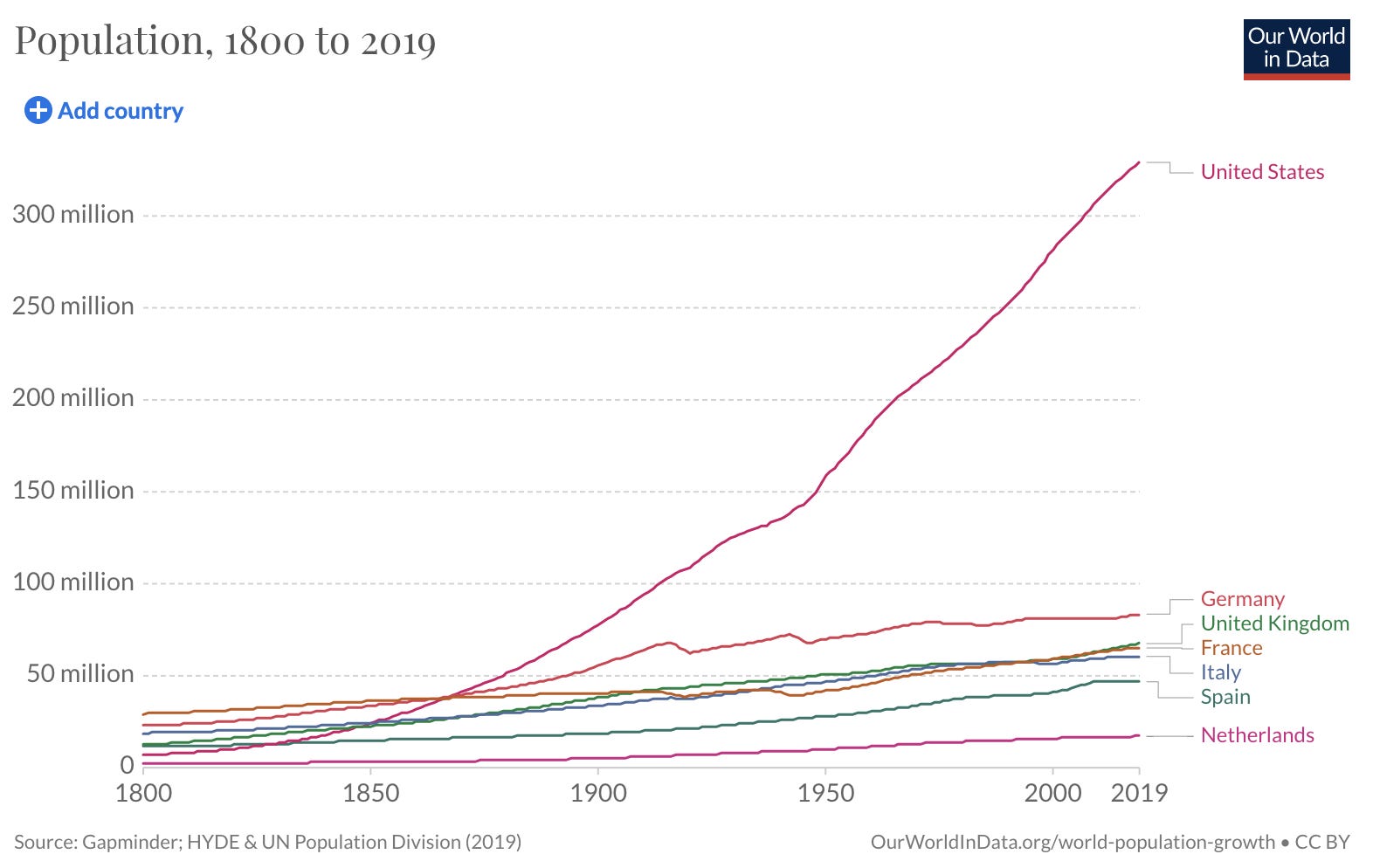
Everybody in Europe was moving to the US for its economic opportunities—ahem to settle the amazing Mississippi ahem—.
But that growth is dwindling now, and other populations are much bigger or growing faster.

Aaaaand they’re catching up on GDP per capita—slowly, but they will eventually catch up.
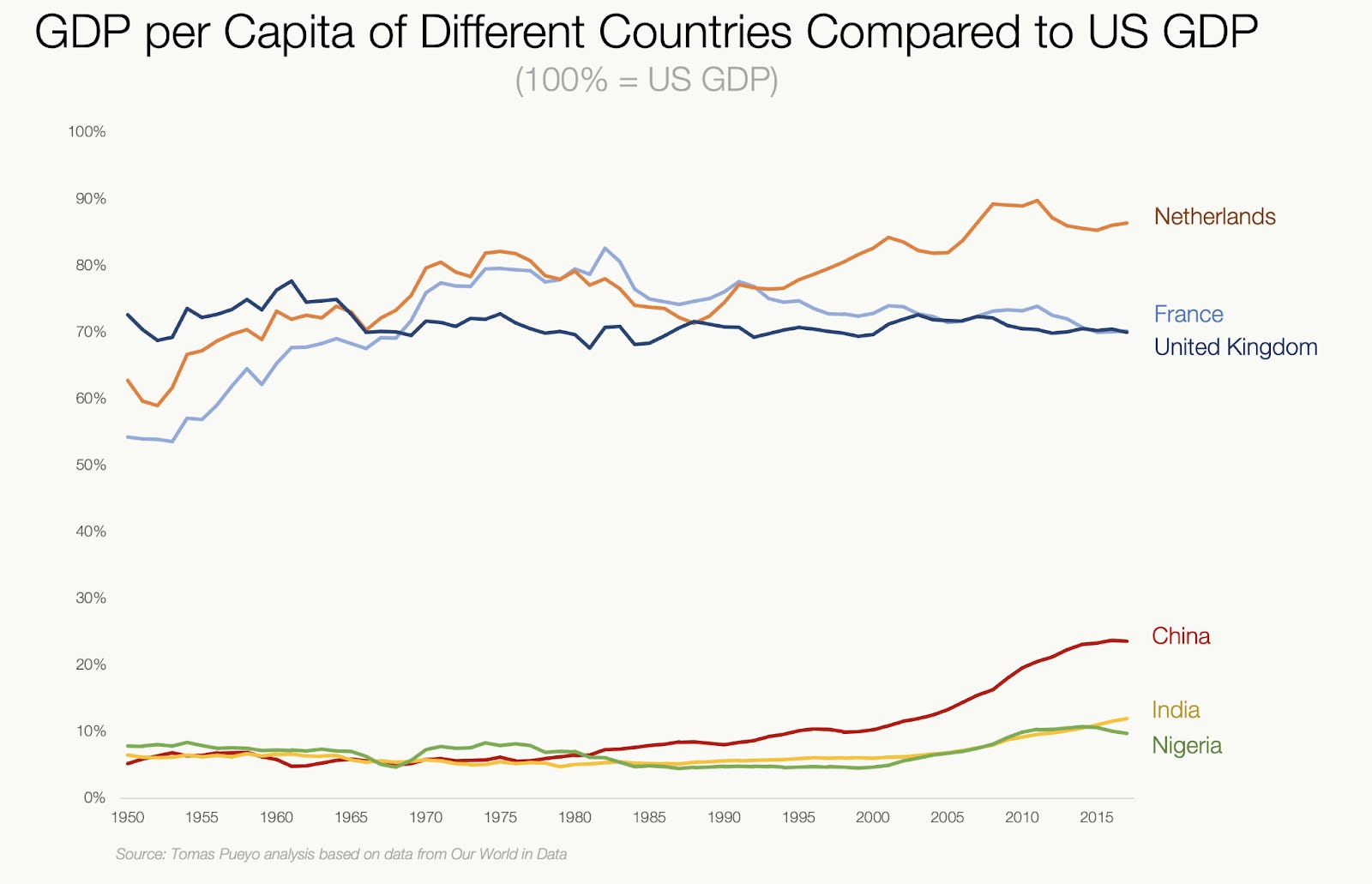
That’s why the share of US GDP has gone down from about 40% of world GDP in 1945 to a bit less than 16% today—and why it is condemned to shrink to 5%-7%.
The US can be as innovative as it wants. In the 21st Century, technology spreads at the speed of light. The US won’t be able to keep a big gap in GDP per capita with other countries.
What it could do, however, is attract immigrants. But because it’s dwindling, people are scared, populists take power, they blame problems on immigrants, and immigration stops. A bit like what happened in Rome. And since its fertility rate is not much higher than that of other countries, it’s impossible for the US to grow its population fast enough to keep its position in the world.
Put another way, short of a radical new policy of allowing immigrants from all over the world, there is no way for the US to keep its current standing in the world [4] .
How We Talk about Inequalities
Annihilating other peoples is what humans have done throughout history. Accepting this helps us talk about current inequities in a more productive way.
When we talk about Native Americans being slaughtered by Europeans, that is a tragedy, like so many others before it. But we pay more attention to it than many other genocides because the cameras were rolling. It lives in recent memory. There’s a written record. And some of its people, thankfully, live to this day.
The same can’t be said of the natives of the Caribbean islands, who were exterminated by the Spaniards’ guns, germs, and steel.
But they, in turn, had obliterated a few thousands of years earlier the natives that had preceded them.
Back to Europe, Romans consistently slaughtered and enslaved the locals who preceded them in many parts of Europe.
But a few millennia earlier, there were 6 human-like species, such as the Neanderthals. Then they disappeared overnight, about 10,000 years ago. Just as the Homo Sapiens was exploding thanks to the agricultural revolution. What a coincidence.
This is what humans have done. It is a result of our genetics, evolution, geography. Humans are humans. When they could, they oppressed and killed. We don’t have a choice in what they did. What we do have a choice on is what we do about what we’re given and the narrative we bestow on these facts. And I think our narratives prevent us from seeing these things clearly.
Each time we talk about these events as one country vs. another, one group vs. another, the guilty against the oppressed, we layer identity on top of it. That is a mistake.
First, people hate being wrong. So if they think the group they belong to did something wrong, they will try to justify it instead of correcting it.
Second, it puts the weight of the solution on the supposed heirs of those guilty, instead of making it a shared responsibility to all.
We should focus less on who did what to whom—every single group that lives today is here because it prevailed over countless others—and instead systematically look at the inequities that exist today so we can correct them together.
This is one of my conclusions from looking at history like a system rather than a random series of events. If we understand its forces, we can dissociate ourselves from these dangerous narratives and solve the problems of the system.
If you remember, thalassocracies are civilizations based on the sea rather than land.
Recalculating hunter-gatherer workday: Hill et al. (1985), p. 44. Hawkes and O’Connell (1981).
They did beat the Greek and the Egyptians. Bur Romans should better be seen as the heirs of the Greek, and Egypt could be beaten because it was a culture centered around the Nile, not the Mediterranean. That limited its potential power. That focus was obvious for example in the fact that it didn’t have a strong navy.
Unless automation makes people irrelevant, which might happen in the 21st Century. That’s for another time.