Concentration of Force and the Future of Social Impact Concentration of Force and the Future of Social Impact
Some content could not be imported from the original document. View content ↗
2021年12月2日
∙ Paid
Today’s premium article is the last one on the series on plastics, and connects it with the series on the future of nation-states. I’m getting back to that series on the future. I’m planning on articles on NFTs, the future of violence, the future of energy, and the future of social coordination, among others. These are hard topics, so thanks for your patience! The second piece from this week’s free article—How to Get Feedback—will come this weekend. It’s called How to Give Feedback. In the meantime, please enjoy this premium article!
In How to Fight Ocean Plastic, a few weeks ago, I suggested that we should fight ocean plastics by joining #TeamSeas to fund programs to clean up plastics on seashores and rivers. Some of you intelligently noted that a better way to fight ocean plastics was not to clean them up, but rather to prevent them at the source. I agree with you. And yet I still believe the best thing we could do is to join #TeamSeas. What’s going on?
The logic is not obvious, but it says a lot about how to maximize our impact in the world as much as possible. I have been thinking hard about this and have an article brewing on that topic and its link to climate change. Today, I want to share the logic so you can (1) criticize my thinking, (2) understand why I think it’s not obvious, but right to promote #TeamSeas, and (3) take away an important insight on how to have social impact in the 21st century.
Plastic Vigilantes
In a last week’s plastics article, I explained the list of things that you, companies, and governments can do to reduce plastic waste. It’s long. Here’s what I wrote at the end of that article:
“This is the more-or-less official list of things that we should do. But if you’re realistic, you’ll read this list and think ‘Never gonna happen. If it does, it will be in a long time.’”
Why was I so cynical?
Let’s be generous. Let’s assume you read that article and change your personal behavior and that of your family and friends. Maybe a few tens or hundreds of thousands of people will change their behavior that way. That’s between 0.001% and 0.01% of the world population. Not enough. You need a way to convince more people at scale.
Maybe you want to act through politicians. You can reach out to your local politician to let them know this matters to you. Or even coordinate a few people in your community to reach more of them. Unfortunately, most of the time politicians don’t pay attention to that.
Maybe we should not vote for politicians that are against these measures? But how do you know as a voter if a politician is going to do these things? How can we pressure politicians to care? Ideally, there should be a group of citizens that coordinates to pressure politicians to fight plastics.
Which environmental groups help citizens tell which politicians fight plastics? How much power do they have? The most powerful ones also do many other things that you might disagree with—such as fighting nuclear energy. Would you support them for plastics knowing that these funds could go to fighting nuclear energy?
What about companies? If consumers reduce their consumption of plastics, companies will eventually notice and do something about it. But the process might take a long time. If, instead, every time you don’t choose a product because of its plastics, the producing company knew that, then they would be much more likely to reduce their plastic usage.
One way you can let them know is by reaching out or coordinating with others to reach out. Most companies are more reactive than governments and might do something about it. Still, one person’s feedback is not enough, so you’d need to coordinate a bunch of people to overwhelm companies’ communication channels over an extended period of time until they noticed it, discussed it, estimated the market impact, and decided to act on it.
In all these cases, what becomes clear is that the best way you can have an impact might not be by changing your behavior, but rather through coordinated action.
But plastics are a massive, global problem. How do you coordinate action at that scale?
Concentration of Force
You should read this great article about coordinated action: Concentration of Force.
Concentration of Force in War
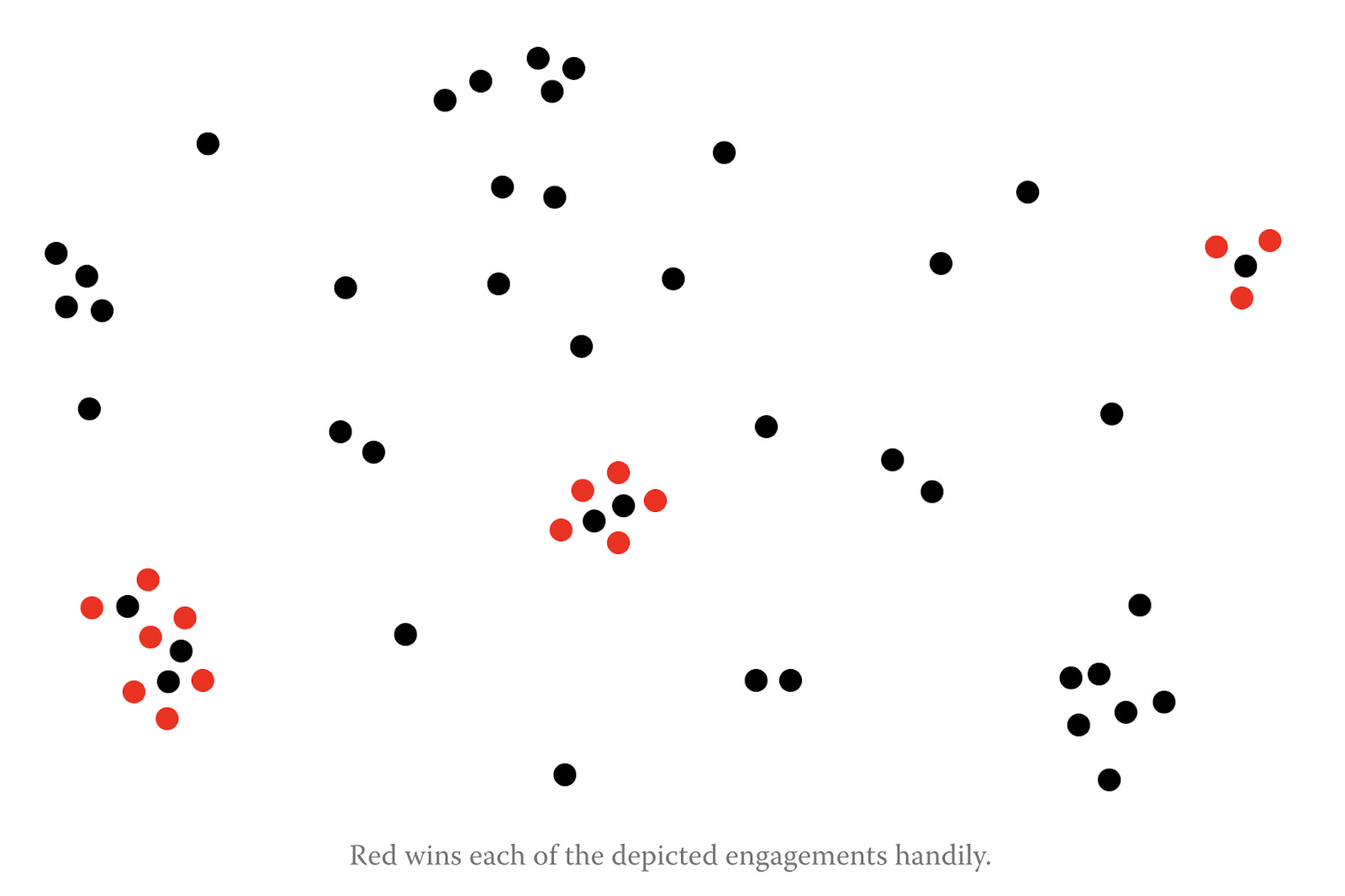
Imagine the dots above are a bit like military units. Even though reds are completely overwhelmed by blacks, they will still win every one of the battles they engage in.
In war, this might still not be enough.
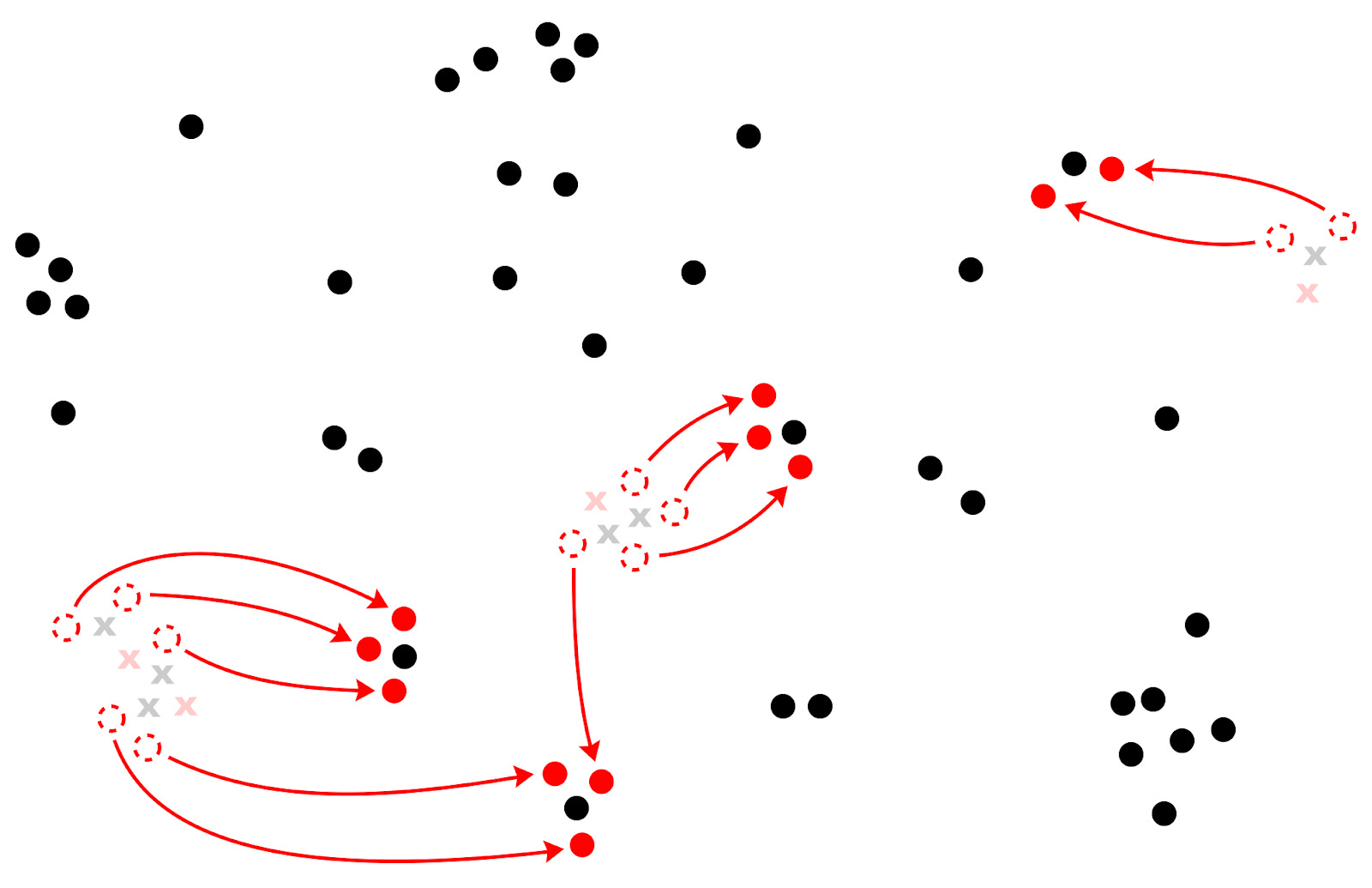
In every battle, the reds might lose fewer units than the blacks, but they will still lose a few.
Paradoxically, the ratio of red to black keeps worsening for the reds. Over time, they will lose enough to disappear and lose the war.
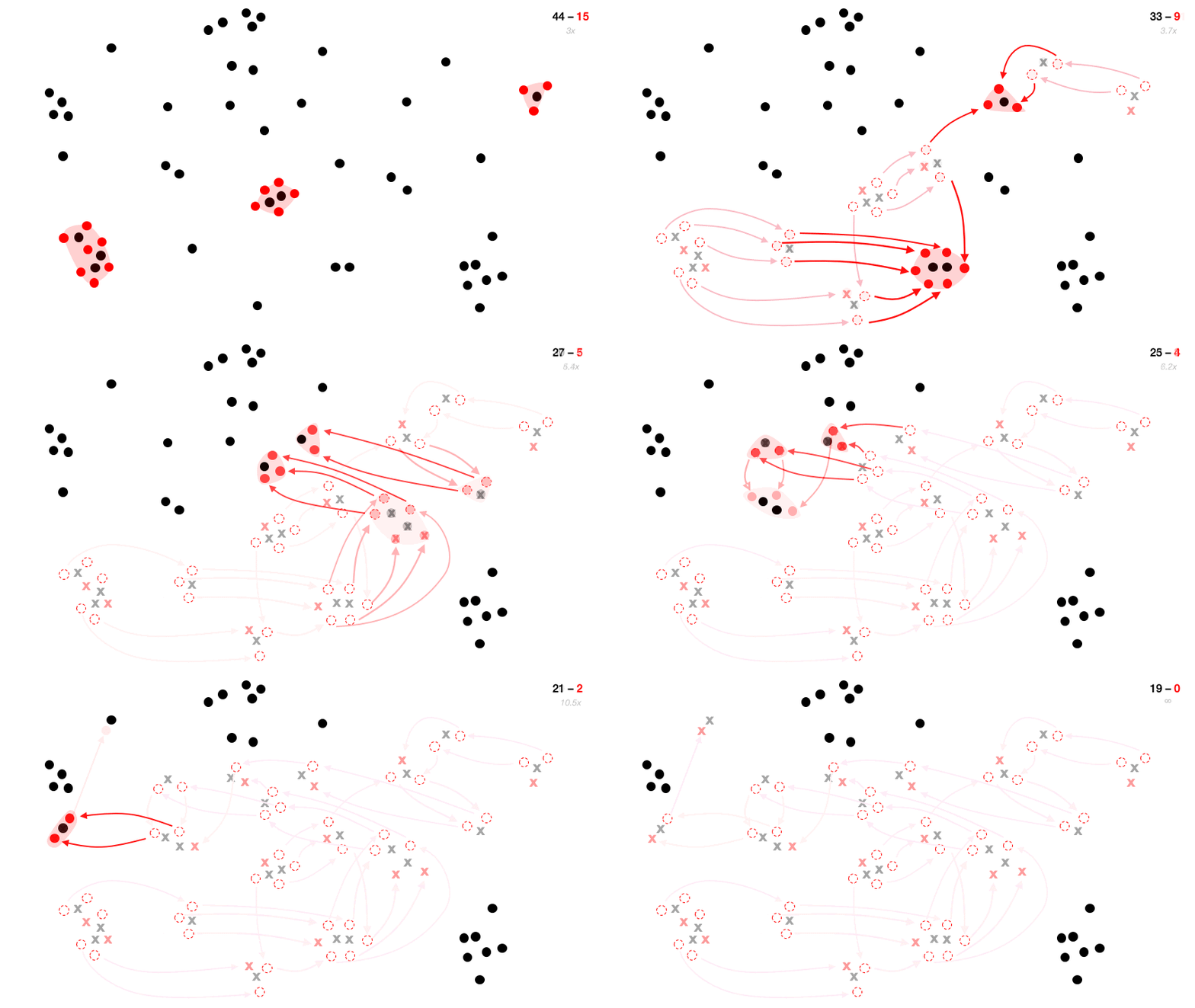
That does not happen in social media.
Concentration of Force in Social Media
In Social Media, when one side wins an argument, it might only lose a fraction of the fighters (due to too much investment). The black dots that fought might either disappear (lay low) or even turn around (ask for an apology and begin promoting the red side). These are portrayed in orange in the schema below. What’s most interesting, however, is what happens to bystanders—the rest of the black dots who witnessed the fray but didn’t participate.
Some might become convinced of the argument and turn red too—these are represented as blue below, before they turn red.
But even if the majority of black dots remains thinking black, they will not want to expose themselves to losing the social media war, and will leave the arena altogether—in green below.
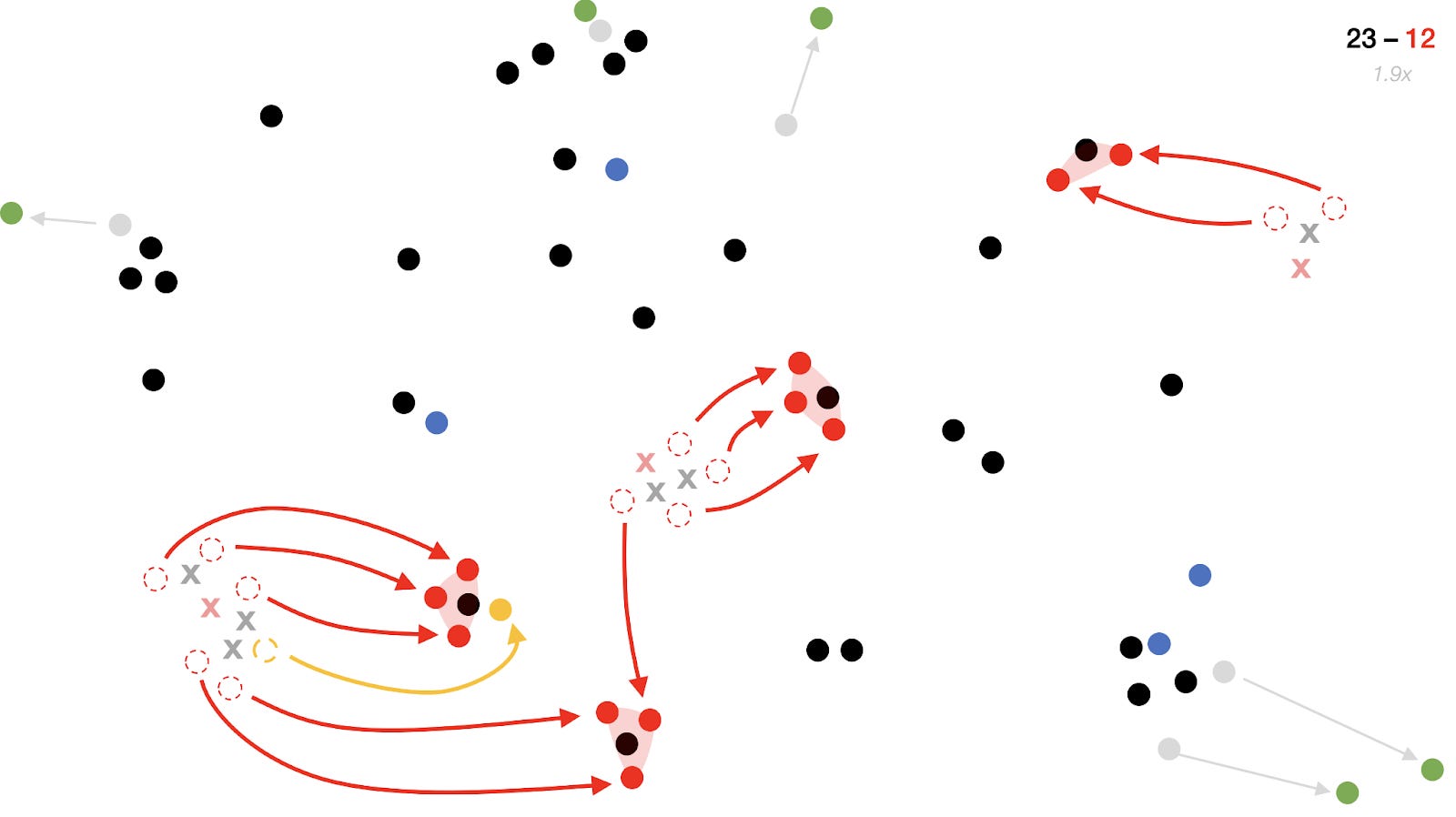
So in social media, a small opinion can overwhelm a much more widespread one if it fights in a very coordinated way.
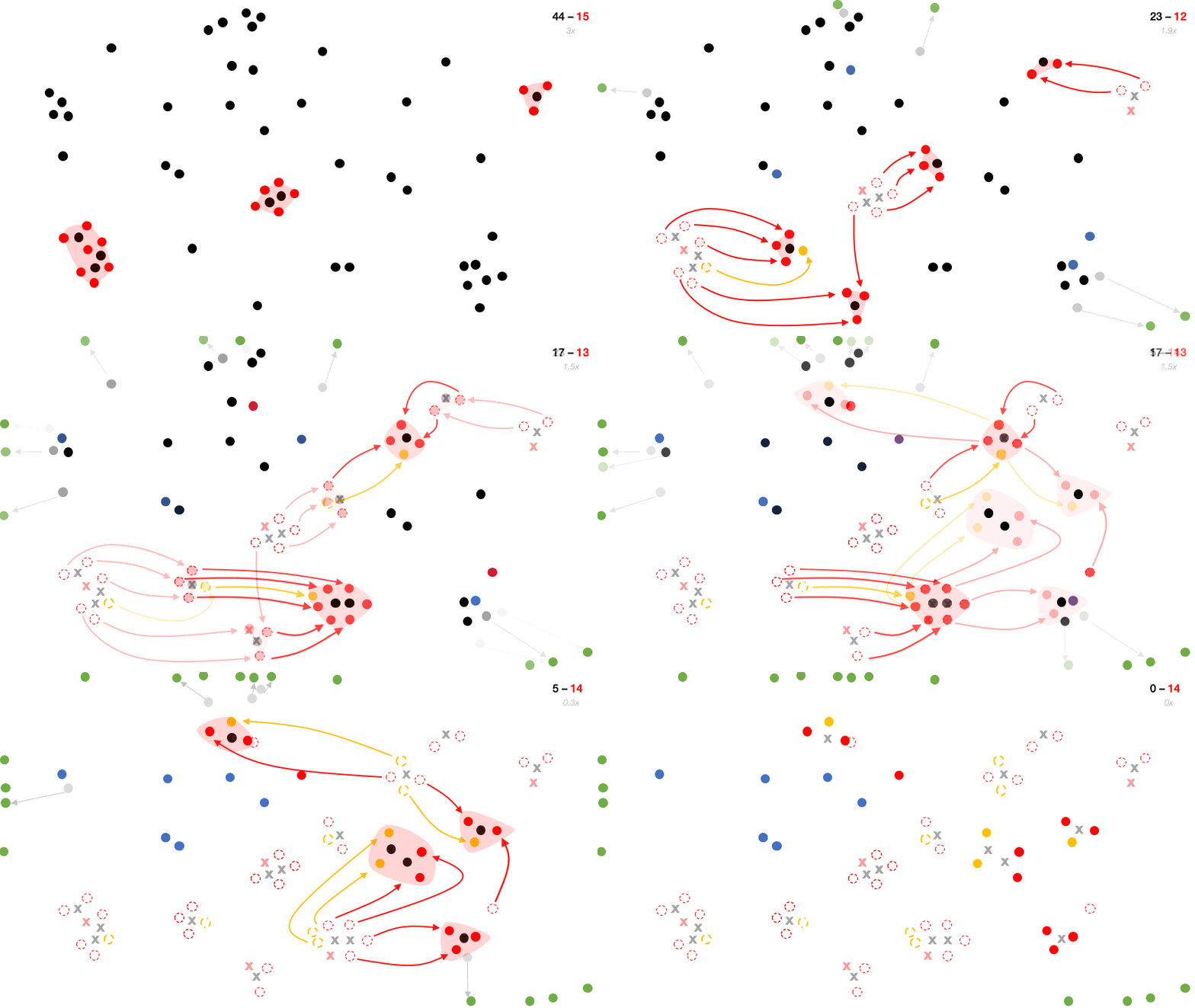
In half the turns, reds completely destroy blacks through the combined force of black dots that are humiliated, turned around, or frightened.
The reds might not be rational and the blacks might be very rational. It doesn’t matter. If the reds can make their opinion look like it’s winning, for example by succeeding in canceling people who are defending a rational position, others will follow, while the supporters of the rational position will drop their support.
Concentration of Force in Ocean Plastics
When #TeamSeas reached out to creators, that was a concentration of force. It might not win the entire war of plastics at once, but it definitely won that battle. And in social media, winning a battle is the beginning of winning several battles, and eventually the war. They were like the red dots above. The right thing to do in these circumstances is to join the fray. And that’s what we did!
Remember the coordination issue I mentioned above, where individual action wouldn’t do much to fight ocean plastics? That’s how you solve it: by joining a coordinated action that strategically sidesteps the central problem, but that’s the very point of it. If it had focused on the central problem, it would have failed. By focusing on a secondary one, it could get a win, gather momentum for the cause, and make the next effort more successful.
The Social Coordination of the Future
#TeamSeas points us in the direction of one potential social coordination of the future.
It has created a network of creators and another one of donors, from whom it gathered the emails through the donation. It has raised awareness of a small environmental problem, but there are many more it could tackle.
I don’t think #TeamSeas will go much further, however, because the promoters are not interested in social engineering. Their background is not in social movements, but rather in online content creation and influence. But what if it had been promoted by a social engineer?
A social engineer would not only have gathered the emails of donors.
He would have gathered the emails of everybody interested in the topic.
He would have kept track not just of donations, but also of content sharing.
He would have given visibility on who shared what, and given benefits to those who shared content the most.
He would have created a stronger community for creators, who are the central nodes in that network.
He would have dropped emails with a certain frequency to show the evolution towards the goal.
He would have organized other ways to contribute, from translating content to reaching out to politicians.
He would have clarified secondary goals that people could focus on, and tasks they could pick up if they were interested in contributing more.
He would have facilitated the self-organization of people to collaborate in solving these tasks.
He would have devised a mechanism to compensate people who work long hours on the initiative, or who bring unique skills to the team...
In other words, he would have coordinated his forces to successively win battles with concentration of force.
This is the future of Internet-based social coordination. We are not there yet.
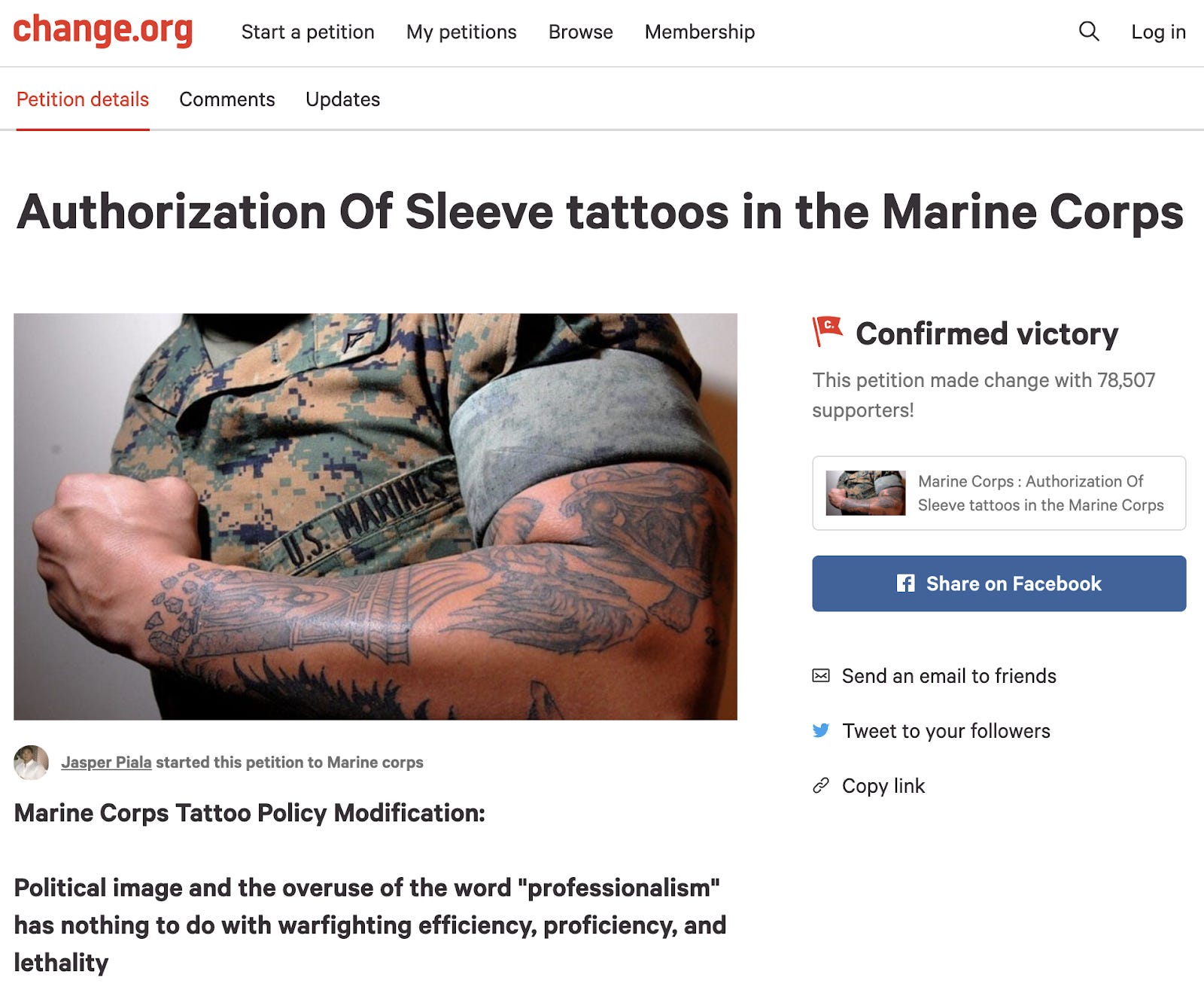
Change.org is one of the main online platforms for online petitions. But none of the functionality I mention above exists there. If you go to the comments section this is what you see:
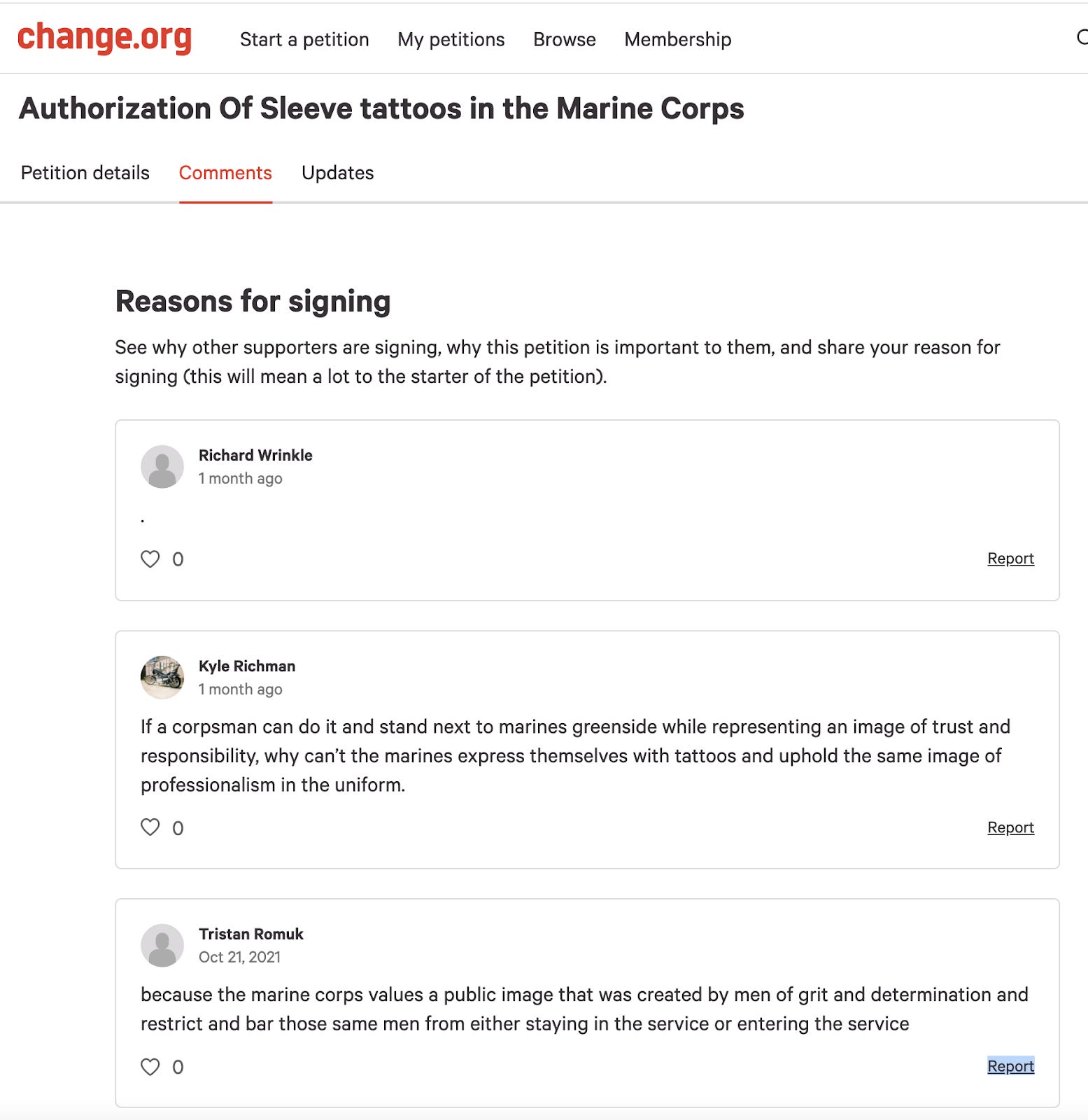
A list of random comments that nobody is interested in. In one of the top petitions of one of the biggest petition sites in the world.
Some projects try to go farther, like this blockchain trying to clean up the oceans. But it’s not there yet [1] .
So we’re in the infancy of social coordination online. What I outlined above will eventually be built, and it will then be much easier to coordinate socially for big movements. In the meantime, we’ll do it manually with hashtags and ad hoc #TeamSeas campaigns.
Too complex, too focused on the compensation, not enough in the social interaction, early in its journey...